
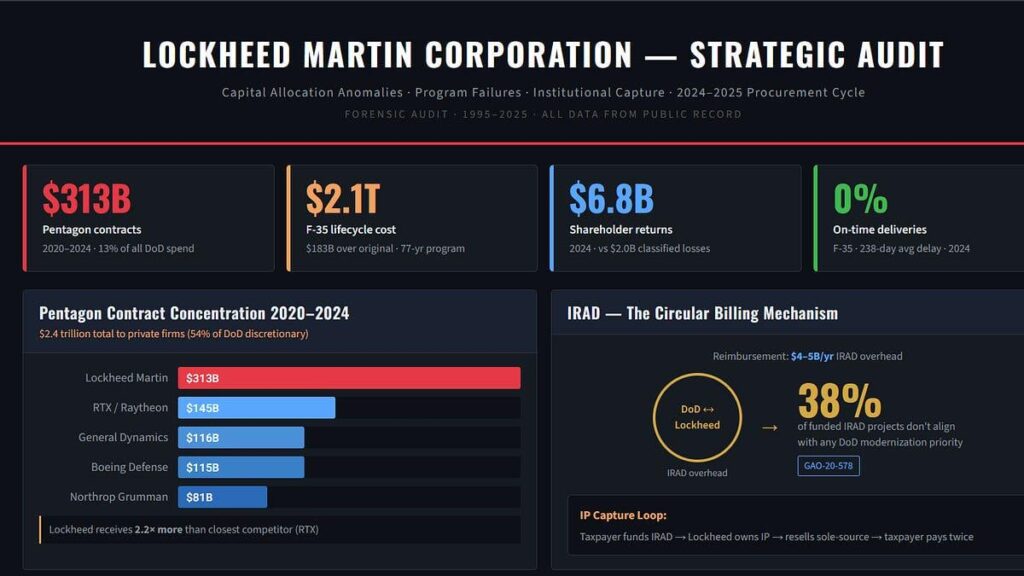
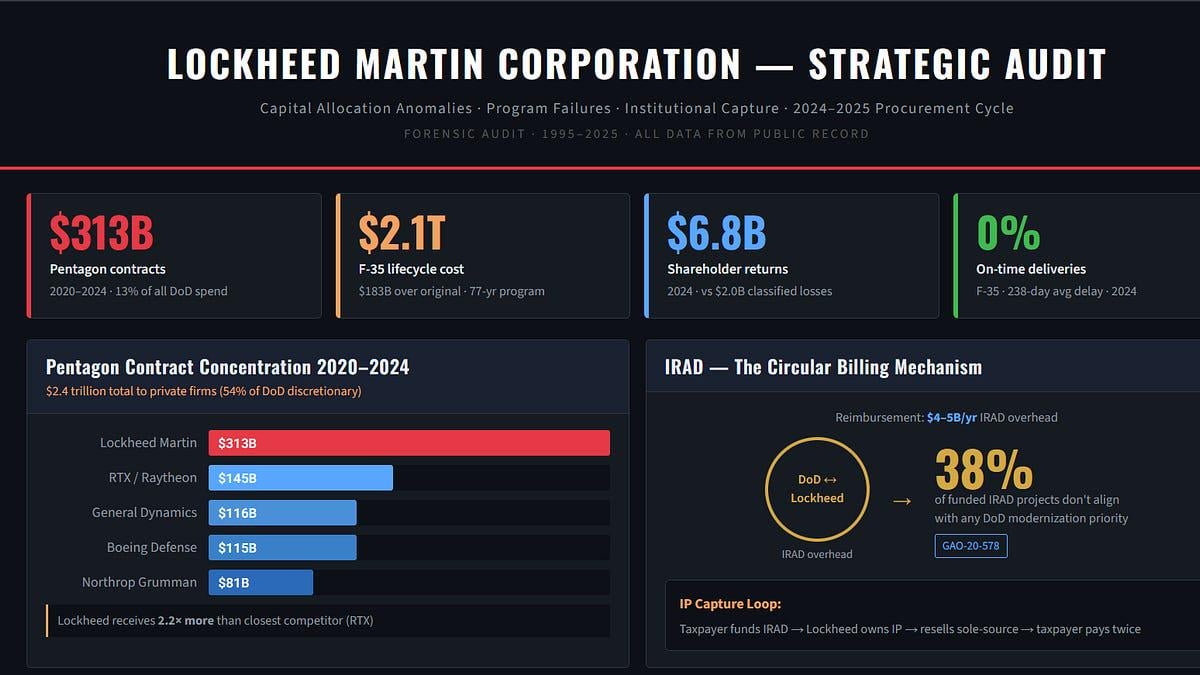
I’ve been looking into the David Grusch and Lue Elizondo claims lately, but I decided to take a different path than just looking at the exotic physics side of things. I started looking at the actual plumbing of the defense industry, specifically Lockheed Martin and the Skunk Works, and how they have built a sovereign corporate state that is effectively audit-proof.
If Grucsch’s testimony is right, the reason Congress cannot find the legacy programs isn't just because they are hidden in a mountain somewhere. It is because the legal architecture was specifically engineered to move these programs into a space where the government can technically claim they do not possess them.
One of the most effective tools for this is the commercial-item designation. In theory, this is for off-the-shelf tech. In practice, it is being applied to advanced systems that are not actually sold on the open market. This matters because the Defense Contract Audit Agency is legally suppressed from auditing prices on commercial items. It is a massive hole in the oversight bucket where billions can be shifted without a paper trail for the watchdogs to follow.
There has also been a lot of talk about Naval Air Station Patuxent River, but the specific detail that sticks out is the logistics concept Elizondo described. He mentioned a specialized hangar designed for air-to-river transfers. The claim is that materials were slated to move from Lockheed custody to Bigelow Aerospace in Nevada, but the CIA allegedly stepped in to block it. This suggests these programs are not a monolith. They are contested by different factions who use private contractors as custodians to keep the materials away from rival agencies and Congressional oversight.
By moving programs into Unacknowledged Special Access Programs, contractors achieve a level of insulation that is basically impossible to crack. They are not subject to FOIA since private companies do not have to answer those requests. Their employees are not government workers and their facilities are not government facilities. It allows the Pentagon to tell a Senate committee they do not have a crash retrieval program and be technically telling the truth. Legally, Lockheed has it and the government just pays the service fee for the data.
It is also hard to have oversight when 73% of Lockheed’s lobbyists are former government officials. When you have board members with active security clearances participating in the very committees that are supposed to be watching them, you don't have a contractor-client relationship anymore. You have a co-constitutive system where the company is the government.
I spent some time pulling the receipts on this and linking Ben Rich’s old UCLA speech hints to the modern whistleblowers and the specific ways the DCAA gets sidelined. If we are going to get Disclosure, we are probably going to find it in an audit trail before we find it in a hangar.
I put the full breakdown of the architecture of the cover-up here if you want to dig into the SEC filings and the procurement mechaincs: free article breakdown
I am curious what the community thinks about the white-collar crime angle. Is this just a massive, multi-decade antitrust and procurement violation disguised as National Securty?
by AFewMilesBack
3 Comments
I wanted to share this because I think the community gets bogged down in the “aliens” part and misses the actual paper trail. If you look at the DCAA (Defense Contract Audit Agency) guidelines, there is a massive loophole regarding commercial-item designations that basically lets major contractors like Lockheed avoid price audits entirely.
The article I linked goes into the boring but important stuff: the SEC filings, the IRAD billing mechanisms, and the specific logistics of the Pax River hangar that Elizondo mentioned in his November responses. I think Grusch hit the nail on the head when he called this “structural procurement fraud.
Thank you for sharing this information 👍 very interesting
You’ve spelled out in detail what I have long suspected. My suspicions spread somewhat wider, though – to include contractors’ authority to deploy paramilitary resources (men in black) at will in order to suppress witness testimony and perhaps even to abduct persons deemed security risks.