
The night sky is not just full of bright galaxies and glowing clouds. It also contains very small, faint galaxies that formed long ago.
These tiny galaxies, called ultra-faint dwarf galaxies, hold clues about the early universe. They help scientists understand what conditions were like in the beginning.

A new set of simulations called LYRA provides a clearer view of these galaxies. The study shows that their formation depends on early ultraviolet light in the universe.
This research helps scientists connect what we see today with events that happened billions of years ago.
Finding ultra-faint dwarf galaxies
Ultra-faint dwarf galaxies are extremely small. Some contain fewer stars than a small town has people. Yet they hold valuable information about the early universe.
“The smallest galaxies are called ultra-faint dwarf galaxies, which are a million times less massive than the Milky Way or even smaller,” said Azadeh Fattahi, co-author of the study from Durham University.
“Due to their small size these galaxies have proven very difficult to model and simulate.”
These galaxies sit at the edge of what scientists call a galaxy. Some dark matter haloes form stars, while others remain empty. Understanding this difference is a key goal in cosmology.
Simulations sharpen the picture
The LYRA project simulated 65 dwarf galaxies from the early universe to today. Each simulation reached very fine detail. It tracked individual stars and supernova events.
“In this work we presented a brand-new suite of cosmological simulations focused on the faintest galaxies in the Universe, with an unprecedented resolution. These are by far the largest sample of such galaxies ever simulated at these resolutions,” said Fattahi.
The simulations covered a wide mass range. Some haloes formed galaxies, while others stayed dark. This allowed scientists to compare different evolutionary paths.
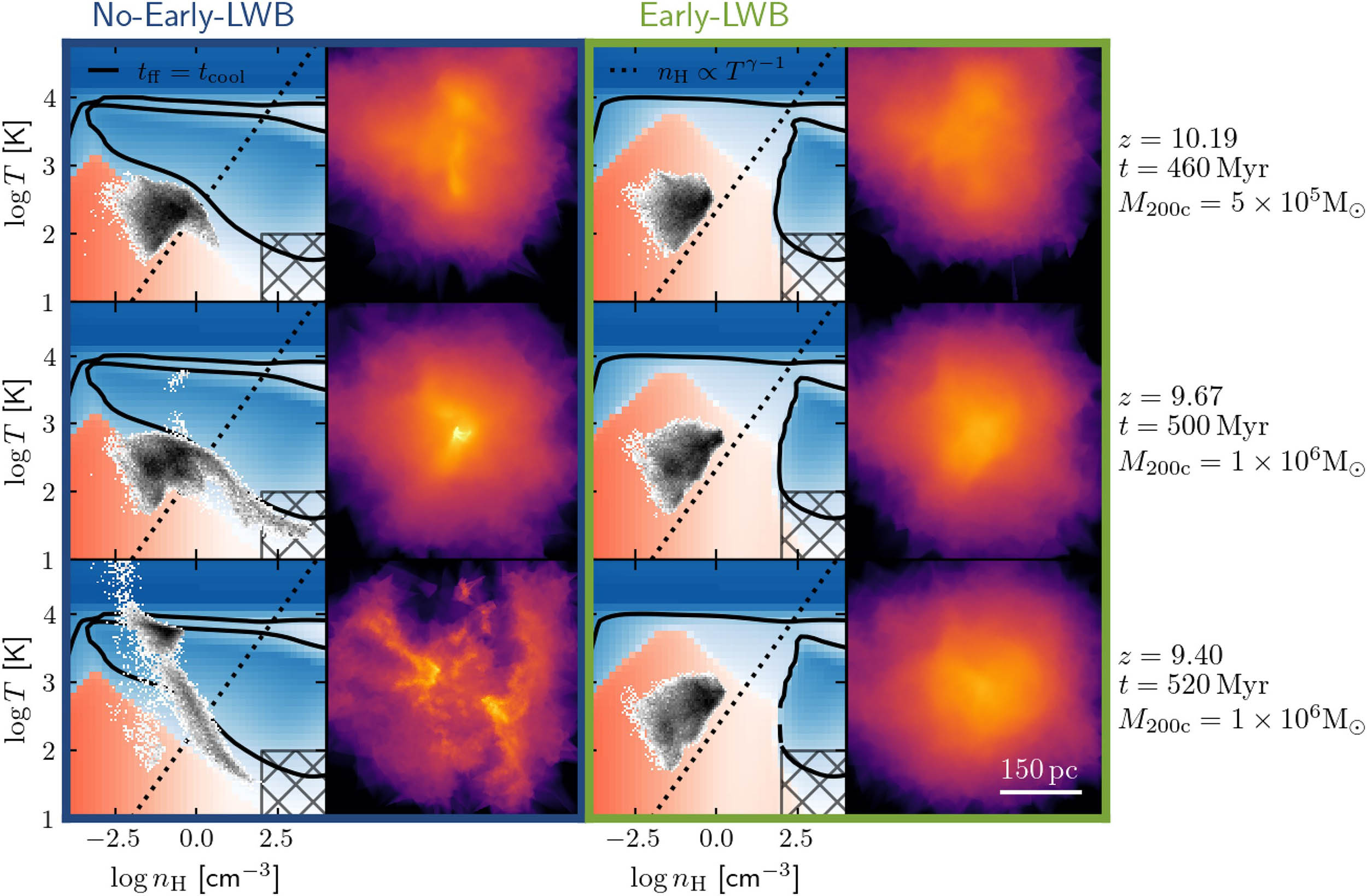 Ultra-faint dwarf galaxies in the presence of an early Lyman–Werner background. The spatial and phase-space distribution of gas in Halo D. Time runs from top to bottom. The No-Early-LWB and Early-LWB models are shown in the left and right-hand panels, respectively. Credit: Monthly Notices of the Royal Astronomical Society. Click image to enlarge.Role of ultraviolet light
Before reionization, the universe contained a type of ultraviolet radiation called the Lyman-Werner background.
This radiation could not ionize hydrogen, but it could break molecular hydrogen.
Molecular hydrogen plays a key role in cooling gas. Without it, gas cannot collapse easily to form stars. This makes ultraviolet radiation a major factor in early galaxy formation.
Testing early universe conditions
The researchers tested two different versions of this early radiation.
“A useful analogy is to plants and crops and how the way they grow is sensitive to the weather conditions,” said Shaun Brown, first author of the study.
“In the same way that the yield of a crop in summer can indirectly tell you a lot about what the weather in spring must have been like, the properties of faint dwarf galaxies today can tell us a lot about the conditions, or weather, of the Universe at a much earlier time.”
One model assumed almost no early radiation. The other included a stronger background.
“In the paper we studied two different assumptions about the properties of the early Universe when it was less than 500 million years old, to understand the effect on the properties of these small galaxies today when the Universe is 13 billion years old,” said Brown.
Galaxies split into two paths
The results showed two clear patterns. In the low-radiation case, galaxy growth followed a smooth trend, and even small haloes could form stars.
In the stronger radiation model, the picture changed. Some haloes formed small galaxies, while others stayed completely dark, creating a sharp divide between these groups.
“We found that these small ultra-faint galaxies are very sensitive to these changes, while more massive galaxies, like our , don’t really care,” said Brown.
“For the smallest galaxies, early conditions can decide whether they become visible galaxies – or remain starless dark matter haloes.”
Stars ignite in early galaxies
The simulations revealed when stars first appeared. Even very small haloes could form stars early, thanks to molecular hydrogen cooling.
However, under stronger radiation conditions, only fast-growing haloes formed stars early enough, while others missed their chance and remained dark.
The smallest galaxies possible
Both models showed a minimum galaxy size. Many galaxies contained about one thousand solar masses of stars.
These galaxies formed stars in a short burst, after which supernova explosions removed their gas. Without gas, no new stars could form.
This process creates small, ancient systems that remain unchanged for billions of years.
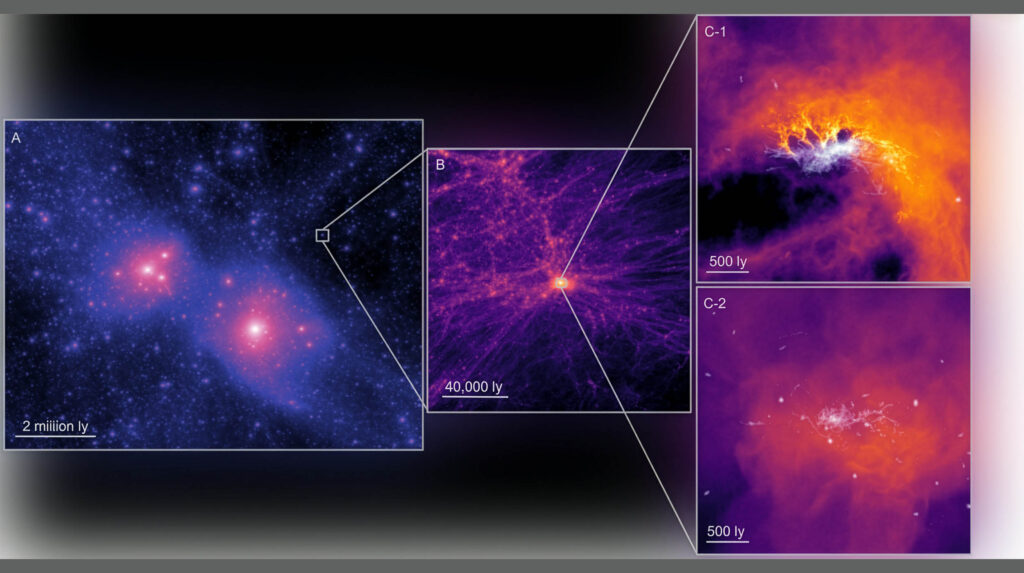
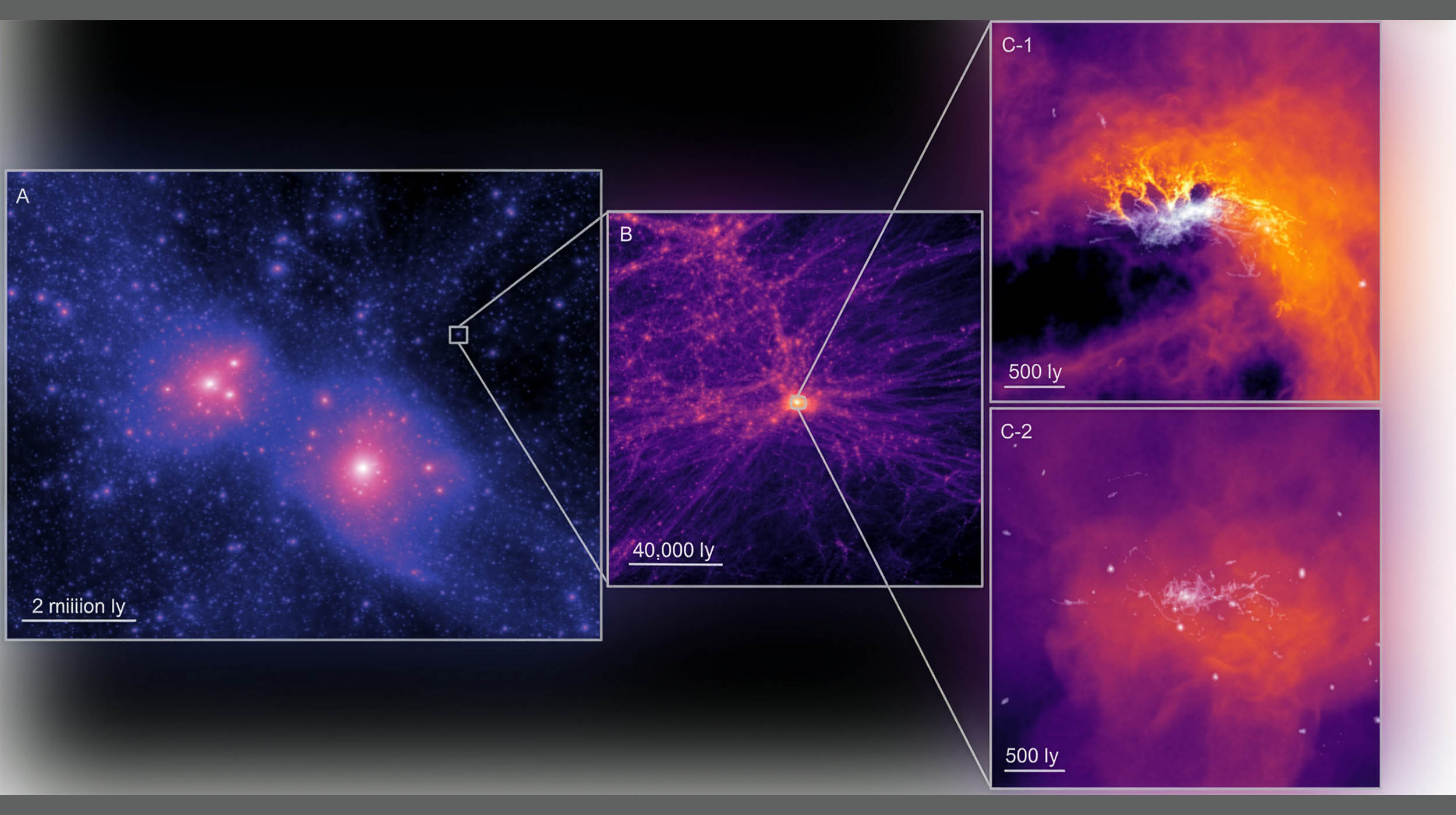 (A) Dark matter distribution in our neighborhood in the Universe, the so-called Local Group of galaxies. The two large dark matter halos correspond to those of the Milky Way and Andromeda galaxy; (B) zoom-in on the dark matter in and around a small halo ~700 million years after the Big Bang; (C-1 and C-2) stars and gaseous material in the simulated ultra faint dwarf galaxy. Credit: J Sureda/A Fattahi/S Brown/S Avraham. Click image to enlarge.Galaxies that become clusters
Some of these galaxies may evolve into objects that resemble globular clusters. Over time, interactions with larger galaxies can strip away their dark matter.
What remains is a dense group of old stars. This offers a possible origin for some globular clusters seen today.
Changing the rules of formation
Older models suggested that galaxies form only in large haloes. The new simulations challenge this idea.
With molecular hydrogen cooling, much smaller haloes can form stars. This shifts the boundary for galaxy formation to lower masses.
This change affects predictions about satellite galaxies and dark matter models.
Galaxies have hidden beginnings
The study also found that early stars do not always form in the main halo. Some form in smaller systems that later merge.
If scientists track only dark matter, they may miss these early stars. This highlights the need for more detailed models.
New telescopes will find more dwarfs
New telescopes will soon test these ideas. The Vera C. Rubin Observatory will detect many more faint galaxies.
“Excitingly, in the near future we will have data from the Vera C. Rubin Observatory which will be able to find many more of these ultra-faint dwarfs around the Milky Way,” said Fattahi.
These observations will help scientists connect local galaxies to early cosmic conditions.
Lessons from ultra-faint dwarf galaxies
Ultra-faint dwarf galaxies may be small, but they carry deep insights. They preserve information about the universe before reionization.
“Our work suggests that these upcoming observations of the very local Universe will be able to constrain what the Universe in its infancy looked like – something we currently cannot directly access with other observations,” said Fattahi.
Even distant discoveries from the James Webb Space Telescope (JWST) connect to this story, as early galaxies show unexpected features.
“The result is particularly relevant in light of recent discoveries of galaxies in the early Universe, by the JWST, which is finding many surprises, in particular unexpectedly massive and bright galaxies in the early universe,” said Fattahi.
The study is published in the journal Monthly Notices of the Royal Astronomical Society.
—–
Like what you read? Subscribe to our newsletter for engaging articles, exclusive content, and the latest updates.
Check us out on EarthSnap, a free app brought to you by Eric Ralls and Earth.com.
—–