
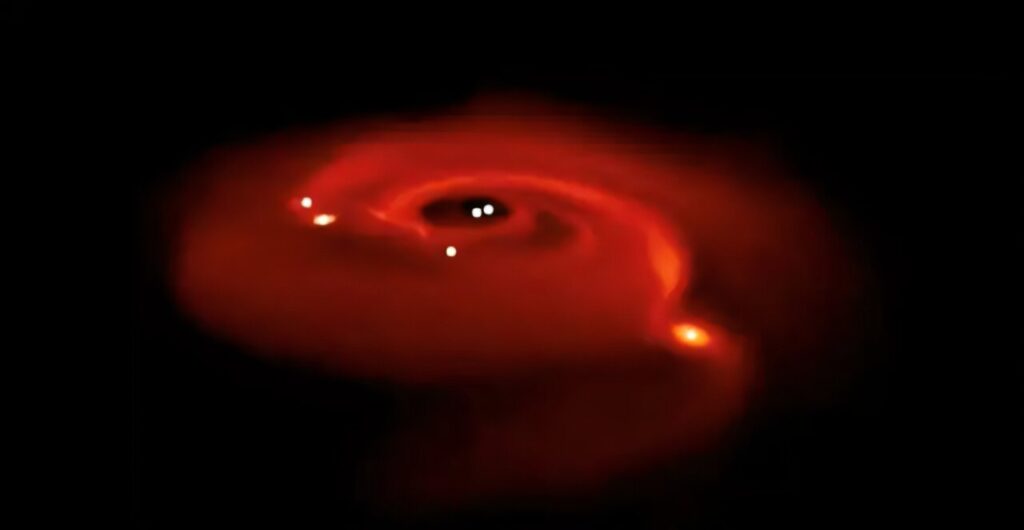
Scientists analyzed various scenarios for planet formation in binary star systems. They concluded that these planets are more likely to remain in their orbits because of their distance from the centers of the gas giants.
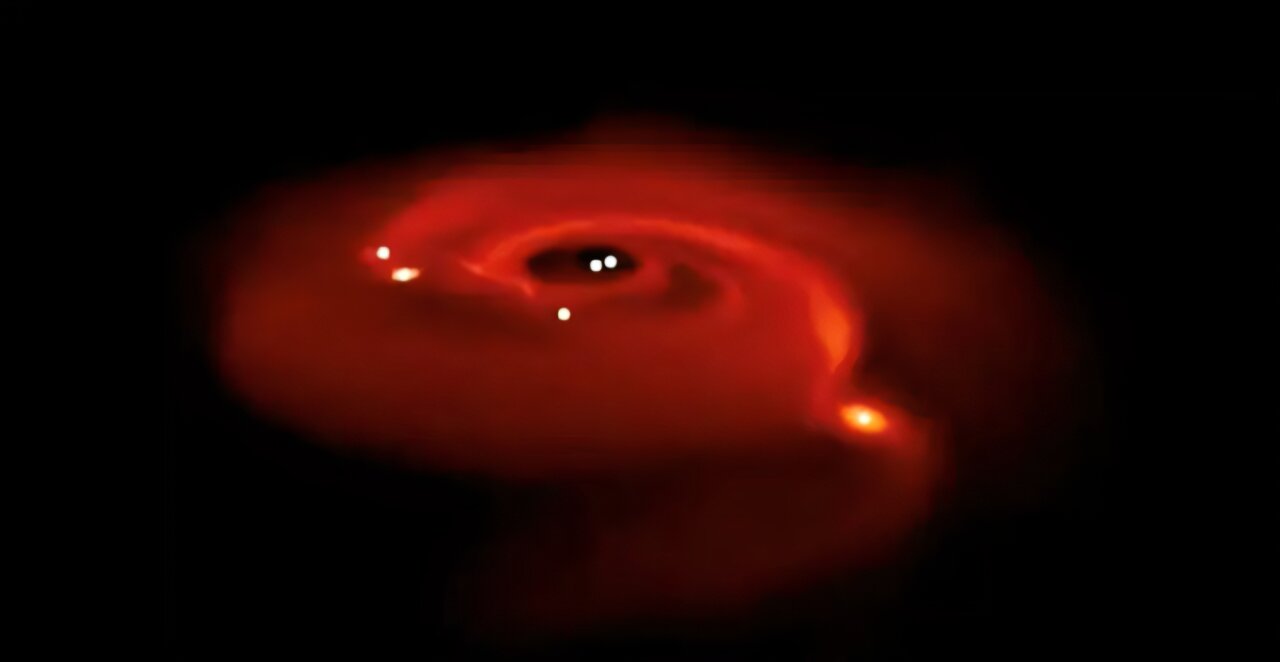 Formation of a binary star system. Source: phys.org
Planet formation around binary stars
According to a new study by astrophysicists at the University of Lancashire, planets may indeed form more easily around binary stars than around single stars, such as our Sun. Such systems are common in our galaxy, but for a long time, astronomers believed that the gravitational tug-of-war between two large objects made it difficult for circumbinary planets—worlds orbiting both stars—to form.
Famous fictional worlds, such as Tatooine from Star Wars with its iconic twin sunsets, were considered more of a cosmic oddity than something nature produces on a regular basis. However, new research by astronomers suggests that the opposite may be true.
Giant exoplanets far from the “forbidden zone”
Using the most advanced computer simulations, the team modeled the evolution of the gas disks surrounding young binary stars. Simulations show that the inner regions of such disks form a “forbidden zone” where strong gravitational effects prevent the formation of planets. But outside this region, the disk becomes a cradle for the formation of giant planets, collapsing under the influence of its own gravity and giving rise to numerous young planets.
The team found that disks around binary stars may form more planets due to fragmentation than disks around single stars, and that most of these objects eventually become gas giants larger than Jupiter. Some planets may also be ejected from their systems, becoming free-floating planets drifting through interstellar space.
Dr. Dimitris Stamatellos, who led the project, added: “Binary stars were once seen as hostile environments for planet formation. What we’re finding is that they can actually be extremely productive. Once you get past the danger zone, planets can form quickly and in large numbers.”
The high prevalence of near-binary planets in the Universe
The study’s findings suggest that binary planets—those orbiting more than one star—may be more common than previously thought, and that gravitational instability, in which massive disks collapse under their own gravity, may be an important mechanism in the formation of these planets.
Given that more than 50 exoplanets orbiting binary stars have already been discovered—including several with wide orbits—these findings help explain how such worlds can form and survive. They also open up new possibilities for future observations using facilities such as ALMA, the James Webb Space Telescope, and the future Extremely Large Telescope (ELT).
Dr. Stamatellos added, “While planets may struggle to survive near their twin suns, further out these systems transform into dynamic planet-forming environments, suggesting that real-life Tatooines may be far less rare than we once imagined.”
According to phys.org