
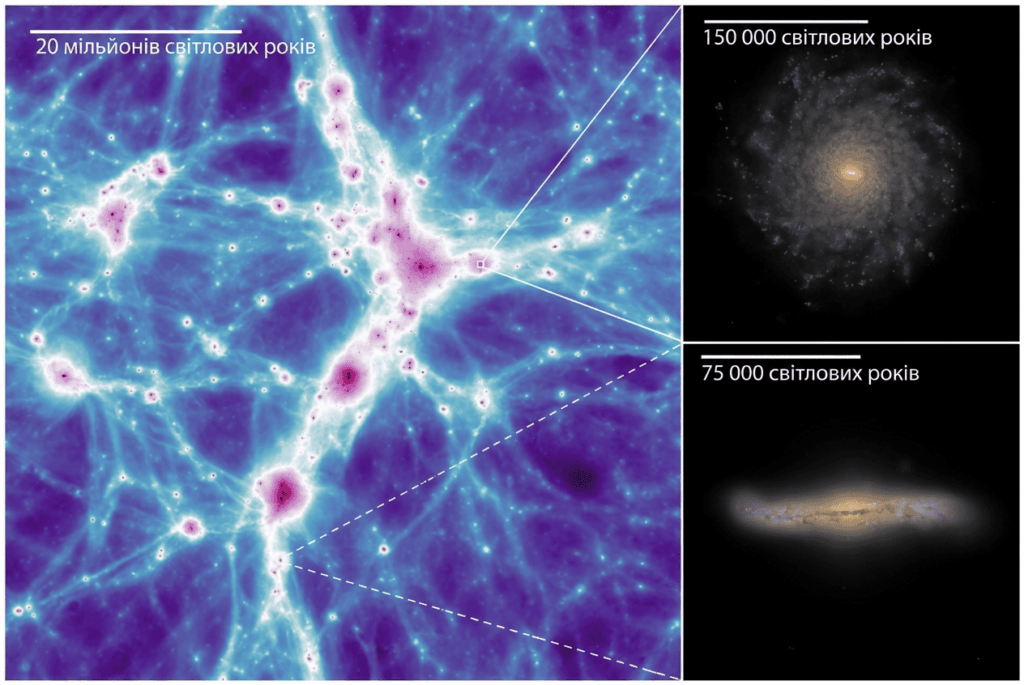
A new supercomputer simulation allows scientists to realistically recreate, for the first time, the cold gas and dust inside galaxies—the key building blocks for the formation of new stars. The results, published in April 2026, confirm the standard cosmological model, which recent observations by the James Webb Space Telescope appeared to have called into question.
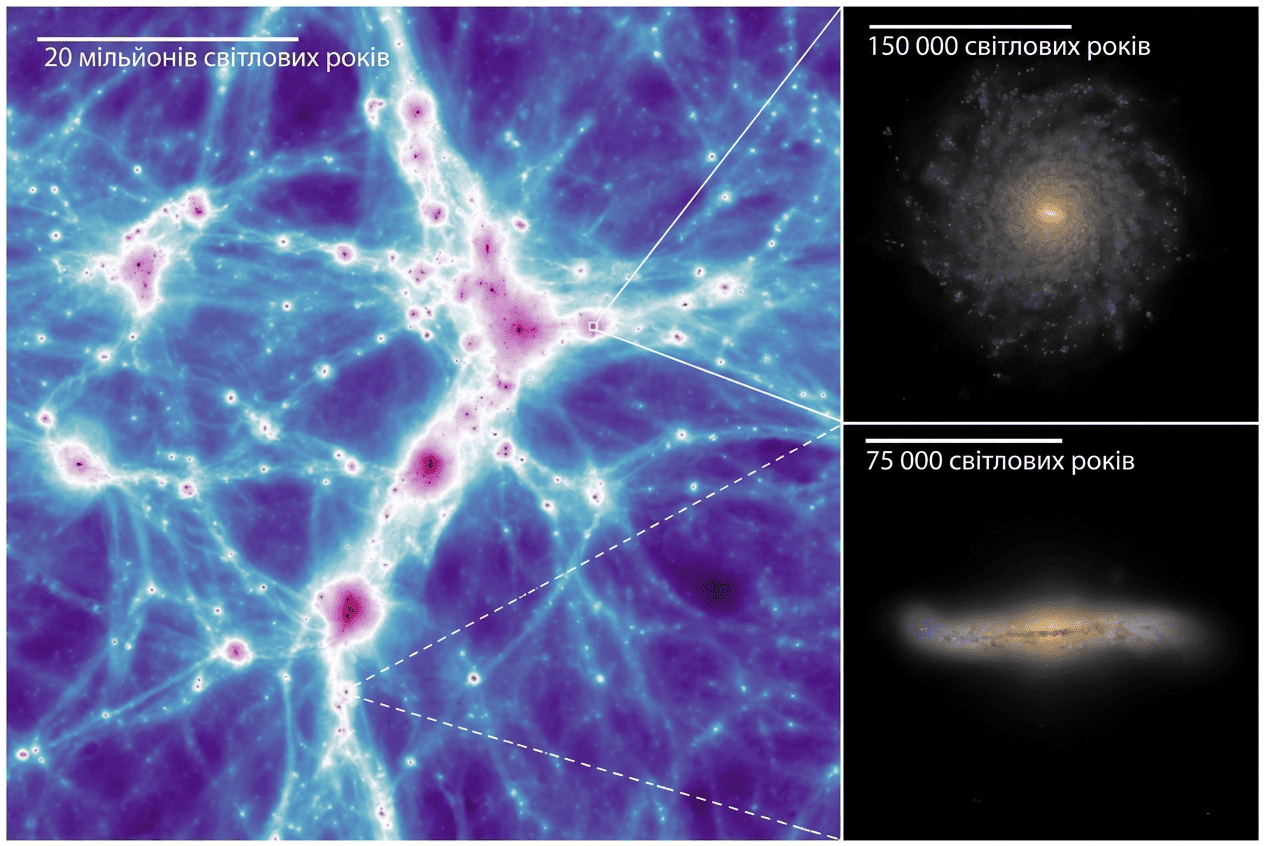 COLIBRE simulation panels: on the left—the cosmic web (gas and stellar density); on the right—two separate galaxies. Source: Schaye et al. (2026) MNRAS.
Why COLIBRE and where its predecessors failed
The COLIBRE project (COLd Ism and Better REsolution) is a set of hydrodynamic simulations of galaxy formation and evolution. The lead author of the study is Joop Schaye, a professor at Leiden University in the Netherlands, along with a large international team.
Scientists have long known that most of the gas inside real galaxies is cold and dust-filled. It is from this gas that new stars form. However, previous large-scale simulations, including IllustrisTNG, were unable to fully reproduce this phase: they artificially set lower limits for the gas’s temperature and pressure.
COLIBRE removes this limitation—the interstellar medium is modeled here without such simplifications. In addition, the simulation tracks the evolution of dust particles and incorporates updated feedback models from supernovae and active galactic nuclei (AGNs)—supermassive black holes that actively accrete matter and emit powerful jets.
Answer to James Webb’s riddle
The James Webb Space Telescope has detected black holes and galaxies in the early Universe that are more massive than predicted by the standard cosmological model—Lambda-CDM (Lambda-CDM with dark energy and cold dark matter). This has sparked a debate: should the fundamental theory be rewritten? COLIBRE offers a cautious answer: if physical processes are described more realistically, the standard theory is consistent with the observed data.
“Some of the early results from the James Webb Space Telescope seemed to challenge the standard cosmological model,” says Evgenii Chaikin of Leiden University. “COLIBRE shows that, after a more accurate treatment of key physical processes, it matches what we observe.”
What was left out
However, the simulation was unable to solve all the mysteries. In particular, it does not reproduce the so-called “Little Red Dots”—unusual compact objects detected by the James Webb Space Telescope in the early Universe. Researchers believe that these may be the precursors to supermassive black holes.
COLIBRE simply takes the existence of such black holes as a given, rather than simulating their formation. The authors also note that the structure of the molecular clouds from which stars form is not reproduced in sufficient detail in most of the galaxies included in the project.
Simulation with sound
In addition to its scientific value, COLIBRE has another unusual feature: its visualizations are accompanied by sound—every process in the galaxy has its own corresponding sound. James Trayford of the University of Portsmouth, who led the development of the audio component, explains that this approach can spark new scientific insights and make research more accessible to a wider audience.
The project also offers interactive maps that anyone can use. Most of the simulations were completed in 2025, and the rest are expected to be finished after the summer of 2026.
According to universetoday.com