
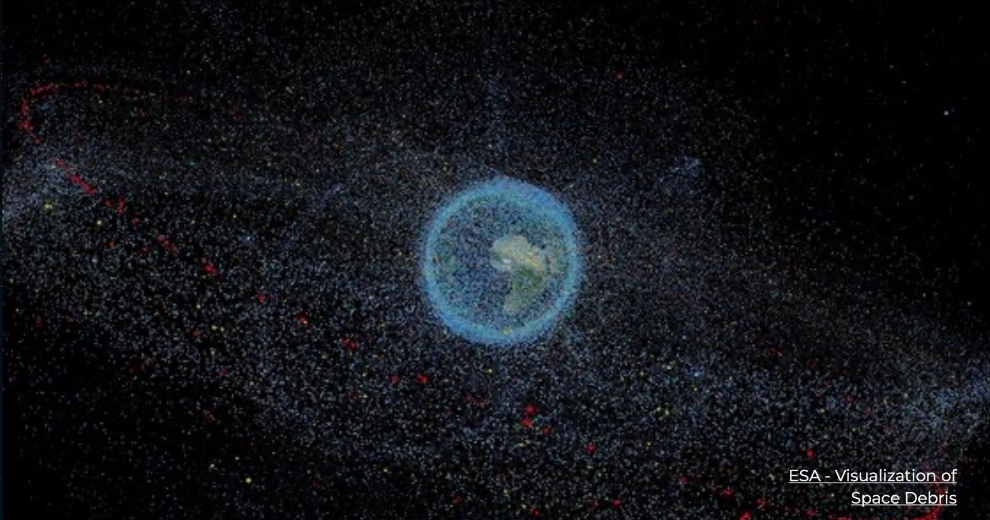
Innovation, Science and Economic Development Canada (ISED) has published its final regulatory framework aimed at curbing orbital congestion and ensuring long-term space sustainability. The policy, outlined in the Decision on Changes to Licensing Requirements and Conditions of Licence for Space Debris Mitigation (SMSE-005-26), introduces new rules for non-geostationary satellite orbit (NGSO) systems.
The finalized decision represents a balancing act for the federal government. While ISED has modernized Canada’s space debris regulations to protect critical low Earth orbit (LEO) environments, it revised its initial proposals following pushback from some domestic satellite operators and the academic space sector.
Key regulatory changes
The updated framework shifts from long-term guidelines to strict, enforceable licensing conditions. The core mandates include:
The 5-Year De-orbit Rule: NGSO satellites in LEO must undergo controlled atmospheric re-entry as soon as practicable, and no later than five years after the end of their operational life. However, satellites in Medium Earth Orbit (MEO) and Highly Elliptical Orbit (HEO) are exempt from this timeline and remain subject to the legacy 25-year post-mission disposal guideline.
Mandatory Propulsion Above 600 km: Satellites operating with an apogee of 600 km or more must be equipped with active propulsion capabilities to execute collision avoidance and end-of-life de-orbit manoeuvres. For spacecraft operating below this threshold without active manoeuvrability, operators are required to outline “alternative risk mitigation measures”—such as drag sails, passive de-orbit mechanisms, or unique mission design elements—within their space debris mitigation plans.
Disposal Reliability: Operators must demonstrate a 90% or greater probability of successful post-mission disposal for individual satellites. For constellations (two or more satellites), a 99% success rate is strongly encouraged, though no longer strictly mandated.
Trackability Standard: To ensure accurate radar tracking and effective Space Situational Awareness (SSA), LEO satellites must measure at least 10 cm in their smallest dimension, excluding deployable components like solar arrays.
Collision Probability Thresholds: Satellite designs must demonstrate that the probability of collision over their operational life is less than 1 in 1,000 for large objects (greater than 10 cm) and less than 1 in 100 for small debris (less than 10 cm).
SSA and Environmental Assessments: Licensees must register with an SSA service to monitor conjunction alerts. Furthermore, applicants must submit an environmental assessment analyzing planned and operating satellites within a 30 km radius of their proposed orbits to coordinate collision risks.
Industry pushback and regulatory alignment
The consultation process leading up to SMSE-005-26 highlighted a divide between small satellite operators—such as university research programs—and established commercial constellation operators.
ISED initially proposed that all satellites operating above 400 km possess active, redundant propulsion systems. Organizations like AlbertaSat warned that this would stifle the Canadian smallsat industry. In its feedback, the university group noted that active propulsion systems are “prohibitively expensive, costing up from $50,000-200,000 CAD.” They stressed that absorbing such a cost—representing at least 14% of their project budget—poses a “significant risk to the sustainability” of their program and is “not feasible this late in the mission.” Conversely, large constellation operators like Telesat opposed granting leniency to smaller spacecraft, arguing that “a collision risk is not size-dependent and that all missions must comply with minimum standards to protect the orbital environment.”
To preserve the viability of the domestic smallsat sector and align with U.S. Federal Communications Commission (FCC) standards, ISED revised its stance. The agency raised the active propulsion threshold to 600 km and removed the redundancy requirement, leaving lower LEO accessible to smaller, passive satellites that will naturally decay through atmospheric drag.
Another key point of contention was defining the “end of operational life”—the trigger that starts the five-year disposal clock. ISED proposed defining it as the date a satellite completes its primary function. While Telesat supported the definition, companies like MDA Space argued it slightly diverged from FCC phrasing, and GHGSat advocated for a stricter threshold, such as when command and control are indefinitely lost. The Canadian Space Agency (CSA) cautioned against using a satellite’s initial “designed” lifespan, noting that safe mission extensions prevent the need for replacement launches. Ultimately, ISED maintained its focus on the completion of the primary function. This approach allows operators to extend missions as long as the satellite is actively serving a purpose, but strictly starts the five-year de-orbit countdown the moment that primary function ceases.
Additionally, ISED softened its proposed constellation reliability metrics. Astroscale had cautioned that a strict 99% mandate “far exceeds existing best practices,” while Telesat argued it “could artificially limit constellation size and hamstring business cases.” By shifting the 99% constellation metric to an aspirational goal rather than a hard requirement, ISED actively moved to prevent regulatory “forum shopping,” ensuring Canadian operators remain globally competitive.
To avoid penalizing operators with satellites already in advanced stages of production, ISED has built a transition period into the new framework. For licenses issued before the decision date (plus a 126-day administrative window), a grandfathering clause applies. New satellites launched under those older licenses will only be forced to comply with the new 5-year de-orbit rule if they are launched two years or more after the decision date.
Foreign operators and future environmental considerations
Domestic operators expressed concern that strict national rules could create an uneven playing field if foreign satellite operators seeking market access in Canada face weaker regulations at home. To avoid duplicative global regulations, ISED adopted a “light-touch” approach for Foreign Satellite Approvals (FSAs), requiring foreign operators to simply attest to having a debris mitigation plan.
The consultation also touched on the emerging environmental consequences of the 5-year de-orbit rule itself. Scientific groups, including the Outer Space Institute, warned that the atmospheric ablation of thousands of satellites deposits heavy metals into the stratosphere, which could contribute to ozone depletion. While ISED formally acknowledged these atmospheric concerns, it deferred action on chemical deposition regulations until international precedents are established.
Related