
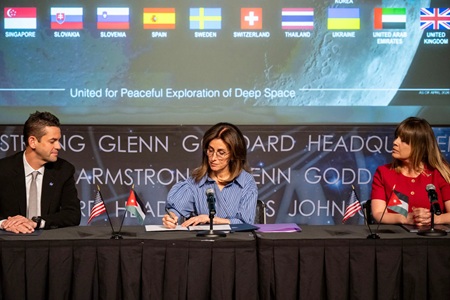
Signing the Artemis Accords commits nations to peaceful, transparent space exploration, sharing scientific data, assisting others, avoiding interference, and protecting historic space sites for the benefit of all.
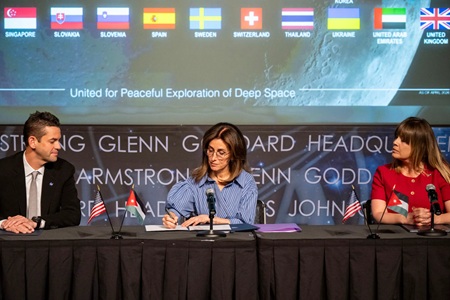 Ambassador of the Hashemite Kingdom of Jordan to the United States Dina Kawar, center, signs the Artemis Accords alongside NASA Administrator Jared Isaacman, left, and U.S. Department of State Acting Principal Deputy Assistant Secretary for Oceans and International Environmental and Scientific Affairs Ruth Perry, right. Photo credit: NASA/Keegan Barber
Jordan has officially joined the growing list of nations committed to responsible space exploration after signing the Artemis Accords during a ceremony hosted by NASA at its headquarters in Washington.
The agreement was signed by Dina Kawar, Jordan’s ambassador to the United States, in the presence of senior officials, including Ruth Perry. The move positions Jordan as a key participant in international efforts to ensure that space exploration is conducted in a safe, transparent, and cooperative manner.
NASA Administrator Jared Isaacman said: “It is my privilege to welcome Jordan as the newest signatory to the Artemis Accords. By signing the accords today, Jordan brings valuable perspective and capabilities that will help expand the Golden Age of exploration for all mankind. They join at a pivotal moment, as we take the accords principles and put them into practice with humanity’s return to the Moon. Through Artemis, we’re going back to the lunar surface, with contributions from our international partners, to build a Moon Base and to stay.”
Dina Kawar added: “Jordan has more engineers per capita than almost any country in the world. Through the National Council for Future Technologies, His Royal Highness Crown Prince Al Hussein is ensuring that talent has a direction, transforming Jordan into a regional and global technology hub across AI, digital infrastructure, advanced manufacturing, and now space. Today’s signing is proof that this ambition has no ceiling. We invite our American partners to build what comes next with us.”
The country’s space ambitions have been steadily developing in recent years. In 2018, Jordan launched its first satellite, JY1, a CubeSat built by university students and sent into orbit aboard a SpaceX Falcon 9 rocket from California. More recently, the Jordan Space Research Initiative has carried out analogue missions in Wadi Rum, simulating human spaceflight conditions and advancing planetary research through its PETRA1 and PETRA2 programmes.
The Artemis Accords, established in 2020 by the United States in collaboration with several founding nations, set out guidelines for peaceful and cooperative exploration of the Moon, Mars and beyond. The framework promotes transparency, data sharing, mutual assistance, and the preservation of historically significant sites in space, while encouraging coordination among participating countries.
By signing the accords, Jordan commits to these principles, joining an expanding international coalition focused on shaping a sustainable and collaborative future in space. More nations are expected to follow, as global interest in lunar and deep-space exploration continues to grow.