
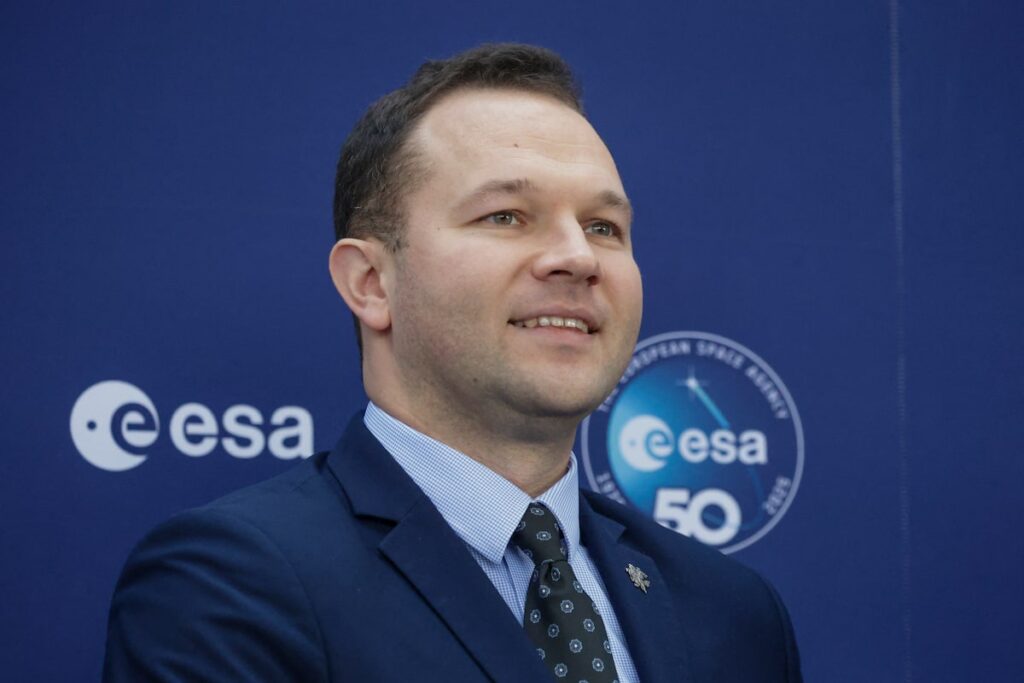
Lithuanian Minister of the Economy and Innovation Edvinas Griksas at the European Space Agency (ESA) ministerial meeting in Bremen, Germany, in November, 2025.FOCKE STRANGMANN/AFP/Getty Images
Lithuania’s Minister of Economy and Innovation visited Canada for the first time to strengthen the NATO allies’ strategic partnership and share lessons the small country learned through beefing up its defences as Canada looks to do the same.
After arriving in Ottawa for meetings with government and bilateral trade talks, minister Edvinas Griksas travelled to Toronto to meet with Canadian companies and innovators on Friday before carrying on to Calgary, where he met with more government officials and the Lithuanian community.
Lithuania is one of a handful of smaller countries along the North Atlantic Treaty Organization’s eastern flank that larger allies, such as Canada, are turning to for insight into how to bolster their own defences as military spending ramps up across the alliance. Though their economies and geographies are generally dwarfed by those of larger powers, the pace and scale of innovation and industrialization they’ve achieved to ward off a Russian threat offer a stark contrast to where Canada is starting from today.
Proportionally, Lithuania is also one of the biggest spenders on defence within NATO, achieving 4 per cent of gross domestic product in 2025 and striving to reach 6 per cent by 2030.
Opinion: The Liberals need to show their defence math
A lot has changed for Lithuania’s industry and economy since Russia invaded Ukraine in 2022. Companies previously operating in other sectors pivoted to defence to meet the moment. And industry revenues have climbed, Mr. Griksas said, shooting up 50 per cent just last year.
The pivot made by Lithuanian company Brolis is an example of the same change Canada’s federal government is asking of its own industry today. Founded in 2011, it previously developed infrared laser products mainly for scientific applications. But when Russia invaded Ukraine, Mr. Griksas said, “They changed their way of working and applied the laser systems to create electro-optical targeting systems that can be used for rifles, for drones, even, and other systems.”
About 100 companies make up Lithuania’s defence industry, compared with the more than 600 that comprise Canada’s. But 60 per cent of those Lithuanian companies are exporting and feeding into NATO supply chains, Mr. Griksas said. “That shows that the products, companies are mature.”
In 2022, exports represented about half of Canadian defence industry revenues, according to a government report, and Ottawa has set a target of doubling defence exports over the next decade.
Ottawa plans to double defence exports, create 125,000 jobs in next decade
But unlike Canada, this prioritization of defence isn’t new for Lithuania. “Russia’s full-scale war of aggression in Ukraine was a wake-up call for a lot of Western countries, but it wasn’t a wake-up call for Baltic states, for Poland, for Lithuania. We knew what kind of neighbour we have,” Mr. Griksas said.
Since arriving in Canada for the first time, he said, he’s discussed Lithuania’s priorities in terms of advanced technology sectors such as biotech and mass manufacturing, as well as priorities for its coming presidency of the Council of the European Union in 2027.
As Canada attempts to strengthen its ties with Europe through mechanisms such as the EU’s Security Action for Europe program, which helps member states invest in defence capabilities, Mr. Griksas is pitching Lithuania as an entryway to the European market.
He’s inviting Canadian companies and governments to visit Lithuania, he said, as they attempt to diversify away from the United States.
Being ahead of Canada, in terms of building a defence industry that can manufacture products such as drones at scale, means Lithuania has a lot to offer in terms of lessons in what does and doesn’t work to incentivize innovation and commercialization, Mr. Griksas said.
“So better later than never,” he said, referring to Canada’s recent defence-spending surge.