
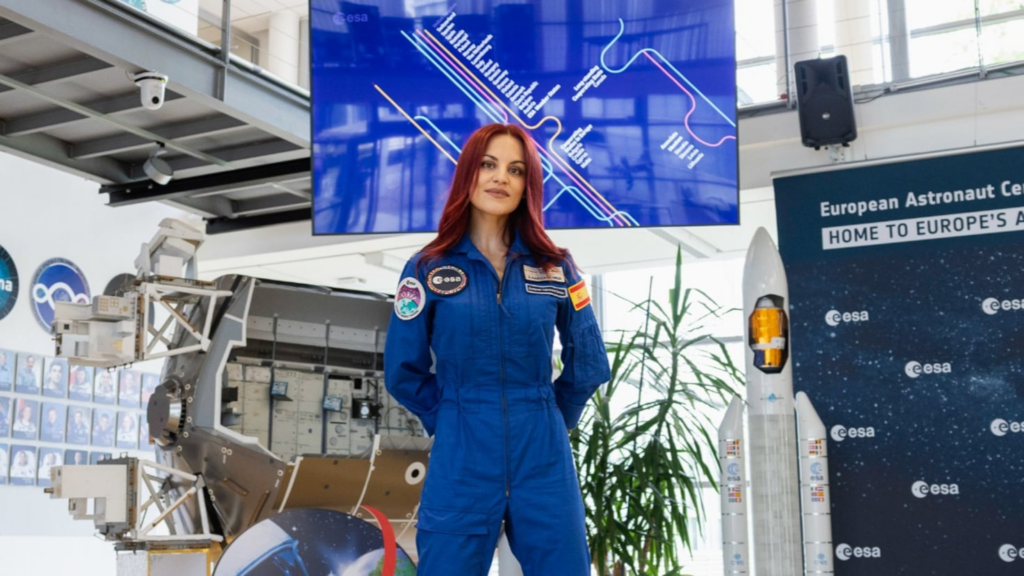
NASA’s Artemis mission, in which the European Space Agency (ESA) is also participating, has reignited humanity’s most ambitious dreams: outer space, the Moon, and what lies beyond our skies. People wonder how it is possible to leave our planet and imagine what Earth looks like from above. Artemis has an even more ambitious goal: establishing a base at the Moon’s south pole.
“It’s every astronaut’s dream,” Spanish astronaut Sara García Alonso tells AS. For now, García is a member of ESA’s astronaut reserve. In May, she will complete her training and wait to be assigned to a mission. Her goal is clear: contribute as much as possible to the agency, continue training, and begin participating in missions. Where will humans be in the coming years? Sara is certain: “Of course, on the Moon.”
Artemis II is a decisive step that marks the beginning of a new space era. For the first time in more than 50 years, we are sending a crew back into the lunar environment, which means validating key systems for everything that comes next. It has been a major success, both technically and from a human perspective, and the entire space community is following it very closely.
Can I see myself on a future mission to the Moon? I’d love to, but I approach it with humility and try to stay realistic. It’s every astronaut’s dream, but I’m also aware of how long the road is. The first European astronauts to travel to our satellite will likely have prior experience in low Earth orbit missions, such as aboard the International Space Station. My focus right now is to prepare as thoroughly as possible. If the opportunity comes, I want to be ready to take it, whatever the mission may be.
 Fotografía cedida por la entrevistada
It’s an exciting scenario and very different from anything we have done before. The Moon is not just a destination; it’s a testing ground for learning how to live off Earth for extended periods. Living there would mean facing constant challenges: isolation, extreme conditions, and resource management. At the same time, it’s a unique opportunity to conduct science and develop technology that can later be applied on Earth. Being able to contribute to that kind of on-site research would be a dream come true. That knowledge is essential for humanity to continue advancing in space exploration.
No two days are the same, and that’s probably the most interesting part. You might go from a theoretical session on spacecraft systems or orbital mechanics classes to physical training in the COSMOS gym, survival training, pool simulations, or robotics and virtual reality work. It’s a very broad and multidisciplinary program. It’s not just about gaining theoretical and technical knowledge across all relevant areas of spaceflight, but also about learning to operate in complex environments, make decisions under pressure, and work effectively with international teams. That constant variation is itself a form of training, since you are always adapting to new situations.
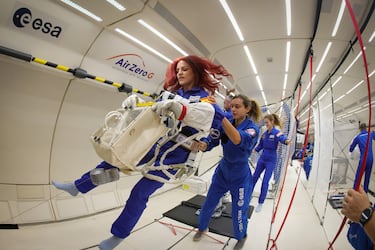 Fotografía cedida por la entrevistada
The focus is on functional, well-rounded workouts. Personally, I exercise about six days a week for one to two hours. On the International Space Station, for example, astronauts use devices such as ARED, which generates resistance without weights using vacuum cylinders, T2, which is similar to a treadmill with harnesses to hold you down, and CEVIS, a seatless cycle ergometer. During a space mission, exercise, about two hours per day, is mandatory and part of an astronaut’s daily routine.
Related stories
Yes, especially survival training, both in cold environments and in water. That’s where you truly realize that being an astronaut is not just about knowledge or physical fitness. It’s about communication, stress management, and making decisions as a team in complex situations. You learn that there often isn’t a perfect answer, and what really matters is how uncertainty is handled.
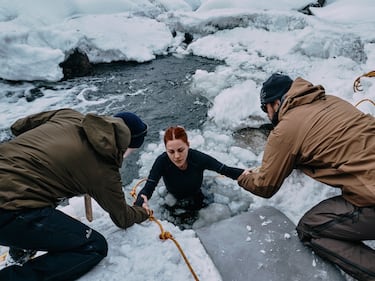 Fotografía cedida por la entrevistada
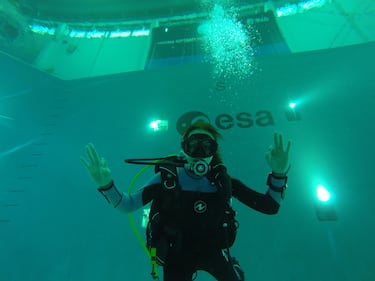 DCIM\101GOPROFotografía cedida por la entrevistada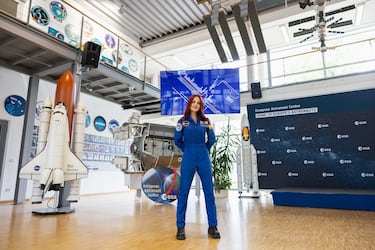
I think we will see a more sustained human presence beyond Earth, starting with low Earth orbit, about 250 miles above our planet, and, of course, on the Moon. We will also see major advances in propulsion technologies, habitability, and space medicine. When the International Space Station is deorbited, low Earth orbit will begin to host new space stations, where public-private collaboration will be the norm. In the medium term, the major goal will remain Mars, but there is still a great deal of technology to develop before that becomes a reality.