
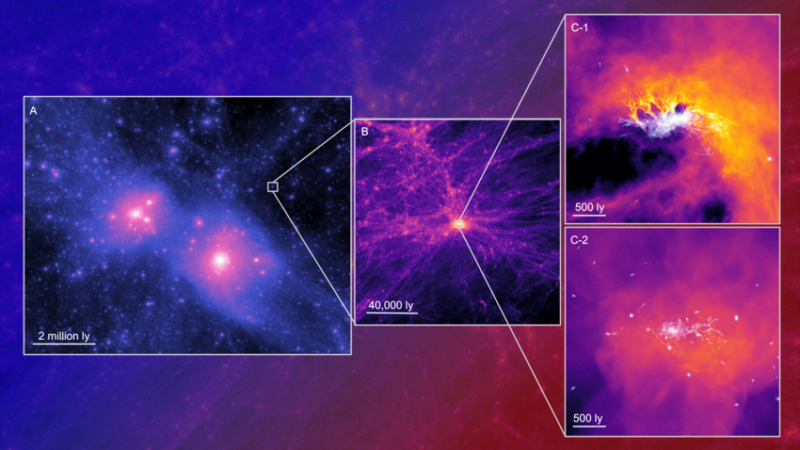
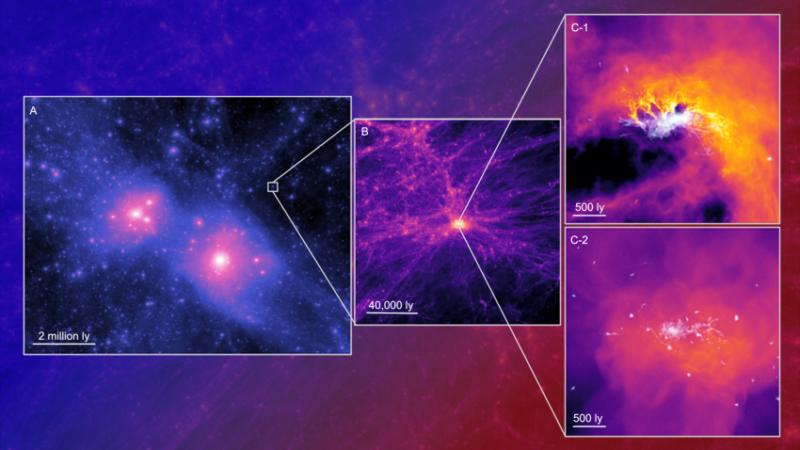
 Figure A shows a dark matter map in our neighborhood of the universe. The 2 blobs are dark matter halos of the Milky Way and Andromeda galaxies. Figure B zooms in to show a small dark matter clump about 700 million years after the Big Bang. Then C-1 and C-2 are stars and gas in the simulated ultra-faint dwarf galaxy. These show different radiation levels shortly after the Big Bang. Ultra-faint dwarf galaxies change their properties depending on which radiation is used. The scale on each image is in units of light-years. Image via Royal Astronomical Society/ J Sureda/ A Fattahi/ S Brown/ S Avraham (CC BY 4.0).
Ultra-faint dwarf galaxies – tiny satellites of the Milky Way – act as cosmic fossils. They preserve clues about radiation and star formation in the early universe.
New high-resolution simulations show these faint galaxies are extremely sensitive to early-universe conditions. Those conditions determined whether small dark matter halos formed stars or stayed dark.
Future observations from the Vera C. Rubin Observatory could use these galaxies to reconstruct the universe’s earliest climate.
The Royal Astronomical Society published this original story on April 24, 2026. Edits by EarthSky.
Ultra-faint dwarf galaxies show state of the early universe
Ultra-faint dwarf galaxies – tiny satellite galaxies orbiting the Milky Way – have long been seen as cosmic fossils.
Now, a new study published April 24, 2026, in the peer-reviewed journal Monthly Notices of the Royal Astronomical Society uses an unprecedented set of simulations to show just how powerfully these faint systems can reflect the conditions of the early universe. And it tells us why some galaxies grew and others did not.
These little galaxies could also reveal what the universe’s earliest ‘climate’ was like. For example, it could show the level of radiation and how this impacted whether and where stars formed.
Astronomers often describe dwarf galaxies as small cousins of the Milky Way. They form in small dark matter halos predicted by the standard model of cosmology. The faintest examples of such systems are extreme in both size and fragility. And they lie on the boundary of our knowledge about galaxy formation and dark matter.
Simulating tiny galaxies
Associate professor Azadeh Fattahi, of the Oskar Klein Centre (OKC) in Stockholm, led the new study with the LYRA collaboration and in collaboration with Durham University and the University of Hawaii. Fattahi said:
In this work we presented a brand-new suite of cosmological simulations focused on the faintest galaxies in the universe, with an unprecedented resolution. These are by far the largest sample of such galaxies ever simulated at these resolutions. The smallest galaxies are called ultra-faint dwarf galaxies, which are a million times less massive than the Milky Way or even smaller. Due to their small size these galaxies have proven very difficult to model and simulate.
This new simulation suite represents a major step forward, enabling a systematic view of how these galaxies form and evolve.
A down-to-earth analogy
Shaun Brown led the study while working at OKC and Durham University. Brown said:
A useful analogy is to plants and crops and how they grow is sensitive to the weather conditions. In the same way that the yield of a crop in summer can indirectly tell you a lot about what the weather in spring must have been like, the properties of faint dwarf galaxies today can tell us a lot about the conditions, or weather, of the universe at a much earlier time.
What makes the results especially timely is that the simulations do more than reproduce faint dwarf galaxies. They suggest that these local objects can act as a probe of the universe’s earliest ‘climate’. The team explored how different assumptions about the early radiation environment influence which small dark matter haloes manage to form stars at all. Brown explained:
In the paper we studied two different assumptions about the properties of the early universe when it was less than 500 million years old, to understand the effect on the properties of these small galaxies today when the universe is 13 billion years old. We found that these small ultra-faint galaxies are very sensitive to these changes, while more massive galaxies, like our Milky Way, don’t really care.
For the smallest galaxies, early conditions can decide whether they become visible galaxies or remain starless dark matter halos.
Future research
That sensitivity opens a clear path to testing early-universe physics with upcoming observations. Fattahi said:
Excitingly, in the near future we will have data from the Vera C. Rubin Observatory which will be able to find many more of these ultra faint dwarfs around the Milky Way.
Many astronomers hope Rubin can deliver a near-complete census of Milky Way satellite galaxies. And these simulations hint that this census may carry information far beyond our local neighborhood. Fattahi added:
Our work suggests that these upcoming observations of the very local universe will be able to constrain what the universe at its infancy looked like, something we currently cannot directly access with other observations.
The result is particularly relevant in the light of recent discoveries, by the James Webb Space Telescope, of galaxies in the early universe. Some of those galaxies are unexpectedly massive and bright.
If the early universe is producing surprises at large distances, then local relics from the same epoch – ultra-faint dwarfs – may provide an additional route to understanding what happened, according to Dr Fattahi.
Looking ahead, Dr Fattahi’s team plans to tackle questions that are still open in modern galaxy and structure formation. For example, where did the very first generation of stars form in the universe? Or what do the properties of ultra-faint dwarf galaxies tell us about the nature of dark matter?
Bottom line: Ultra-faint dwarf galaxies preserve clues to early-universe conditions, acting as cosmic fossils. Simulations show early radiation shaped whether these tiny galaxies formed stars or stayed dark.
Via Royal Astronomical Society
EarthSky Voices
View Articles
About the Author:
Members of the EarthSky community – including scientists, as well as science and nature writers from across the globe – weigh in on what’s important to them.