
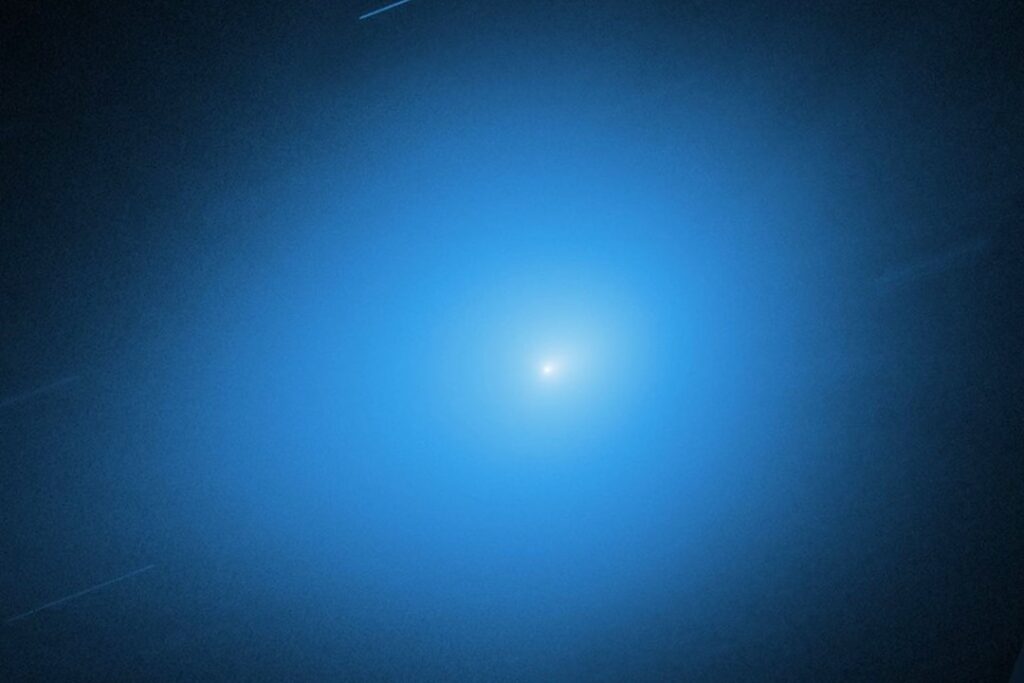
The third confirmed interstellar body to visit our solar system is being revealed as a time capsule from a very different part of the Milky Way. In a new study, astronomers report comet 3I/ATLAS, first spotted passing through our neighborhood last July, carries water with a deuterium-to-hydrogen ratio up to 30 times higher than that seen in any comet born in our solar system, and about 40 times that of Earth’s oceans—evidence it formed in a far colder, lower-radiation environment, per the BBC. The object, thought to be 7 billion to 10 billion years old, appears to have taken shape long before our sun formed around 4.5 billion years ago.
Researchers used telescopes in Arizona and Chile’s Atacama desert, including the ALMA array, to focus in on the comet before it exits our solar system, distinguishing “heavy” water containing deuterium from ordinary water, per the AP. “The amount of deuterium with respect to ordinary hydrogen in water is higher than anything we’ve seen before in other planetary systems and planetary comets,” University of Michigan doctoral student Luis Salazar Manzano, lead author of the study in Nature Astronomy, says in a release. This suggests the conditions that produced our solar system are not standard across the galaxy. With next-generation observatories like the Vera C. Rubin Observatory coming online, scientists expect more chances to survey interstellar visitors for clues to how alien planetary systems are built.