
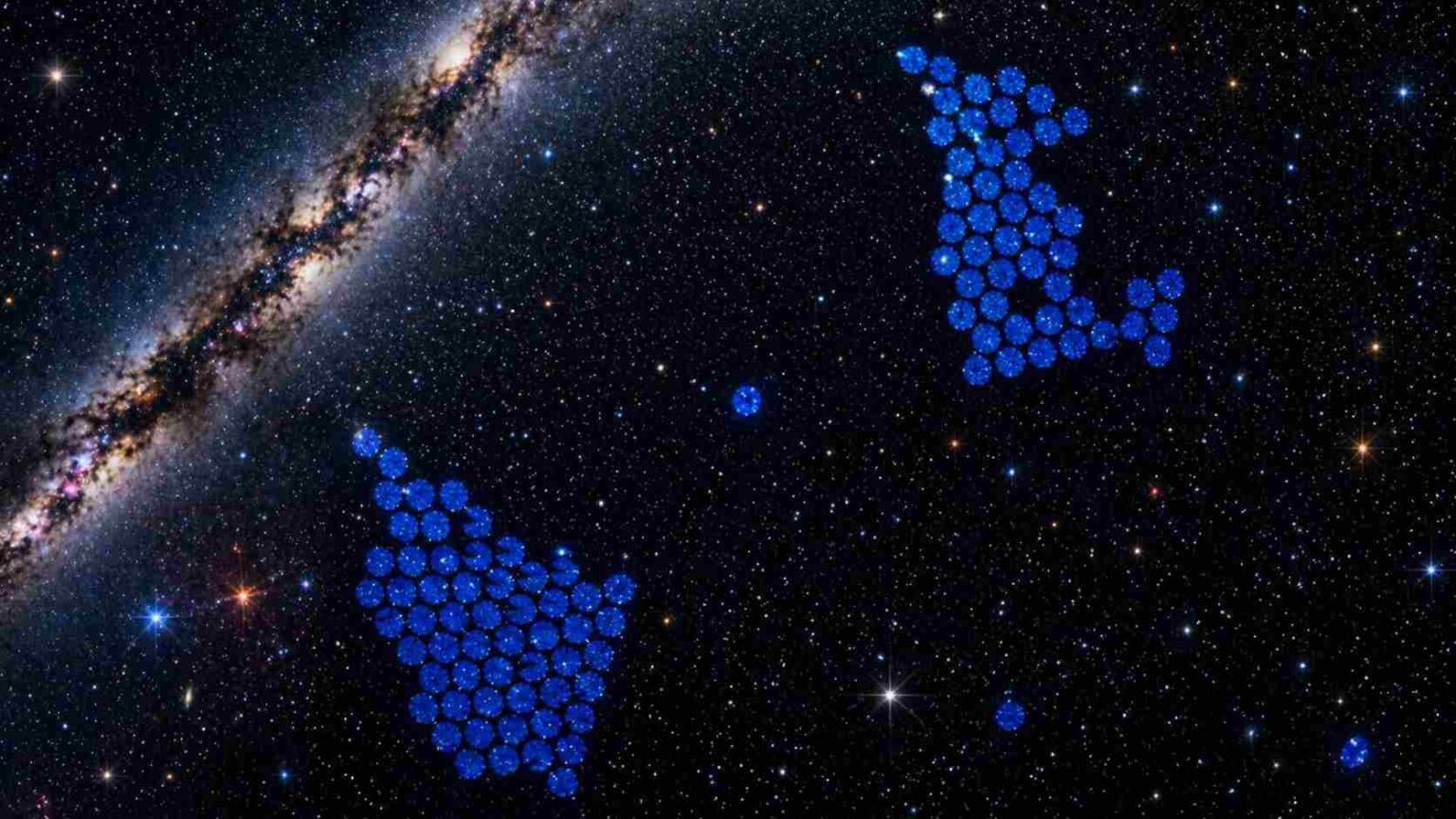
The most detailed map of the universe ever produced has been completed after five years of observations, cataloging over 47 million galaxies and quasars, in addition to 20 million stars. The dataset, obtained by the Dark Energy Spectroscopic Instrument, is expected to generate the first comprehensive results on dark energy in 2027 and has already raised questions about the most accepted models for the expansion of the universe.
Installed on the 4-meter Nicholas U. Mayall telescope at Kitt Peak National Observatory in Arizona, the instrument concluded its initial five-year survey with numbers exceeding expectations. The project observed 13 million more galaxies and quasars than originally planned and gathered cosmological measurements for six times more objects than all previous surveys combined.
The completion of the survey represents a milestone in the effort to understand dark energy, a force associated with the accelerated expansion of the universe. Researchers tracked how galaxies clustered in the past and present to monitor this influence over approximately 11 billion years of cosmic history.
Map of the universe surpasses the project’s initial goal
The survey was conducted by the Dark Energy Spectroscopic Instrument, known as DESI, created to produce the most complete three-dimensional representation of the cosmos ever assembled. At the end of five years, the project surpassed its original objectives and completed the largest three-dimensional map of the universe ever compiled.
Each point on the map represents an individual galaxy, positioned within a large-scale structure marked by dense filaments and immense voids. In these regions, galaxies and clusters appear gathered under the action of gravity, separated by relatively isolated areas.
The final result organizes tens of millions of celestial objects into a three-dimensional structure built from measuring distances relative to Earth. This process allowed light observations to be transformed into a cosmic portrait covering more than a decade of the universe’s history.
How DESI built the three-dimensional structure
The instrument operates by capturing light through the ends of 5,000 optical fibers, each controlled by a miniature robotic arm. As the telescope scans different areas of the sky, these arms reposition the fibers to successively observe new galaxies.
Each fiber collects light from a galaxy and sends it to a spectrograph, which separates that light into different wavelengths. From these spectra, researchers calculate the distance of each object from Earth and assemble the three-dimensional structure of the survey.
David Schlegel, a scientist at Lawrence Berkeley National Laboratory and co-founder of the project, attributed the better-than-expected performance to continuous technical advancements and near-zero downtime. He stated that the team today knows much more about robots and motors than they did ten years ago, which helped keep the instrument operating with high efficiency.
Michael Levi, director of the collaboration and also a scientist at Berkeley Lab, described the instrument’s performance as better than anticipated. He also highlighted the phenomenal pace at which the team executed the survey over the five years.
Dark energy takes center stage in new questions
DESI was designed to test whether dark energy behaves as a fixed cosmological constant, an idea present in Albert Einstein’s theory of general relativity. Data from the first three years of operation had already suggested that the rate of cosmic acceleration may have varied over time.
This possibility opened the door to the hypothesis that dark energy might be more variable than a constant. The statistical significance of this result remains low enough that it might not withstand further analysis, but the signal was sufficient to stimulate the search for alternative models.
Cosmologist Bhuvnesh Jain, from the University of Pennsylvania, stated that DESI’s preliminary findings have generated great interest. For him, the results move away from the simplest physical explanations for dark energy and indicate that it would not be appropriate to prematurely apply Occam’s razor.
Schlegel estimates that the team will still need about a year to determine what the complete dataset reveals about dark energy. Meanwhile, the instrument continues to collect data in more complex observation regions, including lower areas in the southern sky, with the goal of adding over 15 million galaxies to the database.
Upcoming analyses and new articles
The full five-year dataset analysis is expected to deliver the first comprehensive results on dark energy in 2027. Before that, the collaboration plans to publish several additional articles this year based on information collected during the first three years of the survey.
At the same time, the complete five-year dataset has already entered processing. This stage will be crucial to show what the map of the universe can reveal about the force driving cosmic expansion and about the signals that have already begun to challenge the most accepted models.
Stephanie Juneau, NSF’s NOIRLab representative on the project, stated that the survey brings together the work of instrument builders, software engineers, technicians, observatory staff, and many early-career researchers.
She also said that, after indications emerged that dark energy might deviate from a constant and potentially alter the ultimate fate of the universe, she is eagerly awaiting the analysis of the new map of the universe.