
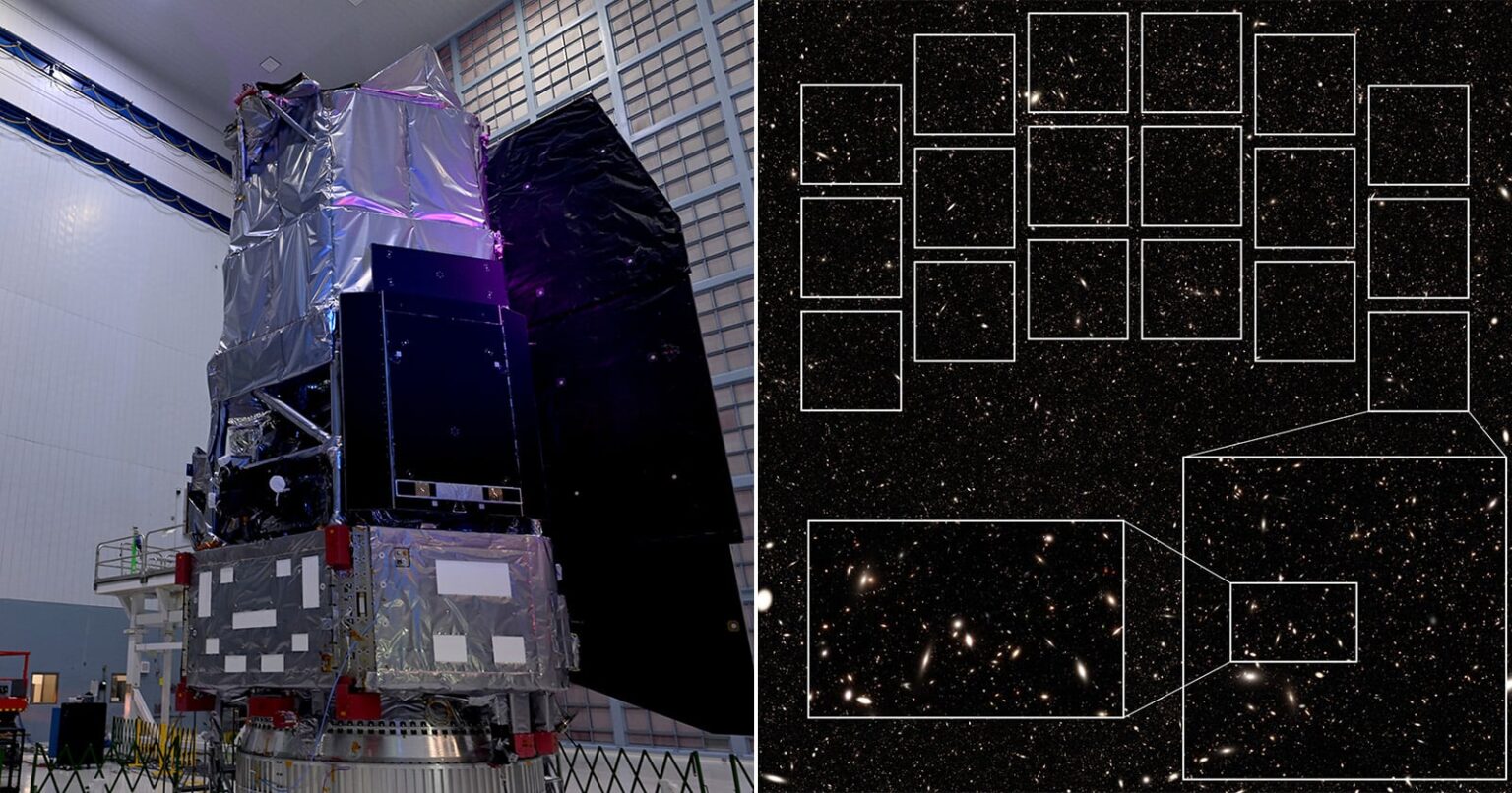
NASA celebrated its revolutionary Nancy Grace Roman Space Telescope (NGRST) yesterday, showing the completed observatory off to the world and announcing that the mission was not only ahead of schedule but, in a rarity for cutting-edge scientific projects, under budget.
Roman is scheduled to launch into space as soon as September aboard a SpaceX rocket and begin capturing an atlas of the Universe, including evidence of the invisible material and energy scientists believe connects the entire cosmos.
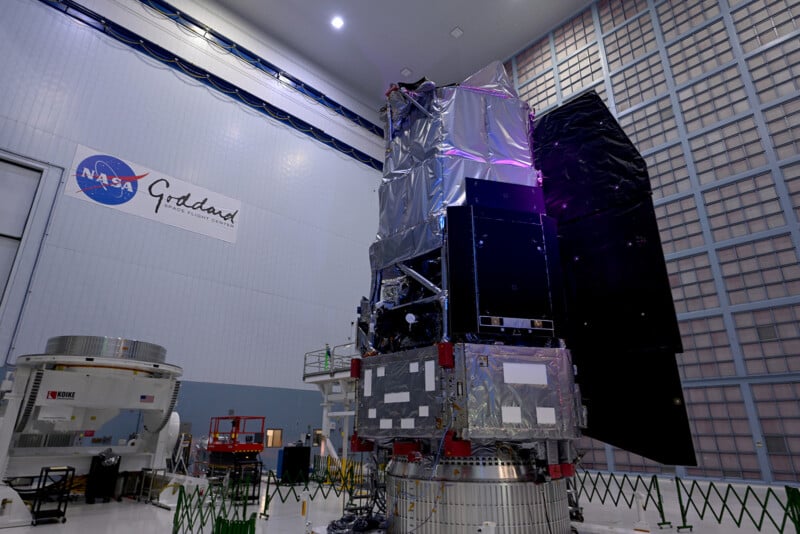 ‘NASA’s Nancy Grace Roman Space Telescope is photographed in the largest clean room at the agency’s Goddard Space Flight Center in Greenbelt, Md. The observatory is on track for delivery to the launch site at NASA’s Kennedy Space Center in Florida in June and launch as soon as early September.’ | Credit: NASA/Scott Wiessinger
The Nancy Grace Roman Space Telescope has had quite the journey to reach this momentous occasion. PetaPixel covered it for the first time back in February 2022, (https://petapixel.com/2022/02/03/nasas-roman-telescope-to-shoot-area-300x-larger-than-hubble/) discussing the telescope, formerly known as the Wide-Field Infrared Survey Telescope, and its ability to capture images with 300 times more area than the venerable Hubble Space Telescope. However, initial planning for Roman dates back much farther, to 2010.
When it hit the news again the following year, Roman was gearing up for a 2027 launch, and scientists were touting its 300.8-megapixel infrared Wide Field Instrument and Coronagraph. The telescope’s primary assembly concluded late last year, and NASA touted Roman’s promise to “expand our understanding of the Universe.”
In the past few months, NASA has been hard at work putting the finishing touches on Roman, and it is officially ready to be shipped to Kennedy Space Center in Florida, where it will be safely attached to a SpaceX rocket and propelled into space, where it will map the Universe and help answer humanity’s biggest questions about space.
After Roman reaches its planned stable orbit location about one million miles from Earth, it will deploy its massive eight-foot-wide mirror, the same size as the one on the Hubble Space Telescope, and start collecting light across all 18 of its 16.8-megapixel custom-built image sensors. These detectors “see” across near-infrared and visible wavelengths and work alongside eight specialized filters spanning 0.48 to 2.3 μm wavelengths. Each of the 18 Teledyne H4RG-10 detectors has large, highly sensitive 10 μm pixels. It’s a seriously impressive camera.
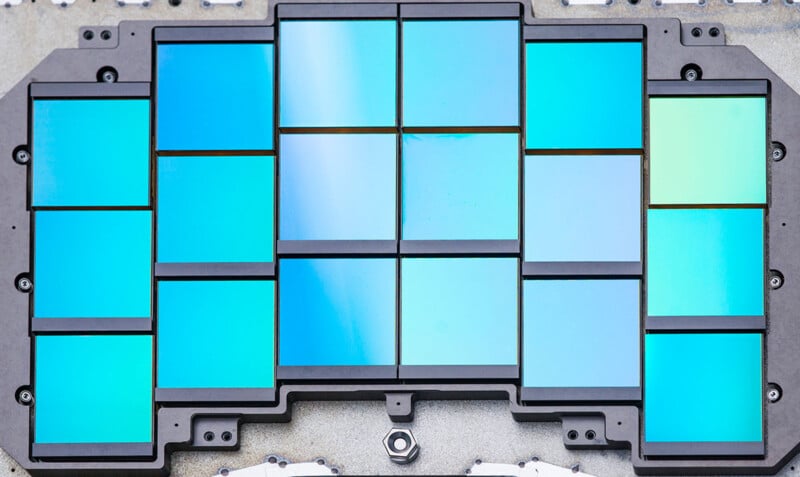 NASA’s Nancy Grace Roman Space Telescope mosaic plate assembly. | Credit: NASA/Chris Gunn
 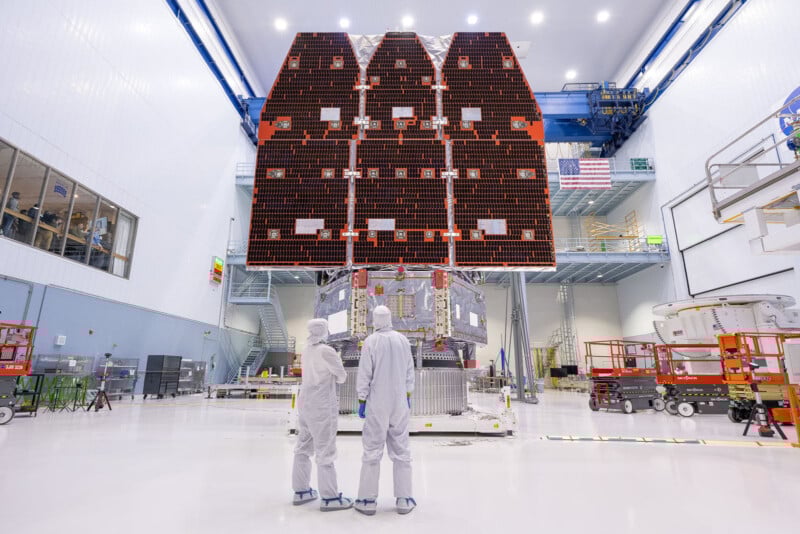 ‘NASA’s Nancy Grace Roman Space Telescope is now fully assembled following the integration of its two major segments on Nov. 25 at the agency’s Goddard Space Flight Center in Greenbelt, Md. The mission is slated to launch by May 2027, but the team is on track for launch as early as fall 2026.’ | Credit: NASA/Jolearra Tshiteya
“The WFI is designed to detect faint infrared light from across the universe. Infrared light is observed at wavelengths longer than the human eye can detect. The expansion of the universe stretches light emitted by distant galaxies, causing visible or ultraviolet light to appear as infrared by the time it reaches us. Such distant galaxies are difficult to observe from the ground because Earth’s atmosphere blocks some infrared wavelengths, and the upper atmosphere glows brightly enough to overwhelm light from these distant galaxies,” NASA explains.
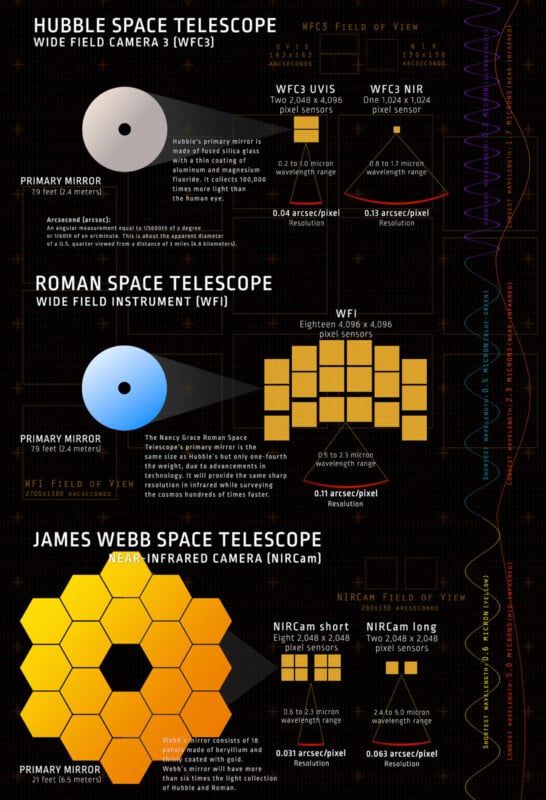 Credit: NASA Goddard Space Flight Center
Roman’s Wide Field Instrument is sensitive enough to detect infrared light from farther away than any other telescope before. The Nancy Grace Roman Space Telescope will quite literally see space unlike anything else has before. In doing so, scientists hope it will help solve big mysteries, including surrounding the fundamental nature of the Universe itself.
A big part of that puzzle is dark energy and dark matter. These are still technically hypothetical, invisible components that astrophysicists believe could comprise about 95 percent of all matter in the Universe. The “Dark Universe” cannot be directly observed, but its interactions with visible objects and matter can be.
Roman’s namesake, the late astronomer Nancy Grace Roman, is known by many in the community as the “Mother of Hubble.” The telescope named after her will, in many important ways, pick up where the Hubble Space Telescope has left off.
“The mission will acquire enormous quantities of astronomical imagery that will permit scientists to make groundbreaking discoveries for decades to come, honoring Dr. Roman’s legacy in promoting scientific tools for the broader community,” said Jackie Townsend, Roman’s deputy project manager at NASA Goddard late last year. “I like to think Dr. Roman would be extremely proud of her namesake telescope and thrilled to see what mysteries it will uncover in the coming years.”
NASA administrator Jared Isaacman said yesterday during a live press conference that what would have taken Hubble 2,000 years to capture and process, Roman will do in a single year. Roman will send 11 terabytes of data to Earth every single day. What an incredible legacy for a truly exceptional pioneer.
There is still a level of mystery, even just months away from Roman’s launch. Ultimately, while the space telescope will measure light from over a billion galaxies arrayed across the Universe, make a map of the Milky Way, and likely discover hundreds, if not thousands, of exoplanets, given that Roman is searching for evidence of the Dark Universe, the team expects plenty of surprises.
“If Roman wins a Nobel Prize at some point, it’s probably for something we haven’t even thought about or questioned yet,” said Mark Melton, a systems engineer at NASA’s Goddard Space Flight Center in Greenbelt, Maryland.
As of now, NASA’s Nancy Grace Roman Space Telescope could launch in early September.
Image credits: NASA