
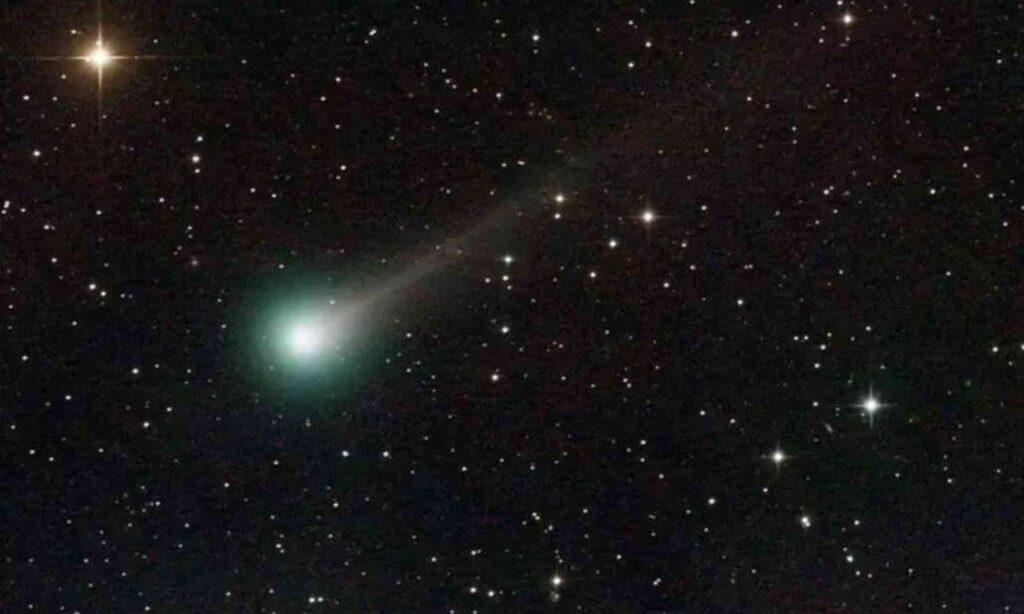
Researchers have found that comet C/2025 R3 has shifted onto an escape trajectory after its solar pass, marking a final visible visit before it leaves the solar system.
That change turns a brief window of dawn visibility into a one-time chance to observe a comet that will not return.
A faint visitor

Before sunrise in mid-April, the comet sat low above the eastern horizon, where its rapid brightening made it briefly accessible to observers.
Observations reported by Yudish Ramanjooloo at the University of Hawaii Institute for Astronomy (IA) directly linked its rise in brightness to material streaming off its surface.
That surge pushed the object from near invisibility into range for binoculars and small telescopes within weeks.
Even at peak brightness, its low altitude and proximity to the Sun limited how easily the comet could be seen from most locations.
Comet reacts to Sun
Near the Sun, frozen ices in the comet started turning directly into gas and lifting dust away as heat reached its surface.
Sunlight and flowing solar particles pushed that material outward, building the fuzzy head and lengthening tail across millions of miles.
By mid-April, magnitude – astronomers’ backward brightness scale – placed the comet near 4, then closer to 3 in dark skies.
Fresh gas and dust made it brighter, but dawn twilight and haze kept that brightness hard to use from most cities.
Finding dawn skies
From Tokyo, the comet sat low in the northeast before sunrise during its best April mornings in Japan.
Because it hovered only a few degrees above the horizon, buildings, hills, and humid air could erase it in thin dawn light.
Binoculars offered the best first look, then some observers could try again with unaided eyes in the washed-out sky.
Timing mattered most near April 20, when the brightening comet also moved closer to the Sun’s glare for most northern viewers.
Seeing the tail
Images from dark sites showed the comet’s tail stretching as long exposures caught more faint detail before closest solar approach.
Sunlight nudges dust into a broader pale stream, while charged particles from the Sun pull gas straighter away from the head.
A coma, the fuzzy cloud around a comet, forms when released gas and dust surround the icy core.
That cloud spreads the comet’s light, so a bright-sounding number can still look dim and smudged through binoculars.
Colors can mislead
Green hints can appear when sunlight breaks carbon-bearing molecules into glowing fragments near the comet’s head in the inner cloud.
White light usually comes from dust grains reflecting sunlight, which is why many comet photos look pale.
Cameras collect faint light longer than eyes can, so photographs often show stronger colors than viewers see on screens.
Any color seen through binoculars will likely remain subtle, especially while dawn haze weakens the view.
One final path
Orbital calculations place C/2025 R3 closest to the Sun on April 19, 2026, at about 46 million miles (74 million kilometers).
Planetary gravity then altered the route enough that the comet now follows a hyperbolic path, an open escape track.
Unlike an ordinary returning comet, C/2025 R3 no longer traces a closed route around the Sun.
That open route gives this viewing window real finality, because the altered orbit points outward, not back.
Photographing the comet
Long-exposure photographs can reveal the tail even when the eye sees only a pale blur near the horizon.
A steady tripod matters because camera shake smears the comet, stars, and horizon during longer exposures on chilly mornings.
Photographers can test exposure time carefully, since too much dawn light can wash out faint structure while the sky brightens.
Results will vary by lens, sky darkness, and haze, so a modest image still counts as success for beginners too.
After peak brightness
After perihelion, the closest point to the Sun, viewing became a geometry problem, because the comet slid toward the Sun’s apparent direction.
For much of April, the comet remained very low near the eastern horizon about an hour before sunrise, making observation difficult even at peak brightness.
For northern observers, that meant the brightest period did not guarantee the easiest view from the ground.
By early May, Southern Hemisphere viewers should get better evening geometry, though the comet will be fading.
Observing safely at dawn
Dark locations with a clear eastern horizon give observers the best chance before the comet sinks into glare in the predawn minutes.
Low altitude also means the atmosphere dims and reddens the light, even under otherwise clean skies before sunrise.
Eyes need several minutes away from bright screens before faint comet light becomes easier to catch.
Patience helps most because the target may appear briefly, then vanish behind haze or sunrise glow in seconds.
A fleeting cosmic event
A once-invisible object has become a brief public event, shaped by heat, gravity, dawn haze, and human timing.
Watching it rewards preparation, but the larger lesson is simpler: some sky events do not circle back within human lifetimes.
The study is published in Central Bureau Electronic Telegrams.
—–
Like what you read? Subscribe to our newsletter for engaging articles, exclusive content, and the latest updates.
Check us out on EarthSnap, a free app brought to you by Eric Ralls and Earth.com.
—–