
Your support helps us to tell the story
From reproductive rights to climate change to Big Tech, The Independent is on the ground when the story is developing. Whether it’s investigating the financials of Elon Musk’s pro-Trump PAC or producing our latest documentary, ‘The A Word’, which shines a light on the American women fighting for reproductive rights, we know how important it is to parse out the facts from the messaging.
At such a critical moment in US history, we need reporters on the ground. Your donation allows us to keep sending journalists to speak to both sides of the story.
The Independent is trusted by Americans across the entire political spectrum. And unlike many other quality news outlets, we choose not to lock Americans out of our reporting and analysis with paywalls. We believe quality journalism should be available to everyone, paid for by those who can afford it.
Your support makes all the difference.Read more
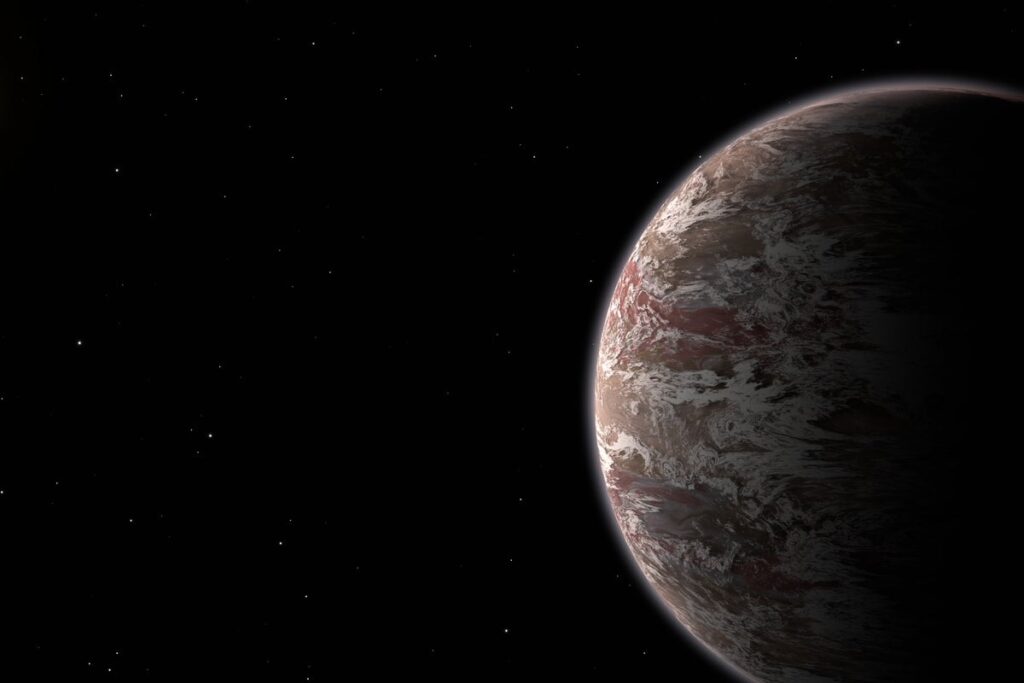
Astronomers have uncovered a Jupiter-like world that likely carries the distinct aroma of urine.
An international team, using the cutting-edge James Webb Space Telescope, has been delving into the atmosphere of Epsilon Indi Ab.
The gas giant, located several light-years away, is roughly 7.6 times the mass of Jupiter but similar in size.
It orbits its star at a much greater distance than many exoplanets, resulting in a relatively cool temperature range of between -70C and +20C.
During their observations, the team made a surprising discovery: alongside an ammonia-rich atmosphere, they detected clouds of water. Such water clouds are not typically incorporated into many existing exoplanet atmosphere models, given their complex nature.
Elisabeth Matthews from the Max Planck Institute for Astronomy, lead author of the study, said: “JWST is finally allowing us to study solar-system analogue planets in detail. If we were aliens, several light years away, and looking back at the Sun, JWST is the first telescope that would allow us to study Jupiter in detail.
“For studying Earth in detail, we would need much more advanced telescopes, though.”
James Mang of the University of Texas at Austin said: “What once seemed impossible to detect is now within reach, allowing us to probe the structure of these atmospheres, including the presence of clouds.
“This reveals new layers of complexity that our models are now beginning to capture, and opens the door to even more detailed characterisation of these cold, distant worlds.”
The less appealing aspect lies in the atmospheric composition. Ammonia and water are primary components of urine, with ammonia causing its pungent smell.
This suggests any future visit to Epsilon Indi Ab could be met with an unpleasant smell, particularly if it were to rain.
Nasa’s planned Nancy Grace Roman Space Telescope, expected later this decade, may directly detect such reflective clouds.
This could confirm if Epsilon Indi Ab is a world best left off humanity’s travel itinerary.