
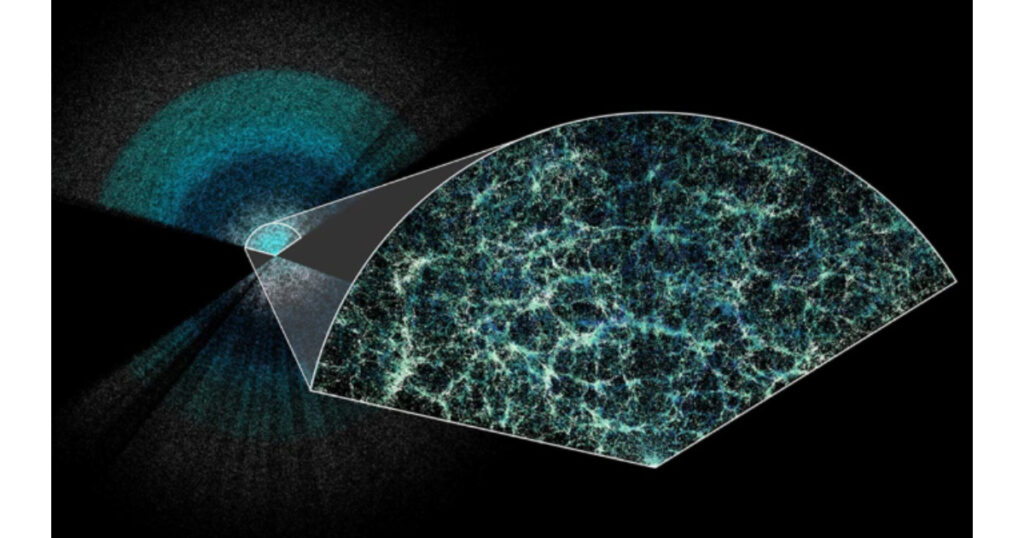
Dark Energy 3D Map is not a phrase that usually makes headlines, but this week it does, and for good reason.
Record‑breaking map of the cosmos
Astronomers have announced that the Dark Energy Spectroscopic Instrument (DESI) has completed a five‑year campaign to build the largest Dark Energy 3D Map of the Universe ever made. Mounted on the 4‑metre Nicholas U. Mayall telescope at Kitt Peak National Observatory in Arizona, DESI uses 5,000 robotic fibre‑optic “eyes” to lock onto distant objects and collect their light every 20 minutes.
Over the course of the survey, DESI measured the spectra and redshifts of more than 47 million galaxies and quasars, along with around 20 million stars in our own Milky Way. The Dark Energy 3D Map traces the large‑scale structure of the cosmos across 11 billion years of cosmic history, offering a high‑resolution view of how matter has clumped and spread as the Universe expanded.
Dark Energy 3D Map challenges old ideas
The core aim of the Dark Energy 3D Map is to probe dark energy, the mysterious component thought to make up about 70 percent of the Universe and to drive its accelerating expansion. Early analysis of DESI data suggests that dark energy may not be perfectly constant, raising questions about the long‑standing “cosmological constant” model that underpins standard cosmology.
When DESI’s measurements are combined with other observations, such as the cosmic microwave background and supernova surveys, researchers see hints that the influence of dark energy could be evolving over time. If confirmed, scientists say this would amount to a genuine paradigm shift in physics, forcing a rethink of theories about the ultimate fate of the Universe.
What comes next for the Dark Energy 3D Map
For now, the Dark Energy 3D Map is just the starting point for years of detailed analysis. Hundreds of researchers across dozens of institutes will mine the data to test dark energy models, study dark matter and refine measurements of how fast the Universe has expanded at different epochs.
Scientific papers based on the full five‑year dataset are expected to appear over the coming years, with major cosmology results already targeted for around 2027. Whatever those studies conclude, the Dark Energy 3D Map is already redefining how we see the cosmos, and may yet rewrite the story of how it began and how it will end.