
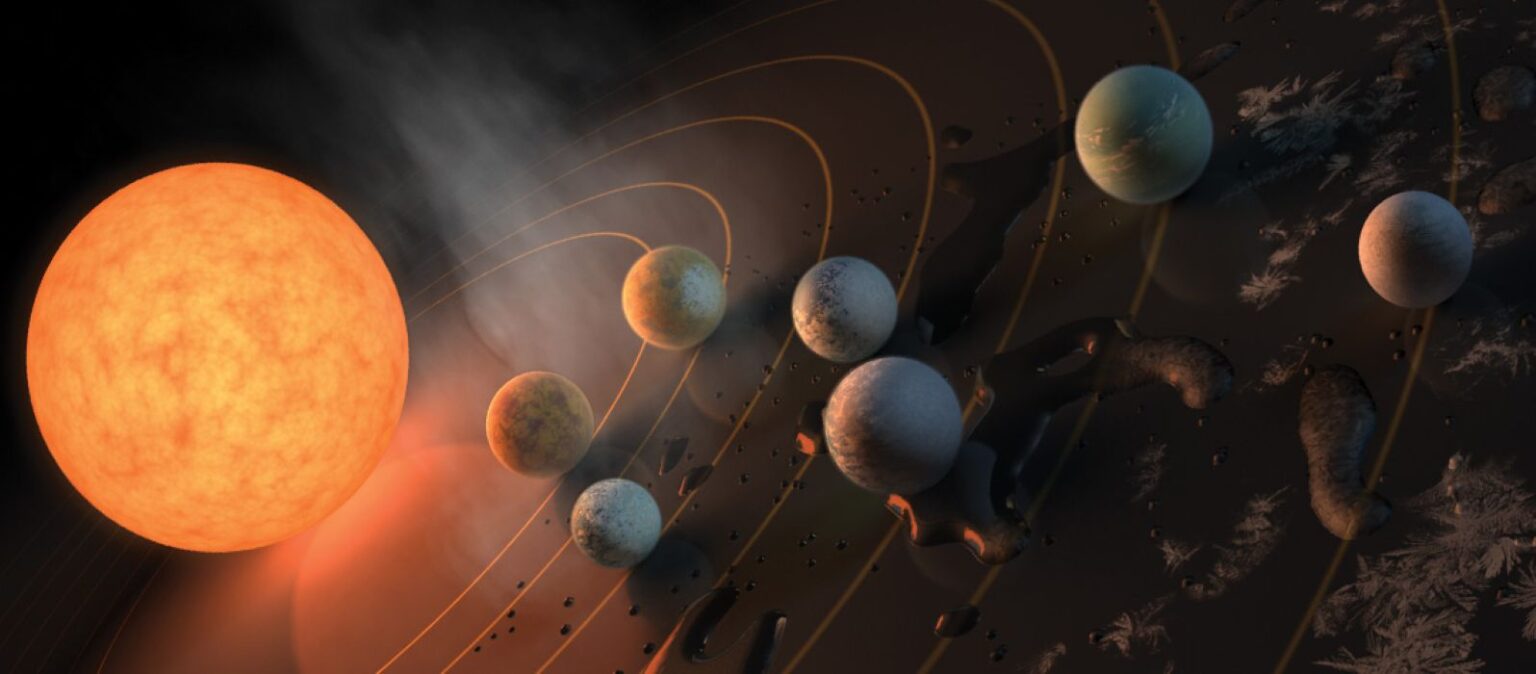
Using JWST data, an international team has, for the first time, successfully mapped the climates of two rocky exoplanets with masses similar to Earth’s. These two planets, TRAPPIST-1b and TRAPPIST-1c, belong to the iconic TRAPPIST-1 planetary system, discovered ten years ago.
The TRAPPIST-1 system, located about 40 light-years away, contains seven rocky planets orbiting a small, cool red dwarf star known as TRAPPIST-1
The two planets are likely devoid of atmospheres, as the temperature difference between day and night exceeds 500°C. TRAPPIST‑1b has a very hot dayside (about 490 K) but no detectable glow from its nightside, suggesting it’s a dark, airless world. TRAPPIST‑1c is cooler (about 369 K) with a similarly cold nightside, which could mean it either has a thin, oxygen‑rich atmosphere or a shiny, airless surface.
Ongoing observations have ruled out the idea of thick atmospheres, confirming that the harsh conditions around their stars significantly impact planetary evolution.
Emeline Bolmont, associate professor in the Department of Astronomy at the Faculty of Science, director of the Center for Life in the Universe (CVU) at the UNIGE, and co-author of the study, said, “The TRAPPIST-1 system is incredible! Seven planets, some with masses similar to Earth’s, orbit the same star. It is the perfect playground for comparative planetology, unraveling the mysteries of this type of planet and testing our hypotheses about the development of life around these stars.”
By measuring the light from TRAPPIST-1 and its planets “b” and “c,” astronomers precisely determined the surface temperatures on both their day and night sides.
TRAPPIST-1b and TRAPPIST-1c show extreme temperature differences. During the day, temperatures soar above 200°C, while at night they drop to nearly -100 °C. This difference suggests no energy transfer between the two sides, indicating the planets likely lack atmospheres. Harsh stellar conditions likely stripped away any atmospheres these worlds had during formation.
The absence of thick atmospheres on the two inner planets of the TRAPPIST-1 system supports the idea that intense radiation and energetic bursts from red dwarfs significantly influence planetary evolution around these stars.
But what about the more distant planets in the habitable zone? The JWST is currently observing planet “e,” which sits in the star’s habitable zone-the region around the star where conditions might be just right for liquid water to exist on the surface, making it a key area for potential habitability.
Emeline Bolmont said, “TRAPPIST-1 serves as a reference system. Our theoretical models show that the outermost planets in the TRAPPIST-1 system can possess atmospheres despite the absence of atmospheres on the two inner planets. This is similar to Mercury, the closest planet to our Sun, which has no atmosphere, while Venus and Earth have retained theirs.“
“We look forward to continuing the exploration of the TRAPPIST-1 system!“
Journal Reference:
Gillon, M., Ducrot, E., Bell, T.J. et al. No thick atmosphere around TRAPPIST-1 b and c from JWST thermal phase curves. Nat Astron (2026). DOI: 10.1038/s41550-026-02806-9