
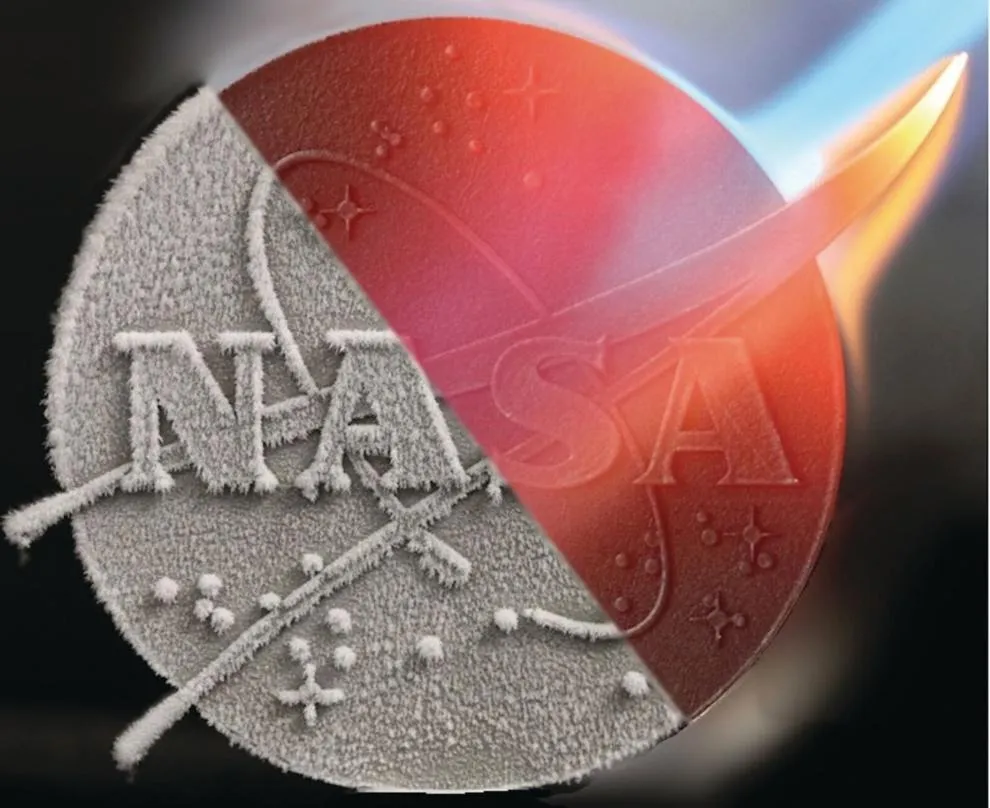
A NASA-funded collaboration between the University of Utah, the Pennsylvania State University (PSU), and Colorado-based Elementum 3D is working to unlock reliable manufacturing and repair pathways for GRX-810, a high-performance alloy designed for the extreme heat and reactive conditions inside rocket engines.
The project is supported through NASA’s Small Business Technology Transfer (STTR) Phase I program, a federal funding mechanism designed to accelerate early-stage technology development. At its technical core is cold spray additive manufacturing, a process that propels metal particles at high velocities to progressively build dense coatings or bulk structures without the thermal damage associated with fusion-based methods.
The industries with the most direct stake in this research are aerospace, space, defense, and energy, sectors defined by components that must perform reliably under extreme conditions.
A NASA-Developed Alloy and the Bonding Problem at Its Core
The material at the center of the project is GRX-810, recognized as NASA’s Commercial Invention of the Year. Developed to withstand sustained exposure to extreme temperatures and oxidative environments, the alloy has demonstrated strong performance credentials, yet the fundamental behavior of its particles during cold spray deposition remains insufficiently understood. Establishing that understanding is a prerequisite for building the repeatable, scalable manufacturing and repair processes the aerospace and defense sectors require.
The collaboration is structured around complementary expertise. Elementum 3D provides GRX-810 feedstock material and contributes an applied manufacturing perspective that grounds the research in industrial relevance. Penn State leads cold spray process development, focusing on how deposition parameters translate into structural outcomes.
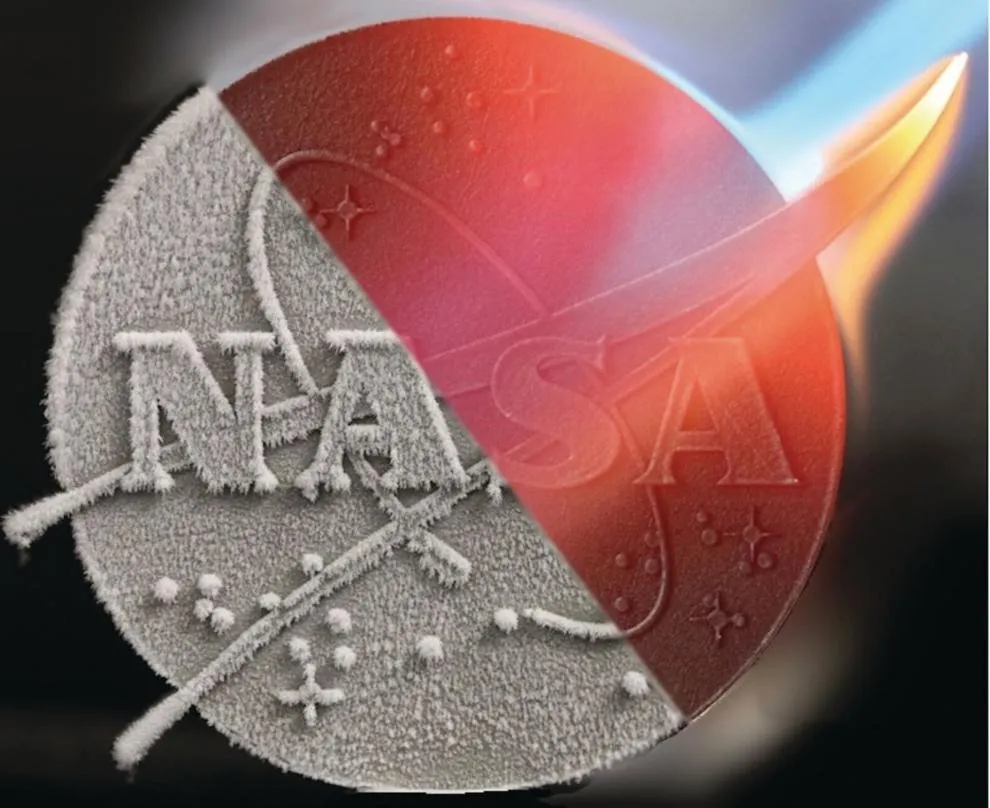 GRX-810, a new metal alloy developed by NASA. Image via NASA.
The University of Utah’s STARS Lab, directed by Dr. Suhas Eswarappa Prameela within the Department of Materials Science and Engineering, approaches the problem at the particle level, using a Laser-Induced Particle Impact Test system to isolate and examine the variables governing whether individual particles bond, deform, or rebound on contact.
Particle chemistry, microstructure, surface condition, impact velocity, and temperature all factor into that outcome, and mapping their combined influence is the scientific foundation on which full-scale process optimization will depend.
“Complex problems like these cannot be solved in isolation,” Dr. Prameela said. “Engaging with people who bring different tools, perspectives, and expertise is essential.”
Phase I covers 13 months, with a Phase II award possible for further scale-up. The end goal is a manufacturing and repair pathway for extreme-environment components with direct relevance to NASA’s space programs and future deep-space propulsion systems.
Closing the Manufacturing Gap for a Next-Generation Alloy
GRX-810 is an oxide dispersion-strengthened alloy developed at NASA’s Glenn Research Center that has redefined what high-temperature materials can deliver. In an interview with Principal Engineer Paul Gradl, he explained the alloy achieves over 1,000 times improvement in creep resistance at temperatures around 1,100°C. GRX-810’s combination of strength, ductility, creep life, and heat resistance is unmatched among available superalloys. Commercialization has already begun: 3D Systems validated the alloy’s properties on a commercial Direct Metal Printing platform, and Powder Alloy Corporation moved to distribute it for satellite components, spacecraft structures, and propulsion systems.
But material availability and manufacturing capability are not the same thing. GRX-810 has been qualified almost exclusively for laser-based additive processes, leaving cold spray, the one technique that can both fabricate and repair components in service, without the scientific foundation it needs to be used reliably. For reusable propulsion systems, where extending component life directly reduces mission costs, that is a big gap.
The U.S. Department of Defense has already backed cold spray field demonstrations in extreme environments through its Point of Need Manufacturing initiative, confirming the technology’s readiness for operational use. What remains missing is the particle-level understanding of how GRX-810 specifically behaves under those conditions, and without it, neither manufacturing nor repair at scale is viable. That is precisely what this collaboration sets out to establish.
3D Printing Industry is inviting speakers for its 2026 Additive Manufacturing Applications (AMA) series, covering Energy, Healthcare, Automotive and Mobility, Aerospace, Space and Defense, and Software. Each online event focuses on real production deployments, qualification, and supply chain integration. Practitioners interested in contributing can complete the call for speakers form here.
To stay up to date with the latest 3D printing news, don’t forget to subscribe to the 3D Printing Industry newsletter or follow us on LinkedIn.
Explore the full Future of 3D Printing and Executive Survey series from 3D Printing Industry, featuring perspectives from CEOs, engineers, and industry leaders on the industrialization of additive manufacturing, 3D printing industry trends 2026, qualification, supply chains, and additive manufacturing industry analysis.
Featured image shows GRX-810, a new metal alloy developed by NASA. Image via NASA.