
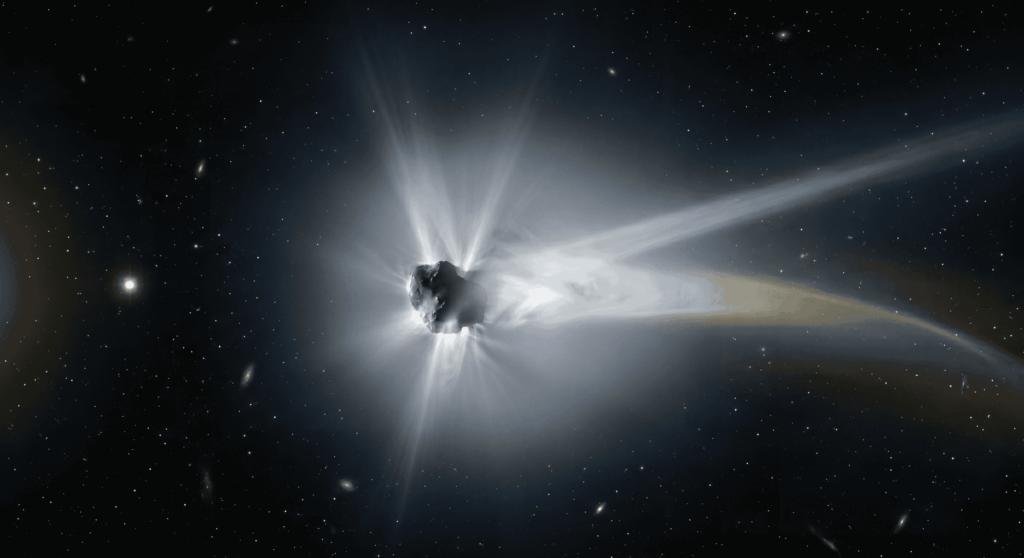
 Illustration of comet 3I/ATLAS shedding water. Credit: ZME Science.
When a hunk of ice from another star system hurtles through our cosmic neighborhood, astronomers pay attention. When that same hunk of ice starts blasting out enough water to fill 70 Olympic swimming pools every single day, they scramble to get every piece of hardware they can to point at it.
I’m referring to the now-famous comet 3I/ATLAS. Discovered plunging through our solar system last summer, this interstellar vagabond recently gave astronomers an unprecedented show. As it swept past the sun late last year, the European Space Agency’s Jupiter Icy Moons Explorer (Juice) — a spacecraft built for a completely different mission — turned its cameras toward the intruder.
The resulting data, which finally trickled back to Earth in February 2026, reveals a frozen relic from the deep past — likely forged over 10 billion years ago — shedding extraordinary amounts of water. Our own Solar System is only 4.5 billion years old. The one-of-a-kind data gives scientists a rare, wet fingerprint of how planets form around alien stars.
A Fire Hydrant in Deep Space
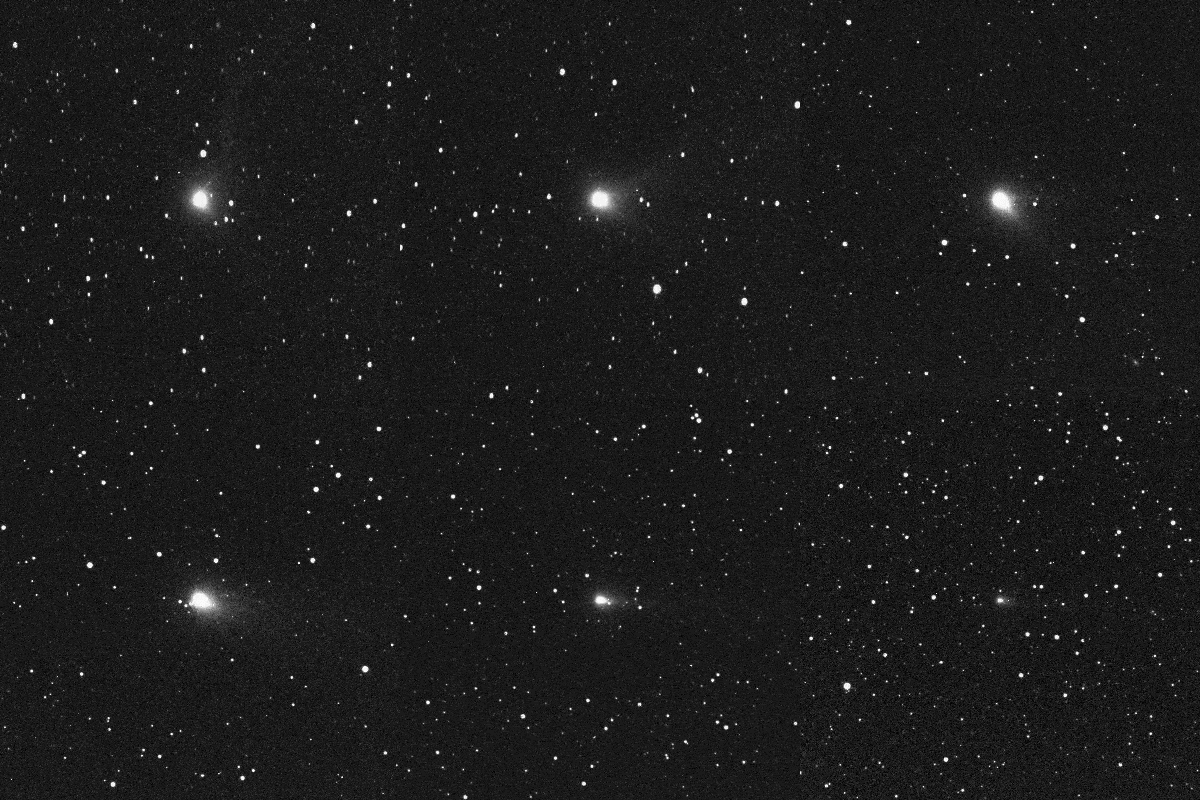 NavCam had a much closer view of 3I/ATLAS, from a different angle to Earth-based telescopes, and when the comet was not visible from Earth. This meant that NavCam images from November 2025 could be lined up to get a better idea of the comet’s changing position and trajectory. Credit: ESA.
Water is a vital building block for life as we know it, making its presence on alien objects from outside the Solar System intensely interesting to scientists.
Usually, comets are dormant blocks of rock and ice. They only wake up when they get close to a star. The intense heat causes their ice to sublimate, flashing directly from a solid into a gas, which creates the brilliant tails we see from Earth.
Yet, 3I/ATLAS woke up early — long before it approached the Sun. While still three times farther out than Earth, the comet began bleeding water. Using NASA’s Neil Gehrels Swift Observatory, researchers detected hydroxyl (OH) emissions, a telltale chemical sign of water. The comet was already leaking water at 40 kilograms per second, according to their reports from October 2025.
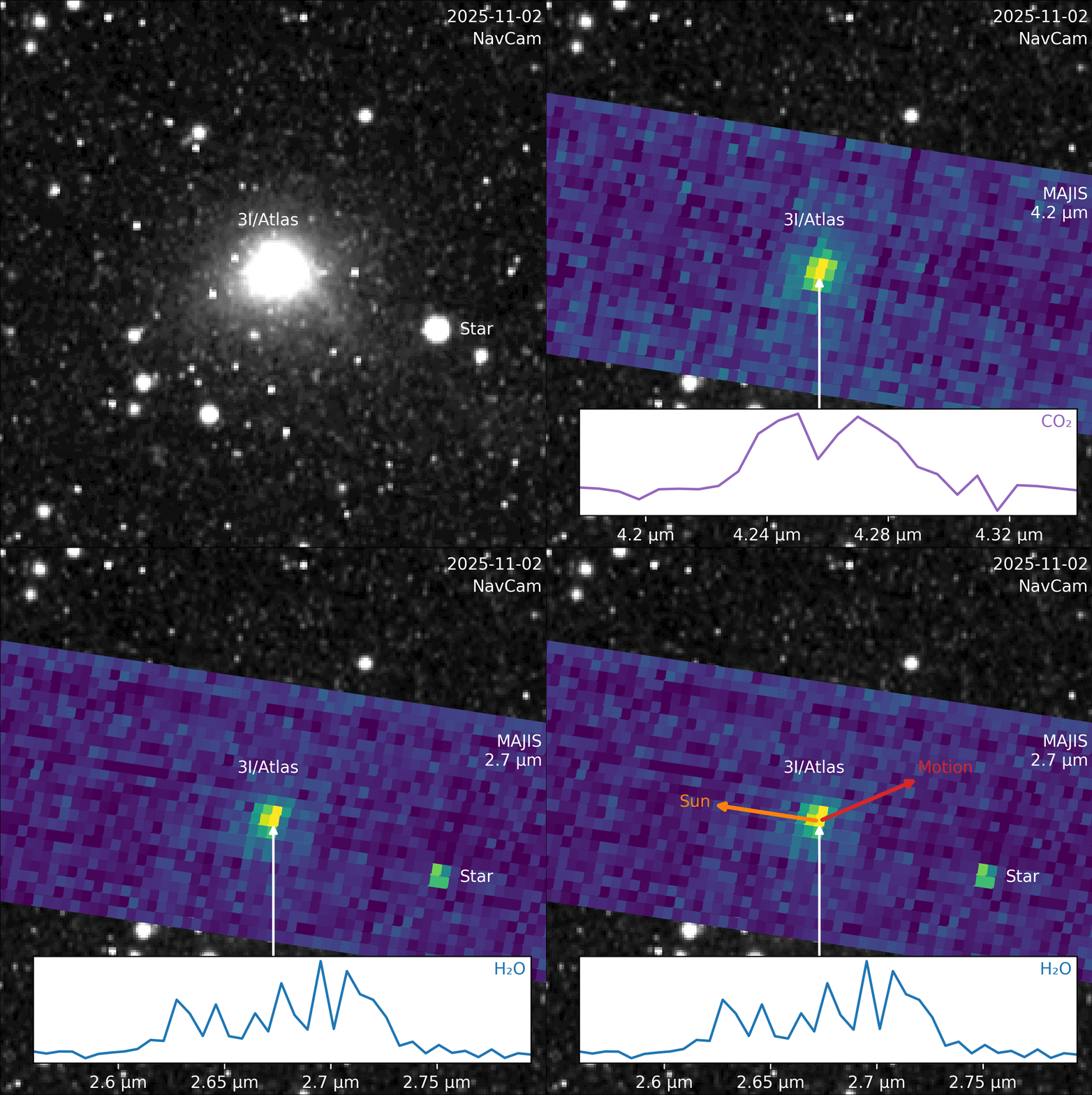 Juice detected water vapour and carbon dioxide from Comet 3I/ATLAS. Credit: ESA.
Researchers compared this early flow to a fire hydrant running at maximum power. This suggests the comet has a fragile structure, perhaps shedding small, easily vaporized chunks of ice into a massive, gassy halo far beyond the usual freeze line.
“When we detect water — or even its faint ultraviolet echo, OH — from an interstellar comet, we’re reading a note from another planetary system,” said Dennis Bodewits, an Auburn University physicist who collaborated on the research from the Neil Gehrels Swift Observatory.
×
Thank you! One more thing…
Please check your inbox and confirm your subscription.
“It tells us that the ingredients for life’s chemistry are not unique to our own.”
Right Place, Right Hardware
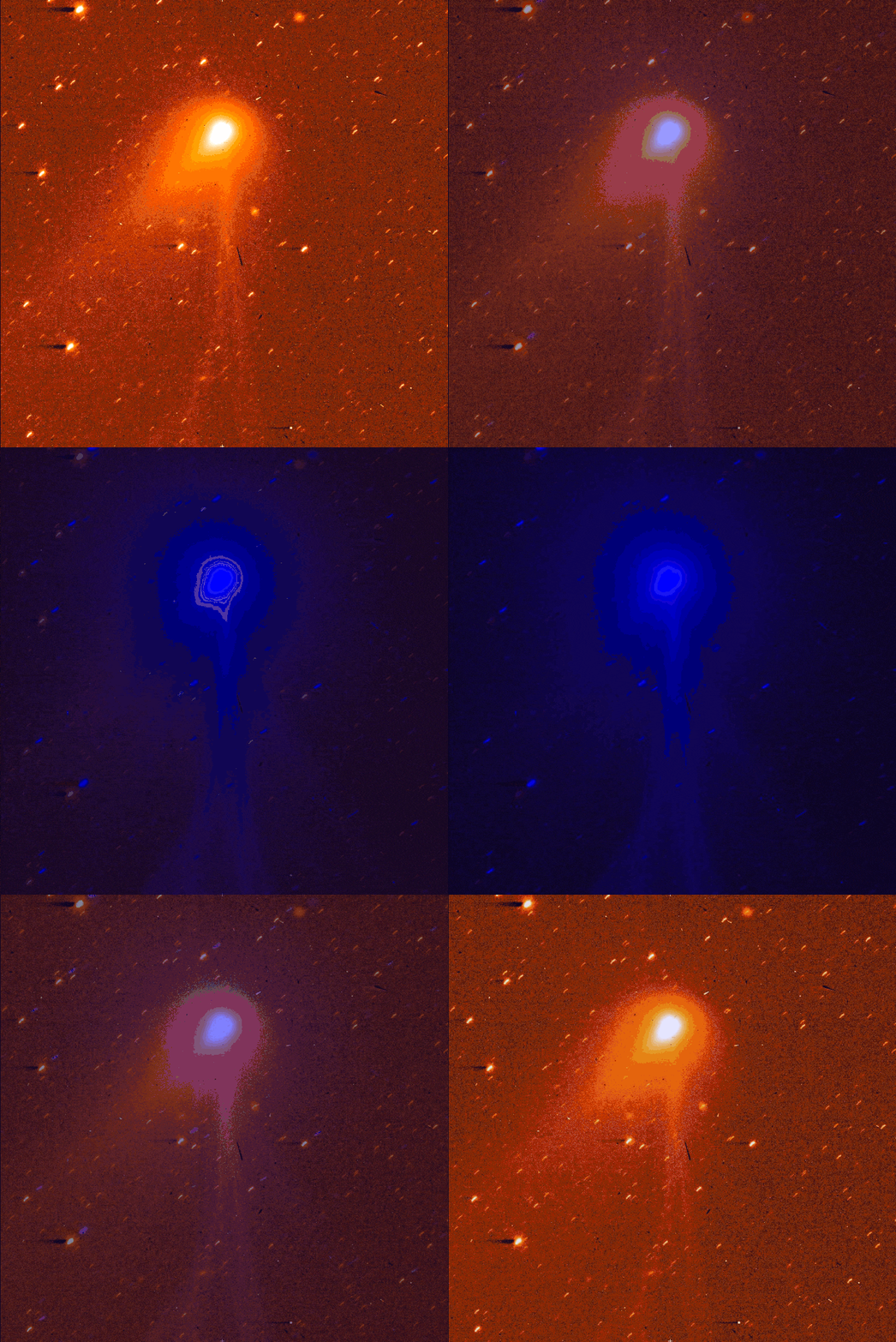 Comet 3I/ATLAS seen through red and violet filters. In the red filter (looking orange in this GIF), the bright centre of the coma is more compact and there are two tails – one straight down, and a fuzzier one going to the lower left. In the violet filter (looking blue in this GIF), the coma is bigger but fainter, and only one tail stands out clearly. The differences arise because different gas and dust particles release or reflect light at different wavelengths. Credit: ESA.
By November 2025, 3I/ATLAS reached its perihelion, its closest pass to the Sun. Earth-based telescopes struggled to observe the comet due to solar glare. Fortunately, the Juice spacecraft was perfectly positioned in deep space.
Mission operators took a calculated risk. They fired up five of Juice’s scientific instruments to observe the comet. It was a serious operational challenge. The observation windows were tight, the signal was weak, and the thermal environment was not ideal for Juice’s sensitive, super-cooled cameras.
“3I/ATLAS is a rare and unexpected visitor, its arrival came as a complete surprise,” says Olivier Witasse, ESA Juice Project Scientist. “But when we realised that Juice would be close to the comet around its closest approach to the Sun, we realised what a unique opportunity this was to collect a once-in-a-lifetime dataset.”
The gamble paid off.
“Observing the comet was challenging, with no guarantee of success, but in the end, it turned into a great bonus for Juice during its journey to Jupiter.”
Rivers in the Void
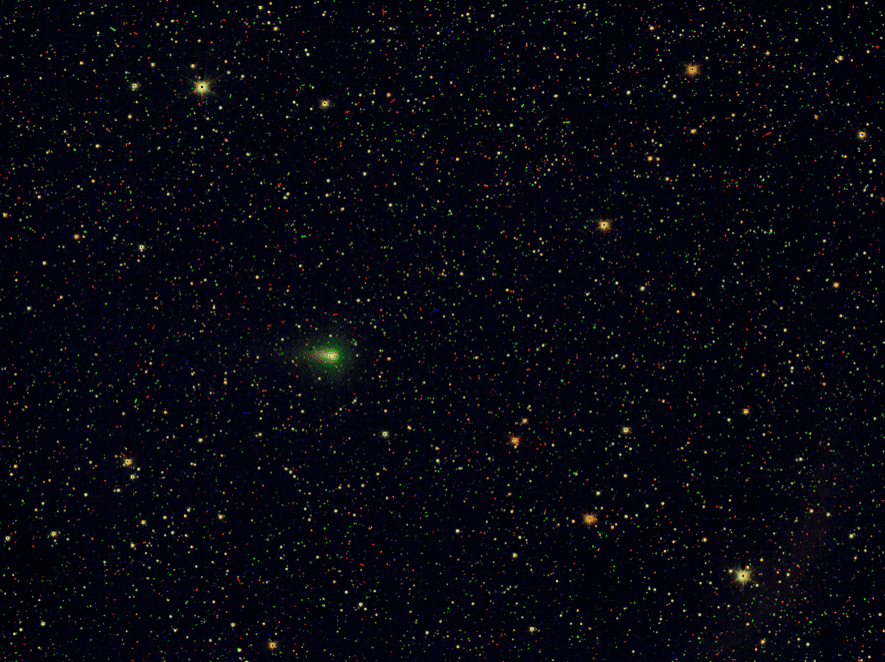 A red-green-blue image of 3I/ATLAS taken by Juice’s high-resolution science camera, JANUS, from more than 180 million km away. The comet seems to glow green, because gases in the halo around the nucleus are shining in light at green wavelengths. Background stars have different colours depending on their temperatures. Credit: ESA.
When Juice beamed its data back to Earth in early 2026, the sheer volume of water coming off the comet stunned researchers.
Juice’s Moons And Jupiter Imaging Spectrometer (MAJIS) locked onto the infrared emissions of water vapor and carbon dioxide.
“Repeated detections of water vapor and carbon dioxide by MAJIS indicate that volatile ices buried beneath the surface were actively released into space shortly after perihelion passage,” team member Giuseppe Piccioni of the National Institute for Astrophysics (INAF) said in a press statement. “From the data collected, we estimated an outflow from the comet’s nucleus of about two tons per second, equivalent to approximately 70 Olympic swimming pools of water vapor ejected into space every day.”
Two tons of water per second is a massive output. While normal comets do shed water, 3I/ATLAS is pushing out volumes on the very high end of expectations for an object its size.
Interestingly, Juice’s Submillimeter Wave Instrument (SWI) revealed that much of this water is not venting directly from the comet’s solid rock nucleus. Instead, it boils off from a surrounding cloud of icy dust grains on the Sun-facing side of the comet.
An Ancient Chemical Fingerprint
The water on 3I/ATLAS is also fundamentally different from the water in our own solar system.
By analyzing the ratio of standard “light” water to “semiheavy” water (HDO), scientists can determine where an object formed. Telescopes like ALMA and Webb previously found this ratio to be extremely high on 3I/ATLAS. This unique chemical fingerprint suggests the comet was born in a brutally cold, ancient environment, battered by intense ultraviolet radiation from young stars.
“Every interstellar comet so far has been a surprise,” said Zexi Xing, an Auburn University researcher and coauthor of the discovery, in a press statement.
“‘Oumuamua was dry, Borisov was rich in carbon monoxide, and now ATLAS is giving up water at a distance where we didn’t expect it. Each one is rewriting what we thought we knew about how planets and comets form around stars.”
Juice’s Ultraviolet Imaging Spectrograph (UVS) recorded elements of water and dust stretching an incredible 5 million kilometers behind the comet’s core.
Anatomy of an Alien Tail
Despite its alien origins, 3I/ATLAS acts remarkably like our own local comets under pressure. Juice’s high-resolution science camera, JANUS, captured the action from 60 million kilometers away.
“We waited a long time, but it was truly worth it,” team member Pasquale Palumbo, an INAF researcher and principal investigator of JANUS, told Space.com. “The wonderful images collected reveal for the first time the comet’s intense activity right around perihelion. 3I/ATLAS showed an extended coma, a tail, and various morphological structures, such as rays, jets, and filaments. The data collected will allow us to study the morphological structures, light intensity, and evolution of the comet’s coma and tail on short and medium timescales.”
The spacecraft’s hardware also proved useful for planetary defense. ESA’s defense team used NavCam — a camera designed to guide Juice around Jupiter’s moons — to track the comet’s trajectory from an angle impossible to achieve from Earth.
Because venting water and dust physically alters a comet’s flight path, these deep-space observations help scientists calculate exactly how much material the interloper is dumping into our solar system.
Looking Ahead to Jupiter
“The MAJIS data will allow us to better understand the activity of this comet after perihelion and the physical and chemical properties of the materials formed around another star billions of years ago,” Piccioni noted.
The Juice spacecraft will go back to sleep soon, not arriving at the Jupiter system until 2031. However, this target of opportunity proved that the probe’s hardware is highly capable of analyzing icy bodies in the harsh environment of deep space.
“The data we are already seeing from Juice’s instruments is really promising,” says co-Project Scientist Claire Vallat. “We are getting more excited about how well they work and how much we will reveal about Jupiter and its icy moons in the 2030s.”