
On January 7, 2026, the Subaru Telescope observed the interstellar comet 3I/ATLAS after it had passed closer to the Sun. By observing the color of the coma surrounding the comet, astronomers were able to estimate the ratio of carbon dioxide to water. This ratio is significantly lower than that derived from previous observations by space telescopes. These results indicate that the chemical composition of the coma changes over time and provide insights into the structure of сomet 3I/ATLAS.
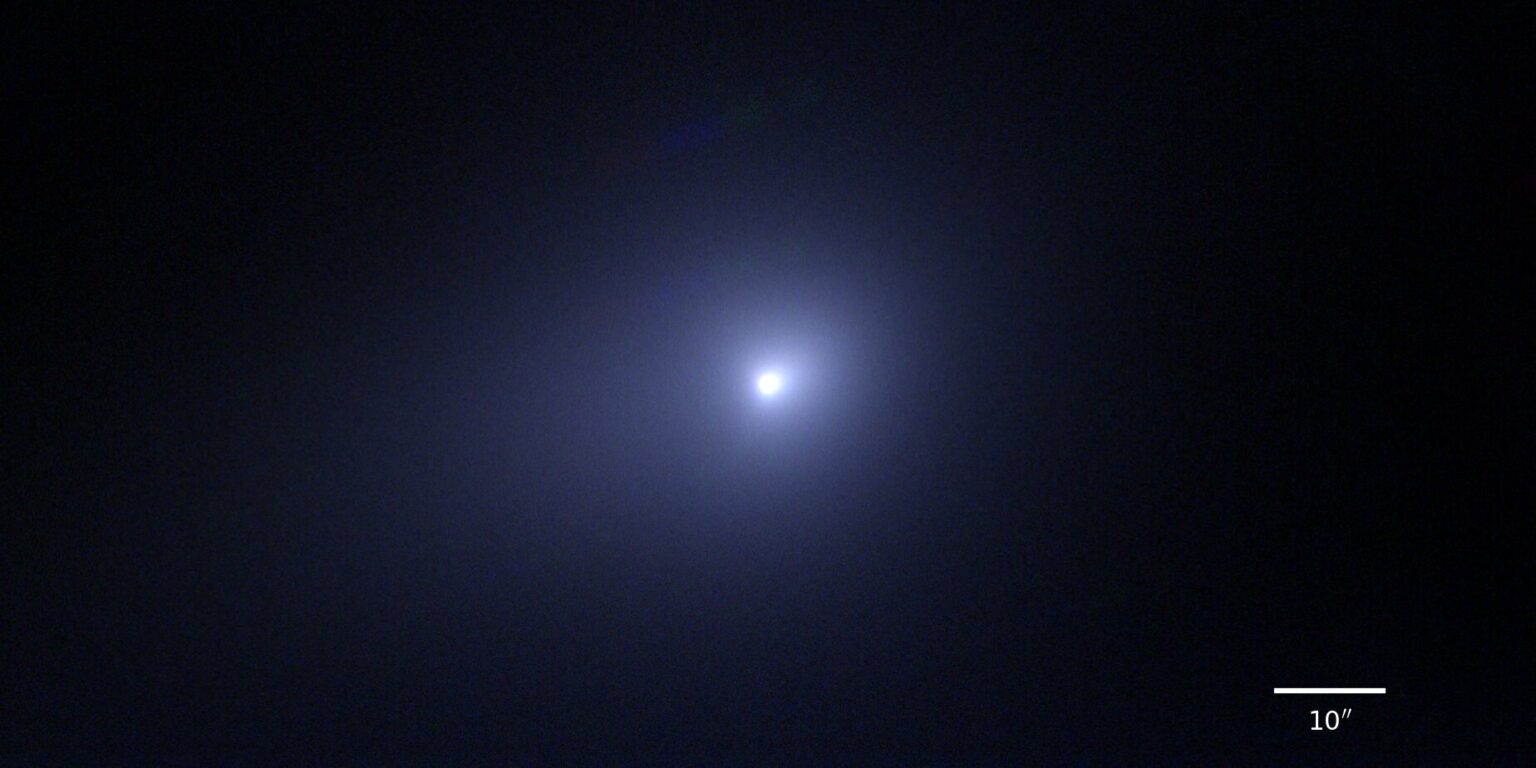 Comet 3I/ATLAS (C/2025 N1). Source: phys.org
The ratio of carbon dioxide to water in the comet’s nucleus
Comet 3I/ATLAS (C/2025 N1) has attracted considerable attention as the third object originating from beyond the Solar System. A research team led by Yoshiharu Shinnaka of the Koyama Institute for Space Science at Kyoto Sangyo University used the Subaru Telescope to observe сomet 3I/ATLAS after its perihelion—the point at which the comet comes closest to the Sun. The team applied analytical methods and the expertise gained from studying comets in the Solar System to the data.
Using this analysis, the team was able to estimate the ratio of carbon dioxide (CO₂) to water (H₂O) in the coma, the cloud of gas surrounding the comet’s nucleus. Since the gas in the coma originates from the nucleus, the composition of the coma provides insight into the composition of the nucleus.
Due to its popularity, the 3I/ATLAS object had already been observed by space telescopes even before it reached perihelion. The CO₂/H₂O ratio calculated from Subaru Telescope data was lower than that indicated by data from space telescopes. This change is consistent with the idea that the composition of the inner part of the core differs from that of the outer part, and when 3I/ATLAS heated up as it passed near the Sun, gas began to escape from different parts of the core.
Application of the developed analytical methods to new interstellar objects
With the full-scale operation of observational telescopes set to begin in the coming years, the discovery of even more interstellar objects is expected. By applying observational and analytical methods developed for studying comets in the Solar System to interstellar objects, astronomers can now directly compare comets originating both within and beyond the Solar System and investigate differences in their composition and evolution.
By studying these objects, scientists hope to gain a deeper understanding of how planetesimals and planets formed in a wide variety of star systems, including our own Solar System.
According to phys.org