
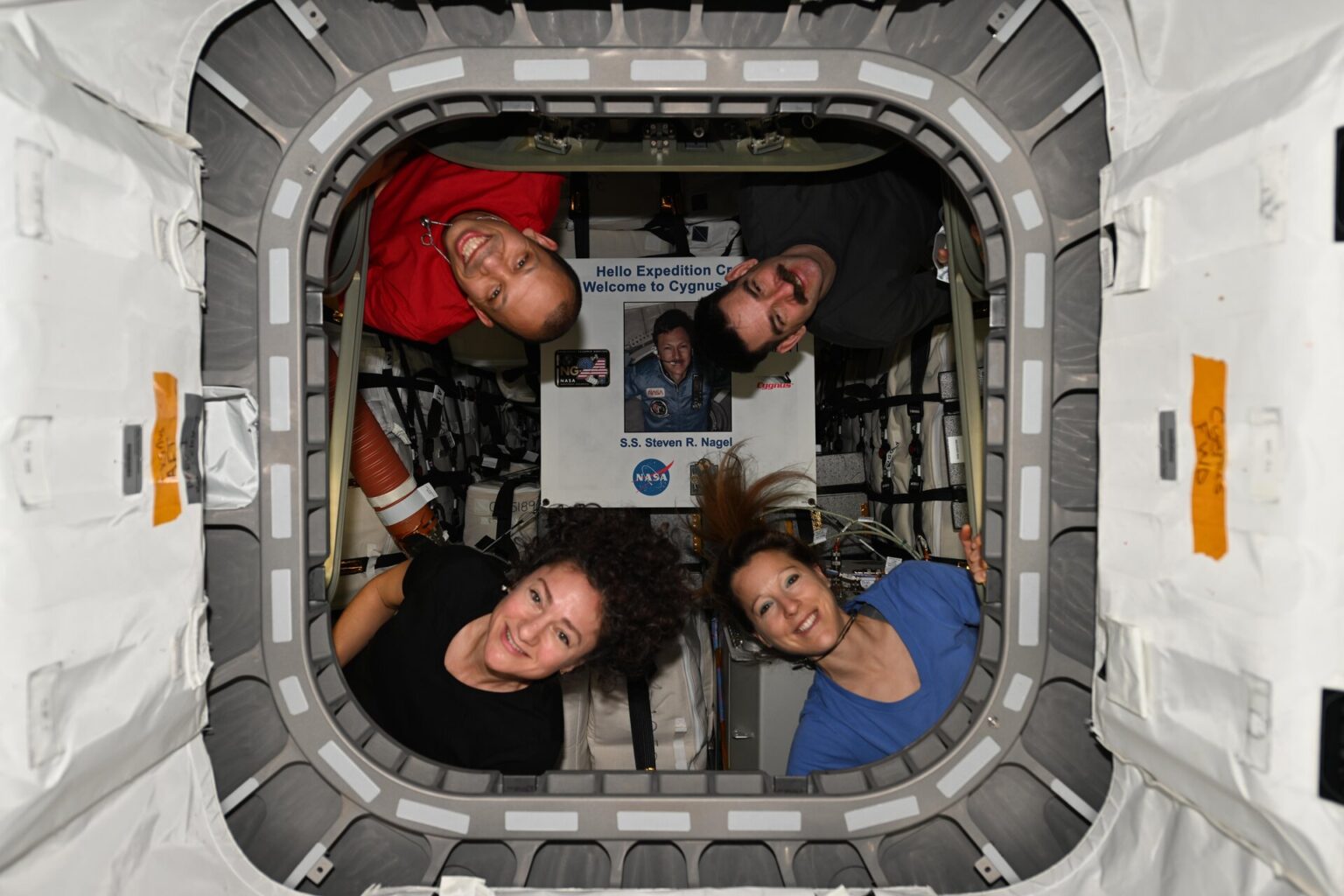
ESA astronaut Sophie Adenot and NASA astronauts Jack Hathaway, Jessica Meir and Chris Williams take a moment to capture the occasion as they first open the Cygnus NG‑24 cargo spacecraft after its installation on the International Space Station.
“I love these moments when the whole crew comes together around an event like this. Welcoming a cargo vehicle is such a special experience: you know you’ll be receiving care packages from teams and families, along with a wealth of scientific experiments – and maybe even some fresh fruit too,” says Sophie Adenot.
Cygnus NG‑24 is delivering around five metric tonnes of scientific experiments, spare parts and supplies to the Station, including several European experiments:
E4D (European Enhanced Exploration Exercise Device) – a compact, modular and multi‑modal exercise system that enables a broader and more adaptable range of resistance exercises including cycling, rowing, resistance training, as well as rope‑pulling and climbing movements, even when unpowered.
LUX in Space – a pioneering research project dedicated to studying DNA repair processes in microgravity.
MatISS‑4 – the latest generation of a passive experiment designed to characterise airborne bio‑contaminants aboard the Station and to test innovative materials and coatings capable of trapping or repelling this contamination.
ChlorISS – an educational experiment that will germinate thale cress and mizuna seeds aboard the Station, carried out simultaneously by Sophie Adenot and in 4,500 classrooms on Earth.
Northrop Grumman’s Cygnus NG‑24 cargo spacecraft launched on 11 April at 11:41 GMT/ 13:41 CEST from NASA’s Kennedy Space Center in Florida. Cygnus was captured on 13 April at 17:20 GMT/ 19:20 CEST by NASA astronaut Chris Williams, with assistance from NASA astronaut Jack Hathaway, using the Station’s Canadarm2 robotic arm.