
Not black, despite what the night sky may suggest.
The vast expanse of the universe that separates stars and galaxies—space as we know it—looks black to the human eye, as it is mostly empty. The stars and galaxies that produce light are extremely far apart, and the light that reaches the Earth is scattered and faint. As a result, when we look up at the night sky, we mostly see darkness between small, distant points of light. This darkness is simply the absence of nearby light sources and not the true average color of the universe. But if all the visible light from all the distant sources is collected and averaged, it forms a color measurable by the CIE system.
What Is the CIE System?
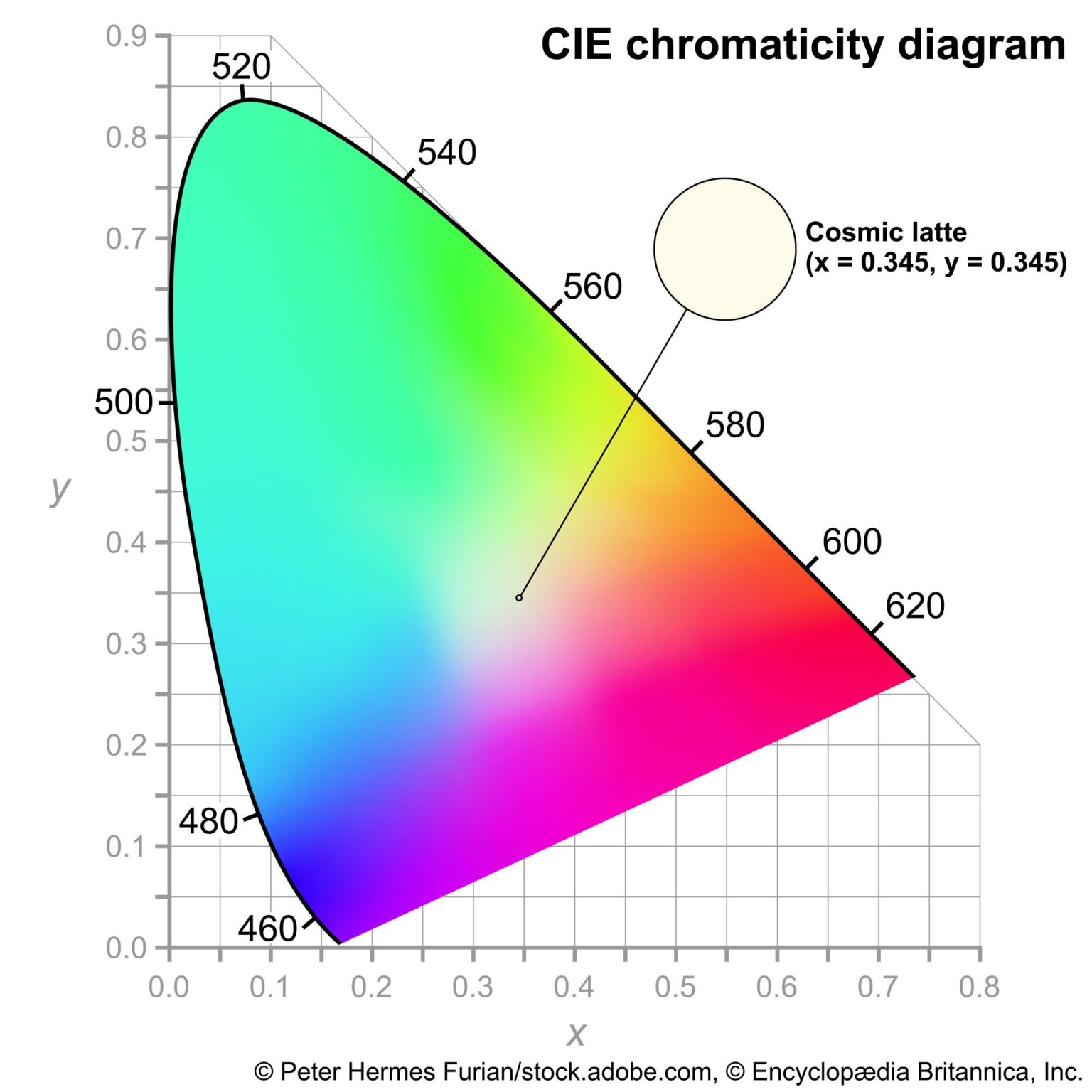
The CIE (Commission Internationale de l’Éclairage) system is the internationally recognized standard for describing and measuring color created in 1931. It measures color by analyzing the light reflected or emitted by an object and calculating how the average human eye would perceive that light. It converts this information into three standardized numerical values, called the tristimulus values, which specify the amounts of the primary colors red, green, and blue required to match a specific color as perceived by the human eye. These values place any color within a universal color space, allowing colors to be compared, reproduced, and communicated accurately across different media and lighting conditions.
In the early 2000s astronomers analyzed the light from more than 200,000 galaxies using data from 2dF Galaxy Redshift Survey—a major astronomical project that mapped a large volume of the universe. They combined the light coming from these galaxies in the local or observable universe into a single “cosmic spectrum,” which showed how much light exists at different wavelengths. By converting this spectrum into a color that humans can see, the astronomers calculated the average color of the universe.
Represented by the coordinates ( x = 0.345 , y = 0.345 ) on the CIE chromaticity diagram, this color can be described as a shade of beige or off-white. Because of its similarity to the color of coffee with milk, the astronomers informally named it “cosmic latte.” It can be represented by the color code #FFF8E7.
Did You Know?
An initial calculation error led astronomers to describe the universe’s color as “cosmic spectrum green,” a shade between turquoise and aquamarine.
As the average color of all the light from stars and galaxies in the observable universe, cosmic latte reflects the types of stars that are most common today. Many stars are middle-aged and emit reddish light, which makes the combined glow of galaxies appear beige rather than bright blue or pure white. In the younger universe, more hot, blue stars were present, giving it an overall bluer color. As existing stars age and fewer new ones form, the combined light becomes progressively redder—a trend astronomers expect to continue.