
There is a question so fundamental that most of us have stopped noticing it: why is there something rather than nothing? For most of human history, that question belonged to philosophy and theology. As shown in the forthcoming theatrical documentary The Story of Everything (out on April 30), what is remarkable about the last century of physics and cosmology is that science itself has walked directly into the picture. And the answer the evidence points toward is not the one the scientific establishment expected or, in many cases, wanted.
The Pale Blue Dot and the Limits of Scientific Authority
Before examining what the cosmological evidence actually shows, it is worth pausing on the philosophical frame that has shaped how most educated people in the Western world have been taught to think about our place in the universe. No one stated that frame more memorably than Carl Sagan, reflecting on the famous photograph of Earth taken by the Voyager 1 spacecraft in 1990 as it reached the edge of the solar system. In that image, Earth appears as a tiny, barely visible point of light suspended in a vast darkness. Sagan called it the pale blue dot and drew from it a sweeping conclusion: that we are insignificant, that our world is a mote of dust suspended in a sunbeam, that the idea we are central to the universe, or that the universe exists for our sake, is — in his word — pathetic.
A Philosophical Assertion
It is a rhetorically powerful statement, but not a scientific one. Sagan was a brilliant astronomer and science communicator, but the move from “Earth is small relative to the cosmos” to “therefore humanity is insignificant” is not a scientific inference. It is a philosophical assertion, and not a particularly well-supported one. Size is not the measure of significance. A library is not more meaningful than the books inside it. A map is not more important than the territory it describes. Sagan’s training gave him deep expertise in planetary science and astronomy. It did not give him special authority to present a philosophical conclusion as though it were a scientific finding. It is precisely the kind of category error that The Story of Everything is concerned to correct.
Display “The Story of Everything | Official Trailer” from YouTube
More importantly, the cosmological evidence points in exactly the opposite direction from Sagan’s conclusion. The universe is not large in spite of us — it is large, in part, because of what it takes to produce us. A universe capable of generating the conditions for life on Earth requires a specific age, a specific size, a specific distribution of matter, and a specific set of physical constants, all calibrated within extraordinarily narrow tolerances. The heavy elements that make up our bodies — carbon, oxygen, iron — had to be forged inside multiple generations of stars, requiring billions of years of stellar evolution before a solar system like ours could form with the chemical richness life requires. A younger, smaller universe would not have had time to produce them. A universe with slightly different physical constants would never have produced stable stars at all. Far from rendering us insignificant, the scale of the cosmos turns out to be one of the many features the universe needed to have in order for us to be here. The pale blue dot, it turns out, required a universe of this exact size and complexity to exist. That is not insignificance. That is the opposite of insignificance, and recognizing it required not less science than Sagan had, but more.
The Universe That Would Not Stand Still
In 1915, Albert Einstein published his general theory of relativity, revolutionizing our understanding of gravity and, with it, the structure of the cosmos. But when Einstein applied his own equations to the universe as a whole, they produced an uncomfortable result: the universe could not be static. It had to be either expanding or contracting. This was deeply troubling to Einstein, who shared the assumption common to nearly all scientists of his era — that the universe was eternal, self-existent, and had always been as it is. To eliminate the implication of a dynamic universe, he introduced what he called the cosmological constant, an arbitrary mathematical term inserted into his equations to force them to describe a static, eternal universe. It was, as he would later confess, the greatest blunder of his scientific career.
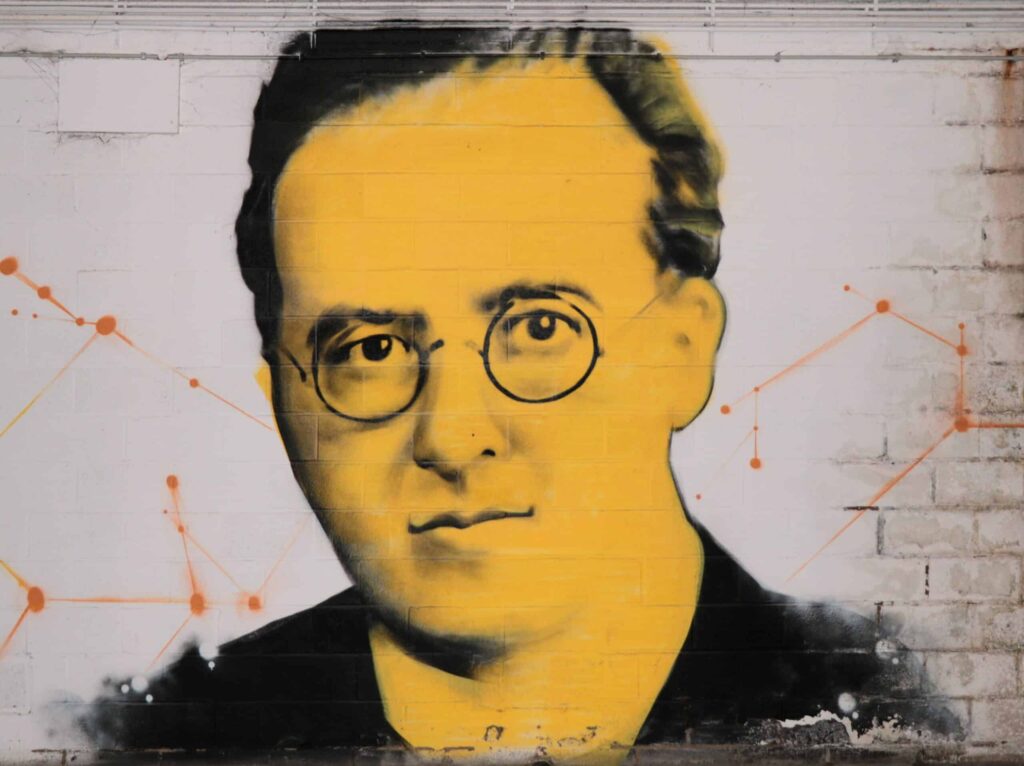
The correction came from an unlikely figure: Georges Lemaître, a Belgian physicist who was also a Catholic priest. Working independently with Einstein’s equations, Lemaître recognized that their most natural implication was an expanding universe, and he was also aware of the red shift data coming from astronomer Vesto Slipher, which showed that distant galaxies were moving away from us. Lemaître pulled these two lines of evidence together and formulated what would eventually become known as the Big Bang theory. When Einstein resisted, accusing Lemaître of being driven by his theological commitments rather than the evidence, Lemaître pushed back. The evidence, he insisted, was on his side. By 1931, after viewing the data from Edwin Hubble’s telescope at Mount Wilson, Einstein publicly acknowledged that the universe was expanding. The cosmological constant — his attempt to hold the universe still — was abandoned. If the universe is expanding, then running the clock backward leads inevitably to a point of origin: a moment before which there was no matter, no energy, no space, and no time. The universe had a beginning.
Hawking’s Proof and Its Uncomfortable Implication
The mathematical confirmation of that beginning came from a young Stephen Hawking. Working on his PhD at Cambridge in the 1960s while already battling the early stages of ALS, Hawking developed the concept of the spacetime singularity — a point of infinite density and infinitely tight curvature that marks the absolute boundary of the universe in the reverse direction of time. As physicist Frank Tipler explains in The Story of Everything, the singularity is not a point within space and time; it is a point outside of space and time. Before it, there was nothing — no material substrate, no physical laws operating on anything, no causal antecedents within the natural order. The universe simply begins.
The philosophical implication is immediate and inescapable. As philosopher of science Stephen Meyer observes, any cause of the universe must be external to it — transcendent of matter, energy, space, and time. Whatever brought the universe into existence cannot itself be a physical thing, because physical things are precisely what came into existence at the beginning. This is not a theological assertion smuggled into science; it is a direct logical consequence of what Hawking’s own mathematics demonstrated.
Hawking recognized the implication and spent much of the rest of his career trying to evade it. His most prominent attempt came in his book The Grand Design, in which he argued that because there is a law such as gravity, the universe could create itself from nothing. Oxford mathematician John Lennox identifies the problem immediately: that is not nothing. A law of gravity is something. And a law, in any case, has no causal power of its own. It describes how matter behaves; it does not bring matter into existence. The Russian physicist Alexander Vilenkin has pressed the same point: in the absence of space, time, and matter, on what tablets could these laws be written? Gravity did not exist before the universe began. It cannot, therefore, be the cause of the universe’s beginning. The attempt to make it so is not physics — it is philosophy, and not very good philosophy at that. As Meyer puts it, if the material universe arose from a set of mathematical equations, and mathematical equations exist in minds, then we are essentially saying the universe came from a mind.
The thought experiment of the universe-creating machine — a vast room filled with dials and sliders, each representing one of the fundamental physical constants, each set to a precise value — captures what the equations are actually telling us. Adjust any one of those dials by the smallest increment, and the universe becomes hostile to life. The precision is not approximate. It is, in many cases, specified to one part in tens of millions, or far beyond. That level of calibration, across dozens of independent parameters, is not what an unguided process looks like. It is what intention looks like.
Not an Explosion, But a Controlled Release
One of the most important corrections the documentary makes is to the popular image of the Big Bang as a chaotic explosion — a random, undirected blast that happened to produce, by extraordinary luck, a universe capable of harboring life. That picture is almost exactly backwards. As philosopher Jay Richards observes, the initial moment of the universe was not an emergence from chaos into order, but the reverse: a moment of exquisite precision and order from which everything since has unfolded. Roger Penrose calculated the initial entropy of the universe — the degree to which its arrangement of matter and energy was specifically ordered rather than randomly distributed — and arrived at a number so staggering it is almost meaningless to state: one chance in ten to the power of ten to the 123rd power. This is not the signature of an explosion. It is the signature of intentional specificity.
Meyer offers an instructive analogy. When civil engineers blast a tunnel through a mountainside, the explosive charges are not simply detonated. They are configured with precision — positioned and timed so that the energy is directed exactly where it is needed, removing the right rock in the right place to produce a passage rather than a pile of rubble. The Big Bang, understood properly, looks far more like the first of those than the second. An unguided explosion radiates outward with no purpose for what comes next. What the cosmological evidence describes is something altogether different: a process in which the end was, in some meaningful sense, present in the beginning.
The scientists who resisted this conclusion were not, in most cases, following the evidence. They were following a philosophical preference for a universe that needed no explanation beyond itself. Einstein adjusted his equations to avoid it. Hoyle spent his career constructing alternatives to it. Hawking devoted decades to circumventing the implications of his own proof. And yet, as physicist Bijan Nemati observes, it is as though the scientific community has been forced, against its inclinations, to accept that the universe is not eternal and that it had a beginning. The question that beginning raises is one that cosmology alone cannot answer: what, or who, was there before?
Following the Evidence
We may be at another Lemaître moment. Just as the expanding universe forced a reluctant scientific establishment to accept that the cosmos had a beginning, the evidence of fine-tuning, of initial conditions calibrated to a precision that no physical process can account for, and of mathematical laws that require a mind to give them meaning, is pressing toward a second conclusion that the establishment is equally reluctant to accept: that the beginning had a cause, and that the cause was a mind. The question is whether the scientific community will finally follow the evidence where it leads.