
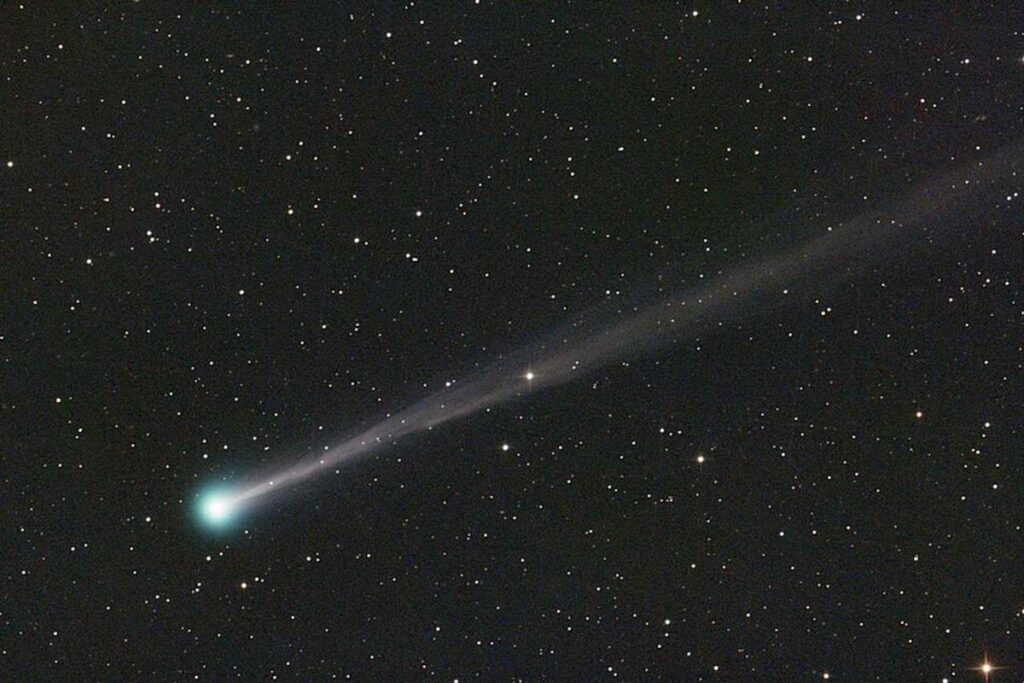
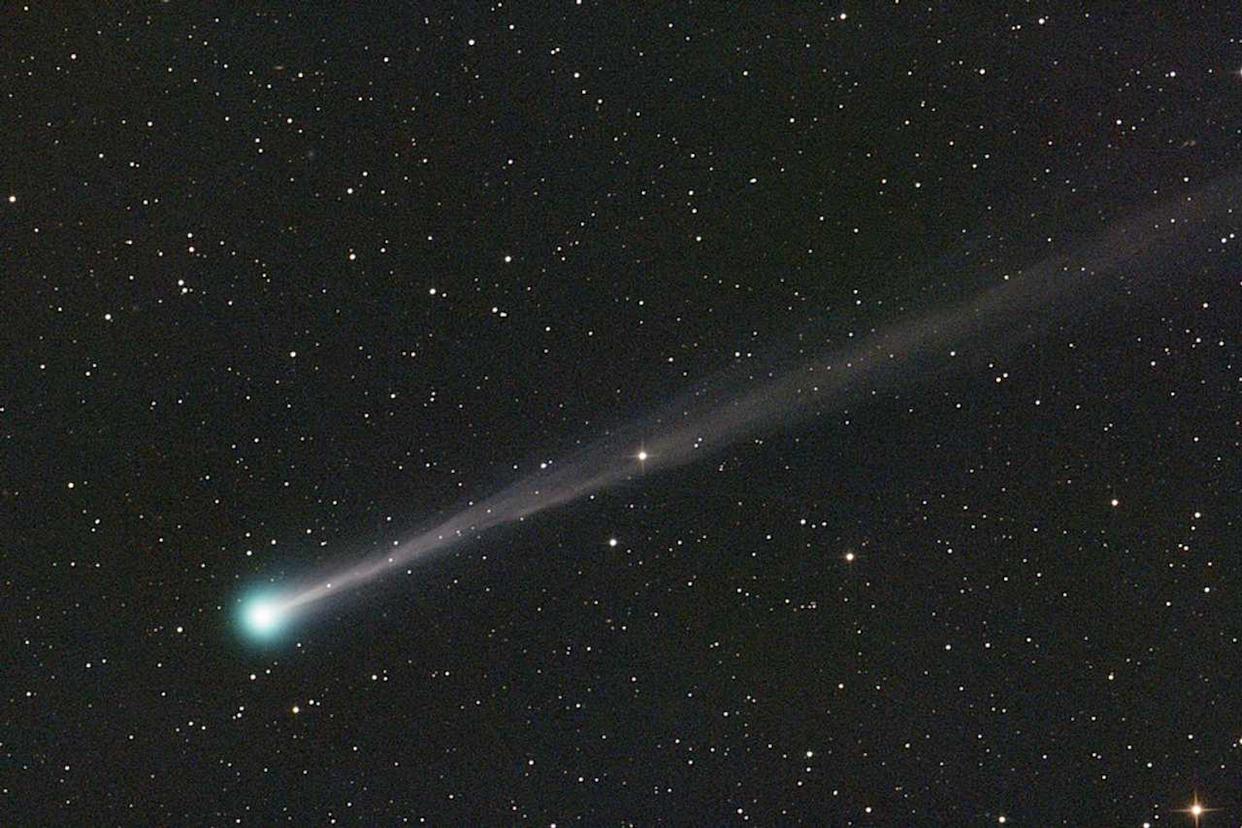
C/2025 R3 (Pan-STARRS) now shows a striking, well-structured ion tail, though some of the detail is softened by the long exposure. — Wikipedia/Dimitrios Katevainis
A rare, long-period comet is making its first appearance in 170,000 years this month, and skywatchers in the Northern Hemisphere will have their best chance to see it starting this week.
Comet C/2025 R3 (Pan-STARRS) is expected to brighten significantly in mid-April, potentially reaching naked-eye visibility under dark skies. The comet will be easiest to spot in the morning sky, low on the eastern horizon, about 60 to 90 minutes before sunrise. Peak visibility is expected from Friday, April 10, through Monday, April 20, as it approaches perihelion — its closest point to the Sun — on Sunday, April 19, and Monday, April 20.
The comet’s brightness is predicted to reach a magnitude of +2 to +3, meaning it could be visible to the naked eye under ideal conditions. However, binoculars are recommended to help locate it, as it will appear fainter than bright stars or planets.
Observers in the Southern Hemisphere may get better views in the evening sky later in the month, particularly after April 27, as the comet moves away from the Sun’s glare.
According to Space.com, the comet’s trajectory and brightness make it a must-see event for astronomers and casual stargazers alike. “This is a once-in-a-lifetime opportunity to see a comet that hasn’t graced our skies in 170,000 years,” said an astronomy expert cited by the publication.
Key viewing tips include heading to a location with minimal light pollution and checking weather conditions for clear skies. Observers should look low in the East or East-Northeast sky during the early morning hours before the Sun rises.
Comet C/2025 R3 was first discovered in 2025 by the Pan-STARRS 1 telescope in Hawaii, which specializes in tracking asteroids and comets near Earth. Its long orbital period means it won’t return to our planet’s vicinity for another 170,000 years, making this viewing window especially unique.
For more tips on spotting Comet C/2025 R3, see videos at cometchasing.skyhound.com.
Check back with Daily Voice for updates.