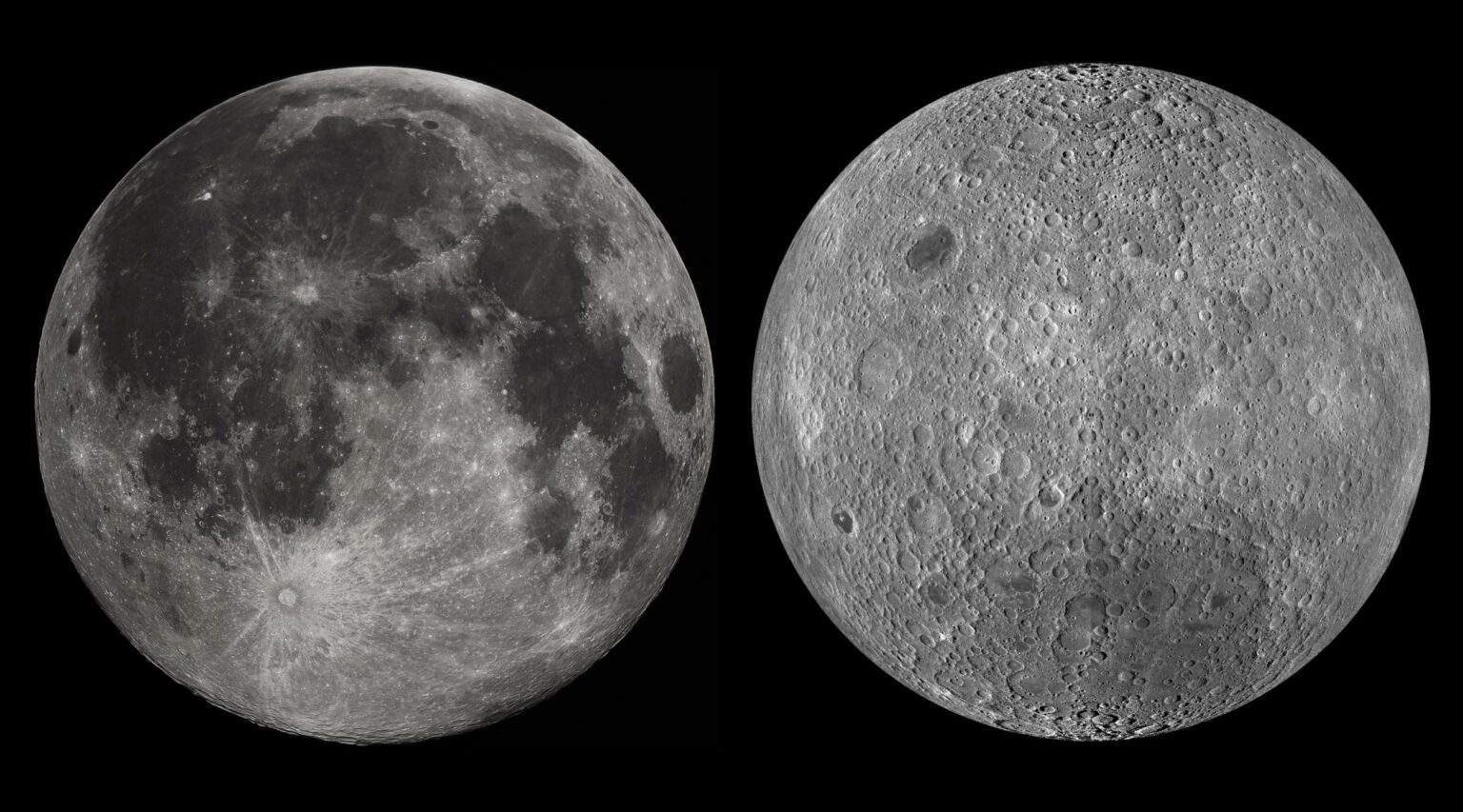
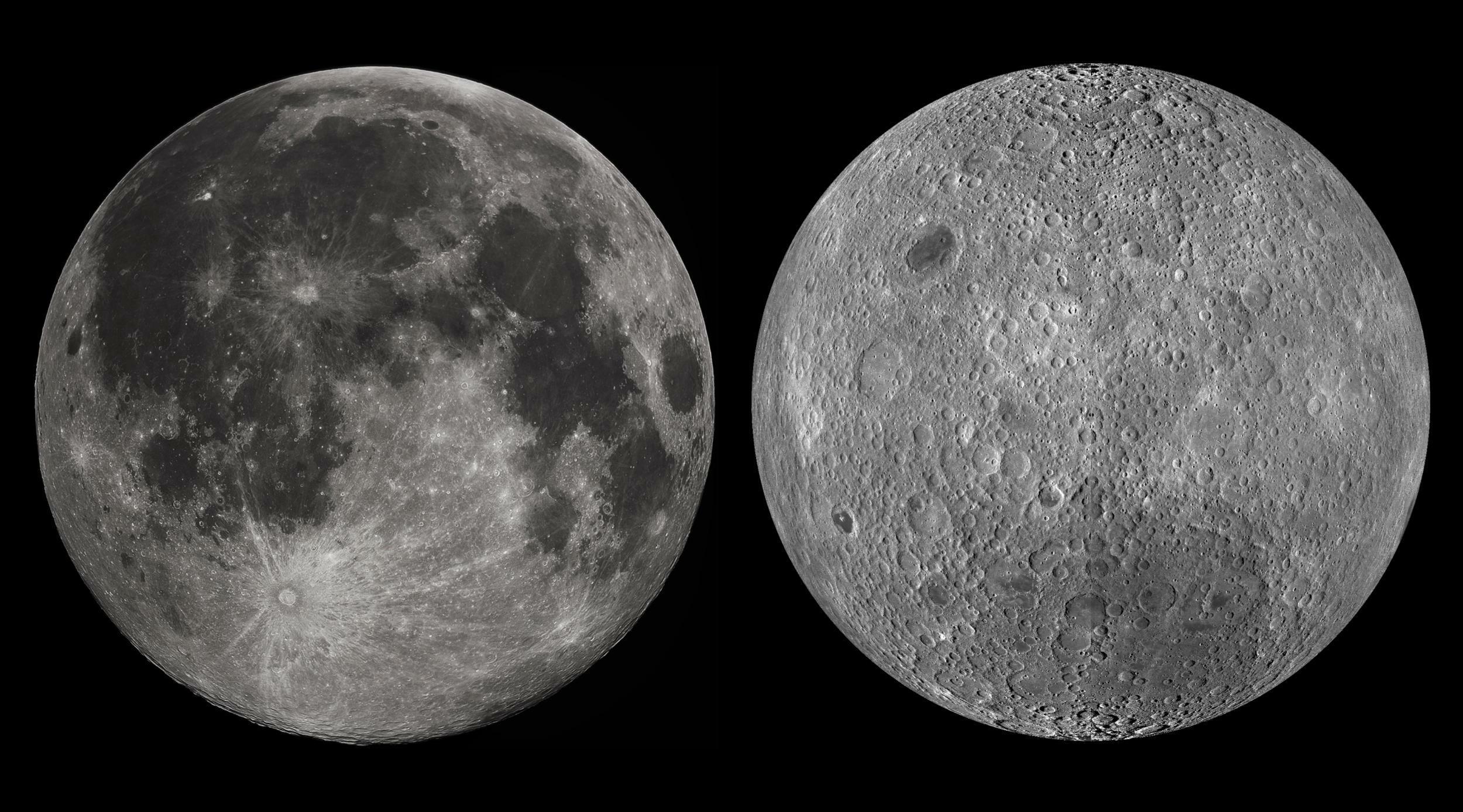
It wasn’t until 1959 that we saw our Moon’s farside for the first time. Because the Moon is tidally locked to Earth, humanity had only seen the nearside lunar hemisphere until that point. When Luna 3 and later spacecraft transmitted the first farside images, they revealed a far more cratered hemisphere which looked more akin to Mercury and Jupiter’s moon Callisto than the world we know.
The farside also lacked the Moon’s familiar dark splotches. Formed as a result of active volcanism over 3 billion years ago, it was anyone’s guess why dark lava plains cover about 31% of the nearside but only 1% of the farside.
Later observations deepened the dichotomy. Several lunar orbiters showed that farside rocks have a noticeably different chemical composition from nearside ones, meaning they formed differently. The twin NASA GRAIL orbiters launched in 2011 revealed that the farside’s crust is about 20 kilometers thicker on average than the nearside.
Scientists are especially interested in this lunar dichotomy because it’s tied to the Moon’s formation and evolution. Scientists think Earth and the Moon have a shared origin, formed when a Mars-sized object collided with the proto-Earth about 4.5 billion years ago. While active geological processes have erased hints of our planet’s makeup in those early years, the material from early Earth that formed the Moon remains largely preserved on our airless cosmic neighbor. This is especially true for the lunar farside where large regions haven’t been volcanically altered. Studying rocks here can give us insight into the early Earth while teaching us about the Moon’s history. Understanding what caused our Moon’s dichotomy will also allow us to better gauge why Mars and other solar system bodies are also asymmetric.
Clementine-TeX on
i see no alien bases here
just_anything_real on
While the concept of a perfect circle exists in mathematics, its realization in the physical world is hindered by various factors, making true perfection unattainable.
CaptainHawaii on
Luna catches a lot of strays for us? Often? Or because there’s no atmosphere (very little) it just never changes? Both?
CrusadingComet on
The remains of Theia stare back at us. Reminding us of our sins and what we stole. Hiding away what little she had to keep.
Convenientjellybean on
Why are they so different? I’d have expected about the same random amount of impacts and the moon being made of moon stuff all over
_DaBau5_ on
i’m glad to know the near side has far more interesting features to look at
UnlitBlunt on
I’m glad we got the more interesting side.
VetusCorvus on
True to form, the earth side has more trash on it.
PsychoNicho on
My guess is that because it’s tidally locked, the earth’s gravity pulled the lava towards earth and that’s why all the cooled lava fields are on the near side.
the-illogical-logic on
I hope that a consensus is reached that if the moon is semi colonised or significantly built in it should only be on the far side.
Waltz_whitman on
That second pic is a different moon, couldn’t be my moon

12 Comments
Image from this article, text excerpt from article below the link:
[https://www.planetary.org/articles/the-two-faced-moon](https://www.planetary.org/articles/the-two-faced-moon)
It wasn’t until 1959 that we saw our Moon’s farside for the first time. Because the Moon is tidally locked to Earth, humanity had only seen the nearside lunar hemisphere until that point. When Luna 3 and later spacecraft transmitted the first farside images, they revealed a far more cratered hemisphere which looked more akin to Mercury and Jupiter’s moon Callisto than the world we know.
The farside also lacked the Moon’s familiar dark splotches. Formed as a result of active volcanism over 3 billion years ago, it was anyone’s guess why dark lava plains cover about 31% of the nearside but only 1% of the farside.
Later observations deepened the dichotomy. Several lunar orbiters showed that farside rocks have a noticeably different chemical composition from nearside ones, meaning they formed differently. The twin NASA GRAIL orbiters launched in 2011 revealed that the farside’s crust is about 20 kilometers thicker on average than the nearside.
Scientists are especially interested in this lunar dichotomy because it’s tied to the Moon’s formation and evolution. Scientists think Earth and the Moon have a shared origin, formed when a Mars-sized object collided with the proto-Earth about 4.5 billion years ago. While active geological processes have erased hints of our planet’s makeup in those early years, the material from early Earth that formed the Moon remains largely preserved on our airless cosmic neighbor. This is especially true for the lunar farside where large regions haven’t been volcanically altered. Studying rocks here can give us insight into the early Earth while teaching us about the Moon’s history. Understanding what caused our Moon’s dichotomy will also allow us to better gauge why Mars and other solar system bodies are also asymmetric.
i see no alien bases here
While the concept of a perfect circle exists in mathematics, its realization in the physical world is hindered by various factors, making true perfection unattainable.
Luna catches a lot of strays for us? Often? Or because there’s no atmosphere (very little) it just never changes? Both?
The remains of Theia stare back at us. Reminding us of our sins and what we stole. Hiding away what little she had to keep.
Why are they so different? I’d have expected about the same random amount of impacts and the moon being made of moon stuff all over
i’m glad to know the near side has far more interesting features to look at
I’m glad we got the more interesting side.
True to form, the earth side has more trash on it.
My guess is that because it’s tidally locked, the earth’s gravity pulled the lava towards earth and that’s why all the cooled lava fields are on the near side.
I hope that a consensus is reached that if the moon is semi colonised or significantly built in it should only be on the far side.
That second pic is a different moon, couldn’t be my moon