
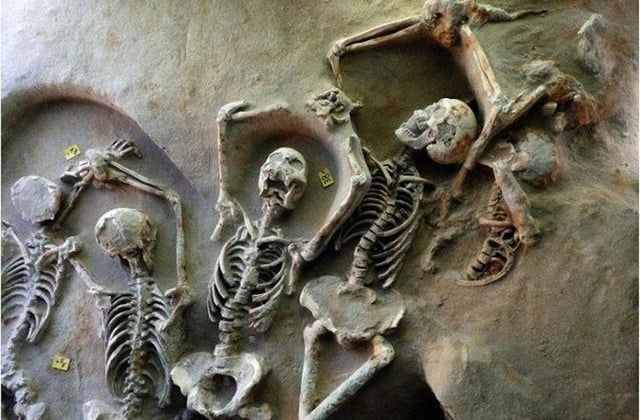
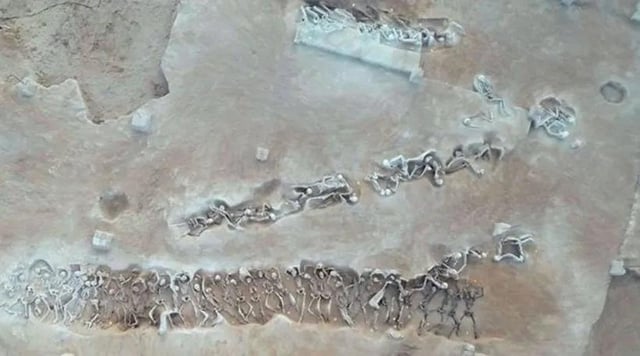
Imagine digging just 50 centimeters into the ground and finding 80 men, laid out in a row, all bound by iron shackles. This is the chilling reality uncovered at the ancient Port of Phalaeron.
The Discovery: Archaeologists have uncovered a "polyandreion" (a mass grave for men who died together). Out of the 80 skeletons found, 36 were still wearing heavy iron prongs on their wrists. They weren't just tossed into a pit; they were executed and buried in a systematic, almost ritualistic array.
The Mystery of the "Elites": These weren't common criminals. Osteological analysis shows they were well-fed, healthy, and high-status individuals—the elite youth of the ancient world.
The Ancient Curse (The Miasma): The pottery found next to them dates the execution to the time of the infamous Cylonian Affair (632 BC). History tells us that Cylon’s followers were promised their lives if they surrendered from the Temple of Athena, but they were betrayed and slaughtered.
This betrayal created what the ancients called the "Cylonian Pollution" (Miasma). The ruling family responsible was considered "spiritually stained" and cursed for generations. For centuries, historians thought this "curse" was just a legend. These 80 shackled men, emerging from the sand after 2,600 years, are the silent witnesses that the legend was terrifyingly real.
A dark chapter of history, literally emerging from the shadows.
by bortakci34
5 Comments
**More details and historical context:**
The discovery at Phalaeron continues to fascinate archaeologists as it provides a rare physical link to the ancient texts of Herodotus and Thucydides.
**Sources:**
* **Smithsonian Magazine:**[https://www.smithsonianmag.com/smart-news/shackled-skeletons-unearthed-in-greece-could-be-remains-of-slaughtered-rebels-180958812/](https://www.smithsonianmag.com/smart-news/shackled-skeletons-unearthed-in-greece-could-be-remains-of-slaughtered-rebels-180958812/)
* **Keep Talking Greece:**[https://www.keeptalkinggreece.com/2016/04/14/faliron-necropolis-with-80-skeletons-in-chains-buried-in-array-indications-to-cylonian-affair-in-632-bc/](https://www.keeptalkinggreece.com/2016/04/14/faliron-necropolis-with-80-skeletons-in-chains-buried-in-array-indications-to-cylonian-affair-in-632-bc/)
* **Arkeofili (Archaeological analysis):**[https://arkeofili.com/yunanistanda-bulunan-zincirli-iskeletler-antik-isyancilara-ait-olabilir/](https://arkeofili.com/yunanistanda-bulunan-zincirli-iskeletler-antik-isyancilara-ait-olabilir/)
I want to know more
LMAO thats not what happened at all. I mean people were killed and shackled sure. It was an uprising that failed silly rabbit.
Just looks like your typical POW execution
Wow, I hadn’t heard of this before. Based on my cursory search, it was Athenian on Athenian violence recorded by some of the most famous ancient historians, Thucydides and Herodotus
Here’s a quick summary of what I found:
The Cylonian conspiracy (or Cylonian Affair) was a failed 7th-century BCE (approx. 632 BC) coup d’état by Athenian noble and Olympic victor Cylon to become tyrant of Athens. Supported by Megara, he seized the Acropolis but failed to gain popular support. The botched revolt led to a sacrilegious massacre of his followers by the Alcmaeonid family, creating a lasting political curse.
Key Aspects of the Cylonian Conspiracy:
The Attempt: Cylon, encouraged by a Delphic oracle, tried to seize the Acropolis during the Olympic festival.
The Failure: The Athenian populace besieged Cylon and his followers, forcing them to take refuge at the Temple of Athena.
The Massacre & Curse: Megacles, an Athenian archon, persuaded the followers to leave for a trial, promising safety. Instead, the followers were massacred, leading to the “Cylonian Agos” (curse) upon the responsible Alcmaeonid family.
Archaeological Evidence: In 2016, a mass grave containing 80 skeletons with iron shackles was found in the Falyron Delta, believed to be the remains of Cylon’s slaughtered followers.
Historical Impact: The incident marked a pivotal moment in Athenian history, highlighting the intense political instability leading towards the reforms of Solon.
The event is primarily known through the accounts of historians Thucydides and Herodotus.