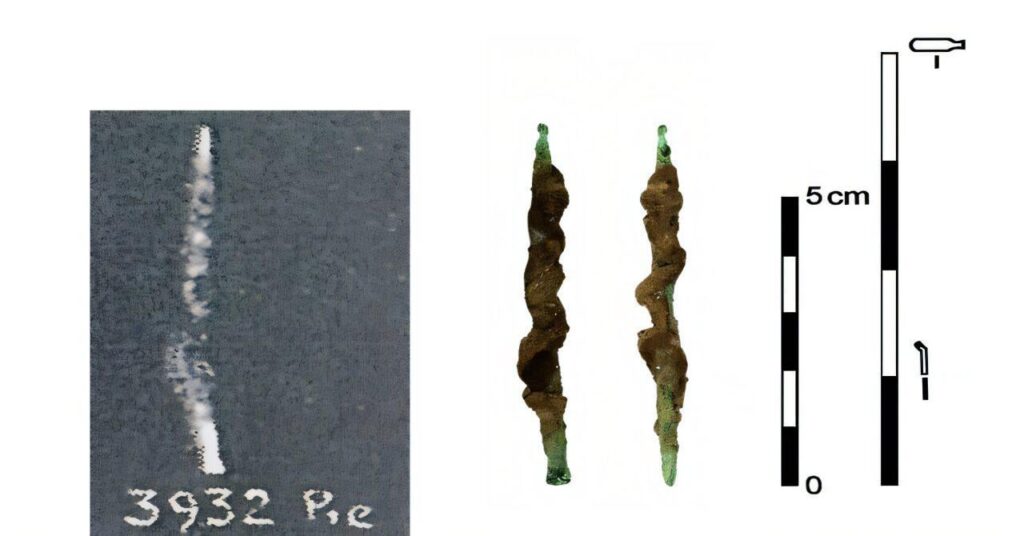
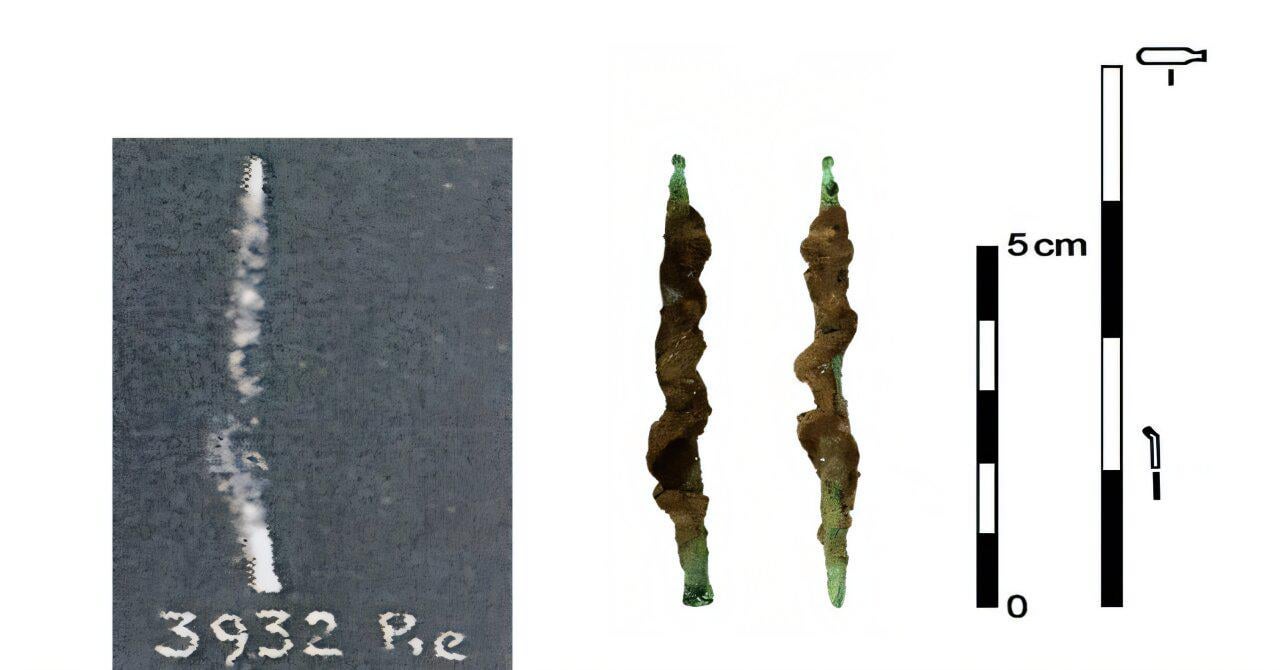
The existence of the (very small) drill isn’t a huge surprise but it’s the oldest known example I’m aware of by a significant margin. There is plenty of evidence for sawing and drilling but the actual tools are relatively rare. The tite from the article might be a little melodramatic but the find is still a big deal.
Most exciting is the metal itself copper with “arsenic and nickel, with notable amounts of lead and silver”. Arsenical copper makes for a harder alloy (obviously useful for drilling)^1 and is rare enough in copper sources near Egypt to make the presence likely from an intentional addition or source of ore.^2 Clear evidence for use of alloys like this from early periods make it easier to reconstruct metallurgical knowledge before dynastic Egypt.
The drill was initially published in the 1920’s but the significance wasn’t realized until now. It’s also a good example of how much can be discovered in existing archives, rather than field excavation.
2. Rademakers, Frederik W., et al. “Copper for the Afterlife in Predynastic to Old Kingdom Egypt: Provenance Characterization by Chemical and Lead Isotope Analysis (RMAH Collection, Belgium).” *Journal of Archaeological Science* 96 (August 2018): 186-187. https://doi.org/10.1016/j.jas.2018.04.005.

1 Comment
The existence of the (very small) drill isn’t a huge surprise but it’s the oldest known example I’m aware of by a significant margin. There is plenty of evidence for sawing and drilling but the actual tools are relatively rare. The tite from the article might be a little melodramatic but the find is still a big deal.
Most exciting is the metal itself copper with “arsenic and nickel, with notable amounts of lead and silver”. Arsenical copper makes for a harder alloy (obviously useful for drilling)^1 and is rare enough in copper sources near Egypt to make the presence likely from an intentional addition or source of ore.^2 Clear evidence for use of alloys like this from early periods make it easier to reconstruct metallurgical knowledge before dynastic Egypt.
The drill was initially published in the 1920’s but the significance wasn’t realized until now. It’s also a good example of how much can be discovered in existing archives, rather than field excavation.
___
1. Odler, Martin. *Old Kingdom Copper Tools and Model Tools* (Archaeopress, 2016). p. 239. https://doi.org/10.2307/j.ctvxrq06g.
2. Rademakers, Frederik W., et al. “Copper for the Afterlife in Predynastic to Old Kingdom Egypt: Provenance Characterization by Chemical and Lead Isotope Analysis (RMAH Collection, Belgium).” *Journal of Archaeological Science* 96 (August 2018): 186-187. https://doi.org/10.1016/j.jas.2018.04.005.