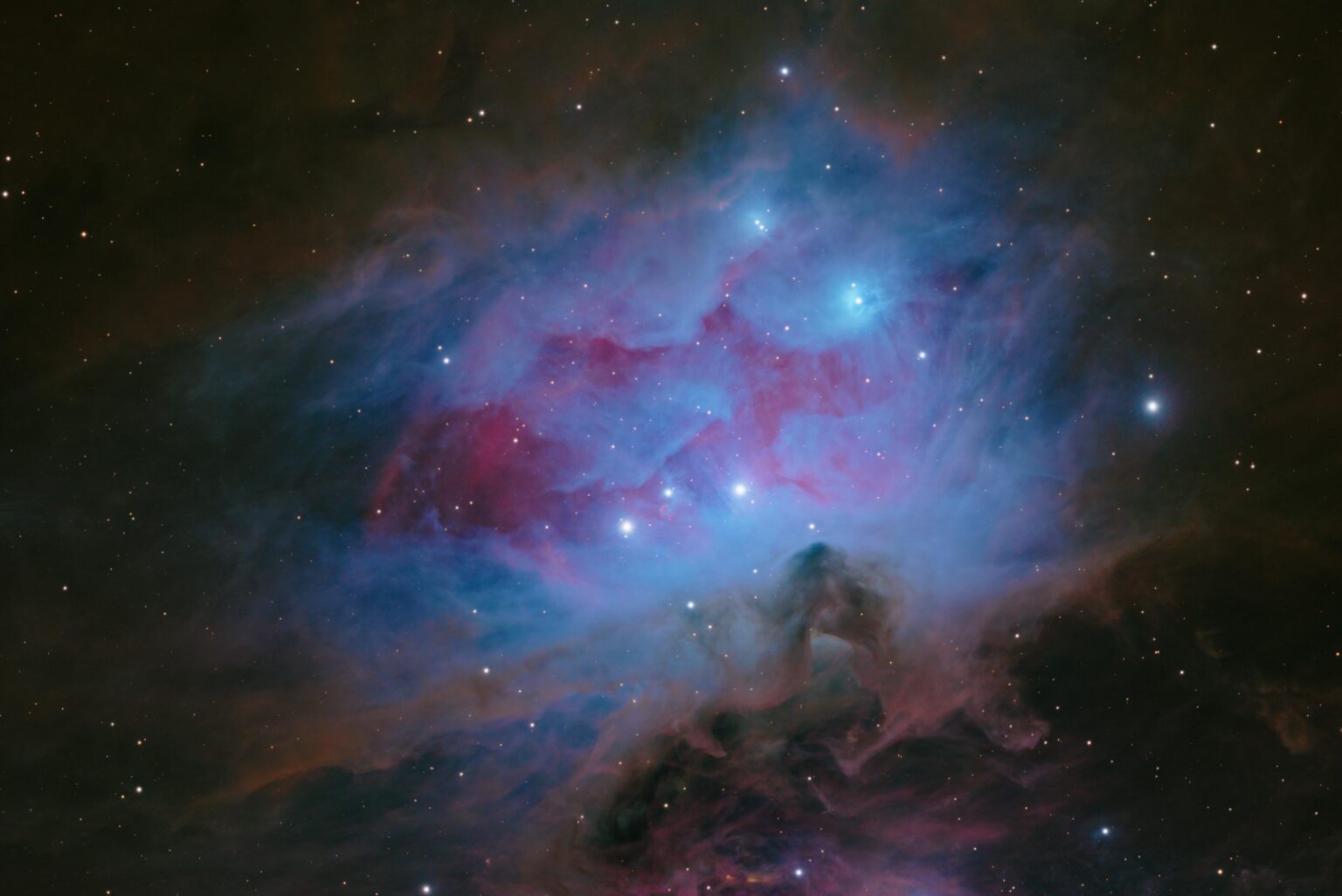
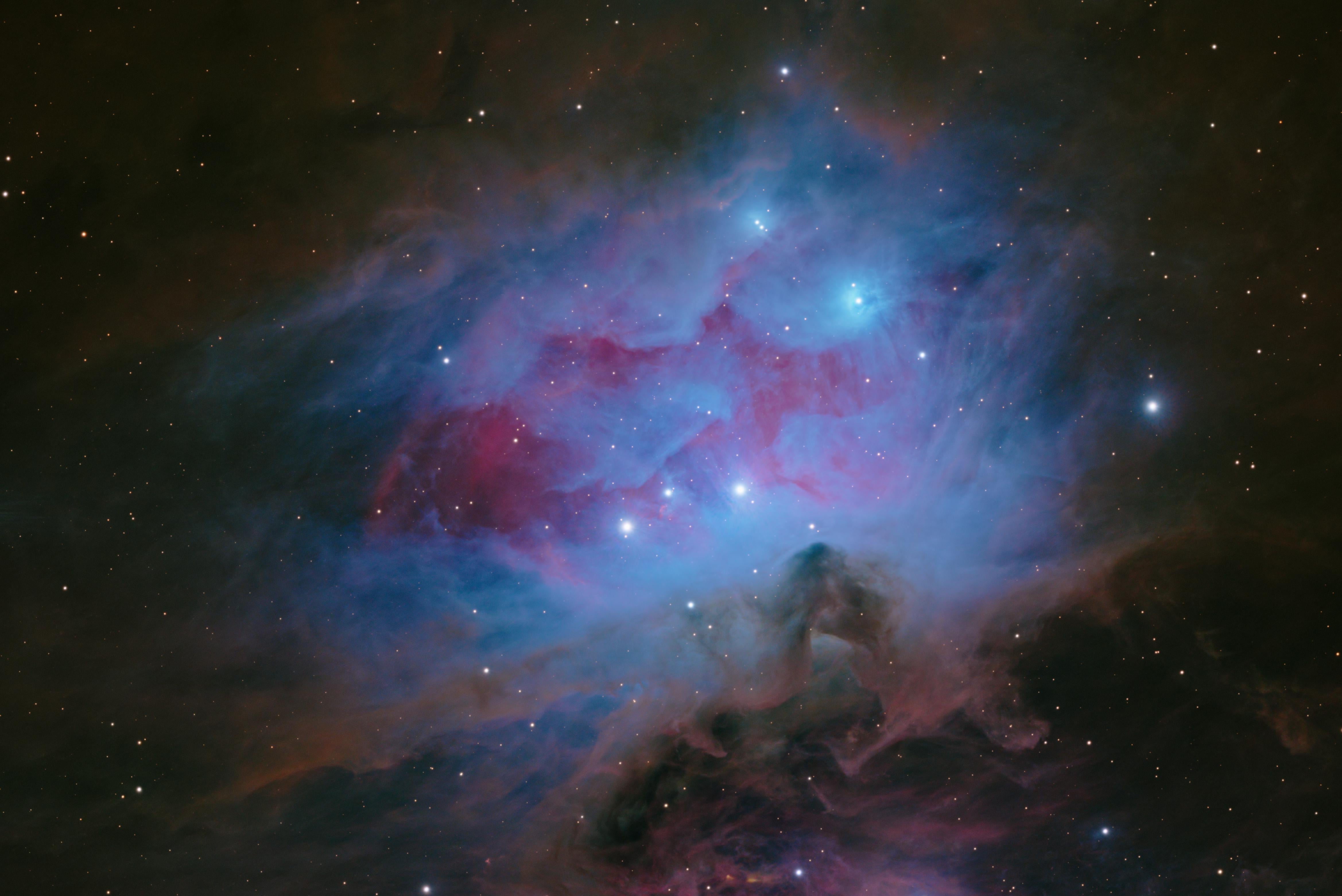
Located approximately 1,500 light-years away in the constellation Orion, the Running Man Nebula is a striking example of a reflection nebula complex. While its neighbor, M42, is dominated by the fiery red glow of ionized hydrogen, Sh2-279 shines primarily through the scattering of light.
The ethereal blue hues captured here are the result of Rayleigh scattering. High-energy radiation from hot, young stars — primarily the bright c Orionis — strikes interstellar dust grains. Because these grains are smaller than the wavelength of visible light, they scatter shorter (blue) wavelengths more efficiently than longer (red) ones, similar to the process that colors Earth’s daytime sky.
The “Running Man” figure itself is an optical silhouette created by three distinct NGC catalog objects:
NGC 1977: The brightest portion, illuminated by 4th-magnitude c Orionis.
NGC 1973 & NGC 1975: Smaller, northern lobes separated by dark, opaque filaments.
These dark lanes are high-density regions of interstellar dust that are not yet ionized. They sit in the foreground, carving the nebula into the recognizable shape of a sprinting human figure. While reflection is the primary driver, faint hints of HII emission (reddish-pink) can be seen where the intense UV radiation from the nearby Trapezium cluster begins to ionize the local gas.
Technical Interest
This region serves as a crucial laboratory for studying photodissociation regions (PDRs) — the interface where stellar far-ultraviolet photons dominate the chemistry and heating of the interstellar medium.
Telescope: SVX180T
Camera: ASI6200MM
Mount: 10Micron GM2000
Exposure:
L — 250x30s
R — 250x30s
G –250×30
B –250x30s
Total — 8h20m

1 Comment
Located approximately 1,500 light-years away in the constellation Orion, the Running Man Nebula is a striking example of a reflection nebula complex. While its neighbor, M42, is dominated by the fiery red glow of ionized hydrogen, Sh2-279 shines primarily through the scattering of light.
The ethereal blue hues captured here are the result of Rayleigh scattering. High-energy radiation from hot, young stars — primarily the bright c Orionis — strikes interstellar dust grains. Because these grains are smaller than the wavelength of visible light, they scatter shorter (blue) wavelengths more efficiently than longer (red) ones, similar to the process that colors Earth’s daytime sky.
The “Running Man” figure itself is an optical silhouette created by three distinct NGC catalog objects:
NGC 1977: The brightest portion, illuminated by 4th-magnitude c Orionis.
NGC 1973 & NGC 1975: Smaller, northern lobes separated by dark, opaque filaments.
These dark lanes are high-density regions of interstellar dust that are not yet ionized. They sit in the foreground, carving the nebula into the recognizable shape of a sprinting human figure. While reflection is the primary driver, faint hints of HII emission (reddish-pink) can be seen where the intense UV radiation from the nearby Trapezium cluster begins to ionize the local gas.
Technical Interest
This region serves as a crucial laboratory for studying photodissociation regions (PDRs) — the interface where stellar far-ultraviolet photons dominate the chemistry and heating of the interstellar medium.
Telescope: SVX180T
Camera: ASI6200MM
Mount: 10Micron GM2000
Exposure:
L — 250x30s
R — 250x30s
G –250×30
B –250x30s
Total — 8h20m