
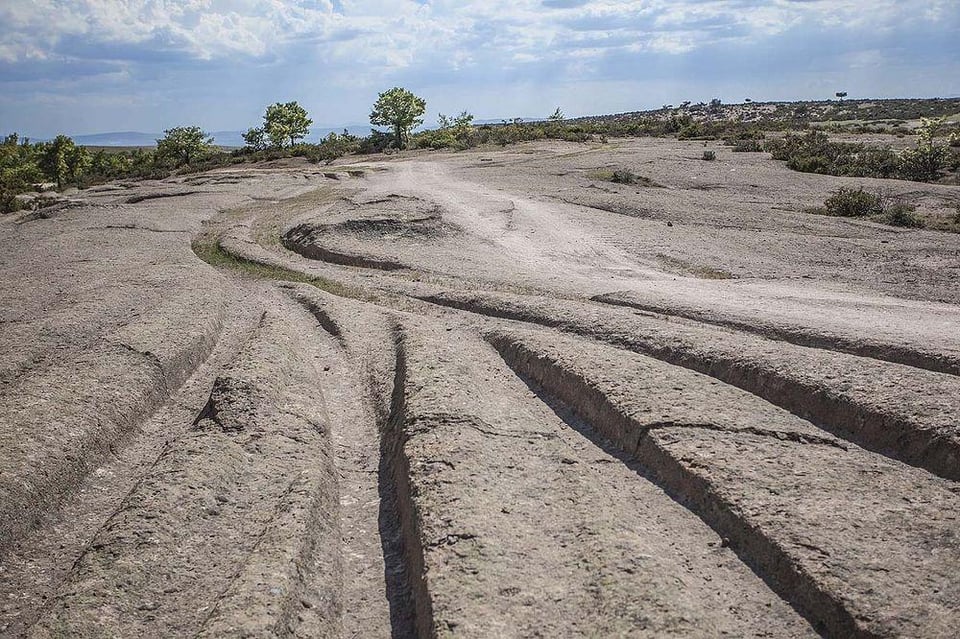
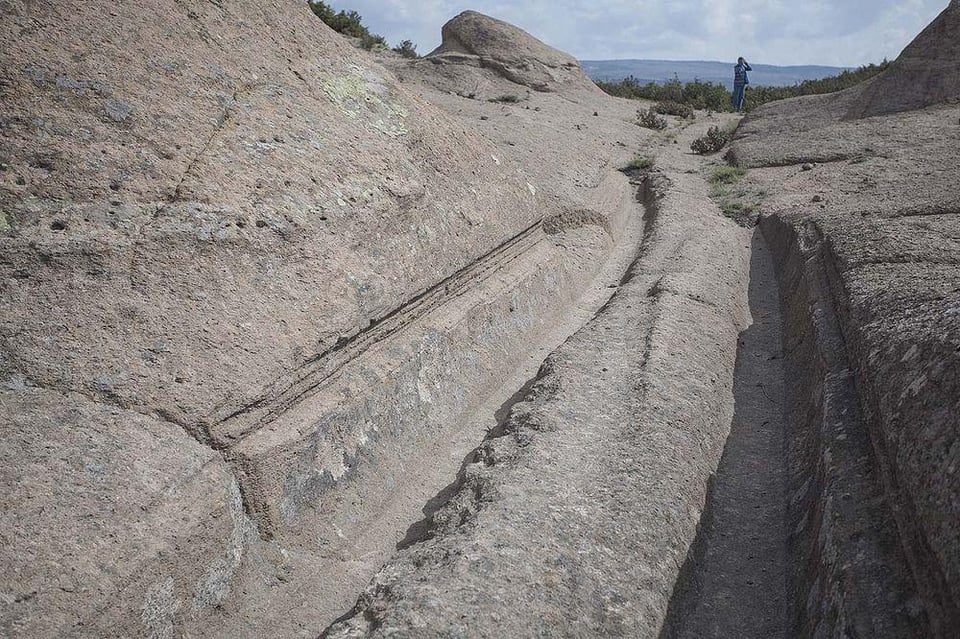
Deep in the Phrygian Valley of Anatolia, Turkey, there is a phenomenon that defies conventional archaeology: perfectly parallel, fossilized ruts carved into the volcanic tuff.
Here are the key points of this enigma:
- Extreme Depth: In certain areas, these ruts reach a depth of 1 meter (3.3 feet). They aren't just surface scratches; they look like heavy vehicles were driven over soft volcanic ash millions of years ago, which then petrified into solid rock.
- The Geological Age: Dr. Alexander Koltypin, a geologist and director of the Natural Science Scientific Research Center at Moscow's International Independent University of Ecology and Politology, claims these tracks date back to the Miocene period (approx. 14 million years ago).
- Technological Precision: The distance between the parallel ruts remains consistent, identical to the gauge of a modern vehicle's axle. Dr. Koltypin argues that these were made by heavy "all-terrain vehicles" belonging to an unknown civilization.
- Mainstream Explanation: Conventional archaeologists, such as Claudia Sagona, suggest these might be ancient agricultural irrigation furrows or drainage systems dating back about 5,000 years. However, critics argue that the depth and the vertical "axle" marks on the sides of the ruts make the irrigation theory difficult to sustain.
These tracks are often compared to the "Cart Ruts" found on the island of Malta, but the Turkish ruts are significantly deeper and found in much older geological layers.
What do you think? Are we looking at the remains of a pre-human industrial civilization, or is there a natural/agricultural explanation that can account for 1-meter deep parallel ruts in bedrock?
Note on sources: This theory has been discussed in various scientific circles and covered by media outlets like the Daily Mail and Express, based on Dr. Koltypin's field research in the region.
Photo Credits: Hidden Inca Tours / Amusing Planet
by bortakci34
26 Comments
Rain water tracks? From a mountain? Eroded by heavy rainfall ?
1 guy claiming they’re 14 MYO… why should be believe him?
Also the Daily Mail and Express aren’t exactly reputable papers.
Glacial movement. There are similar grooves all across the Canadian Shield
Glaciers
I notice you’ve failed to provide any linked sources. You’ve made a note on your sources, but you’ve failed to link them for examination.
Please provide specific sources.
So fucking stupid.
https://preview.redd.it/w6jhqyss8kdg1.png?width=1080&format=png&auto=webp&s=e749bcce19bf7976b578137c14b5432374282e45
Lots of those in Crimea. Just wheels tracks + erosion
A Moscow based Russian scientist on Daily Mail said they’re 14 Million year old tracks; we should absolutely trust our lives on this! It’s definitely not glacial or rainfall tracks, nope, Russian propagandist says it’s vehicle tracks; so its vehicle tracks!
What are the odds they would use the exact same axle width for a vehicle 14M years ago? Extremely low.
It’s 99.999999% most likely a natural formation.
They’re goofy, some plunge down into the Mediterranean, I have no idea how deep they go. They probably couldn’t have just been made by wheels because many don’t deform in turns like a wheel in mud, and some are weirdly deep.
For the sake of argument just say they were worn into the stone over ages by carts, **or** it was a mud path that somehow fossilized after a landslide…there isn’t a trackway in the center where the puller (human or horse) would have been harnessed, which would have also worn down over time or fossilized along with the ruts.
Here are a couple links to episodes of the brothers of the serpent podcast in which they talk about the ruts. I guess they have something like ’em in texas too.
https://youtu.be/k_18ojb5z30
https://youtu.be/e_ADwH7LM3c
Volcanic tuff is relatively soft. Based on the geometries I see, I suspect these could be man-made by repeated traverses using heavy wheeled carts of some sort, quite possibly ancient, just not 14-million-years old.
It could be: human technology from a pre-era.
Check out the cart tracks in Malta. They go right into the ocean
Swamp gas!
Its called a sledge. Lol.
I know Koltypin in person. He is good geologist but in history he is too conspicuous.
all these “cart ruts” around the world are tracks on which the boats were released into the sea after being built. like in modern shipyards, you carve a path to the sea for the boat you are building. that is all.
The age of the tuff provides only a maximum for the tracks. Without any dated younger deposits covering these racks, there is a lack of any constraints on the minimum age for them. Thus, can they can be any age younger than the tuff, including a few thousand, a few hundreds, or a few tens of years.
In addition, tuff is quite brittle and would break readily under the repeated pressure of wheeled traffic. The compressive pressure of iron-rimmed, even wood, wheels is quite large given the limited surface area of contact and weight of historic, animal drawn vehicles. This pressure makes short work of even hard rock because stone is weak and brittle under the conpressive weightf wheeled vehicles.
Some examples:
[“The Guernsey Ruts” of Oregon Trail Ruts National Monument](https://enjoyyourparks.com/wyoming/top-things-to-do-in-wyoming/oregon-trail-ruts-national-historic-landmark/)
[The White Cliffs Wagon Trail: Carved Into Stone, Kingman, Arizona](https://www.youtube.com/watch?v=bBOBUTuXgR8)
[Wheel ruts worn into the road stones of ancient Pompeii](https://www.reddit.com/r/ancientrome/comments/137g21q/wheel_ruts_worn_into_the_road_stones_of_ancient/)
In a tectonically active area such the one thee tracks are found, it is highly implausible that the currrent landscape older than even a few hundreds of thosuand years. In case of the Phrygia region, the volcanic tuffs are deeply eroded by tens to over a hundred meters since their inital deposition, indicating that they predate the current surfce by millions of years. That alone indicates that any surface features that date to the Miocene would have been destroyed by erosion millions of years ago along with the original Miocene surface, which no longer exits.
Go see:
Özdemir, M.A. and Kaymak, H., 2025. Inventory and assessment of geomorphosites of Mountainous Phrygia (Eskişehir/Türkiye). *Journal of Mountain Science*, *22*(7), pp.2313-2331.
Very intriguing. 🤨
Not for wheels. For cables and pipes.
Milion? Don’t ridiculous. Look up how erosion works…
or….we have figured out time travel in this modern age and we’re sending soldiers and builders back in time to build a new, better world and that’s the only evidence left behind from our survey crew.
Not vehicle tracks. Plumbing.
The rock is formed, check out Natron Theory.
I wonder what the measured wheelbase is; is it consistent between tracks, and what unit of measurement are they closest to. Most likely metric- but that’s what I want to know
They have similar to these in Malta
These ruts are all over Norway aswell, often leading straight into the ocean