
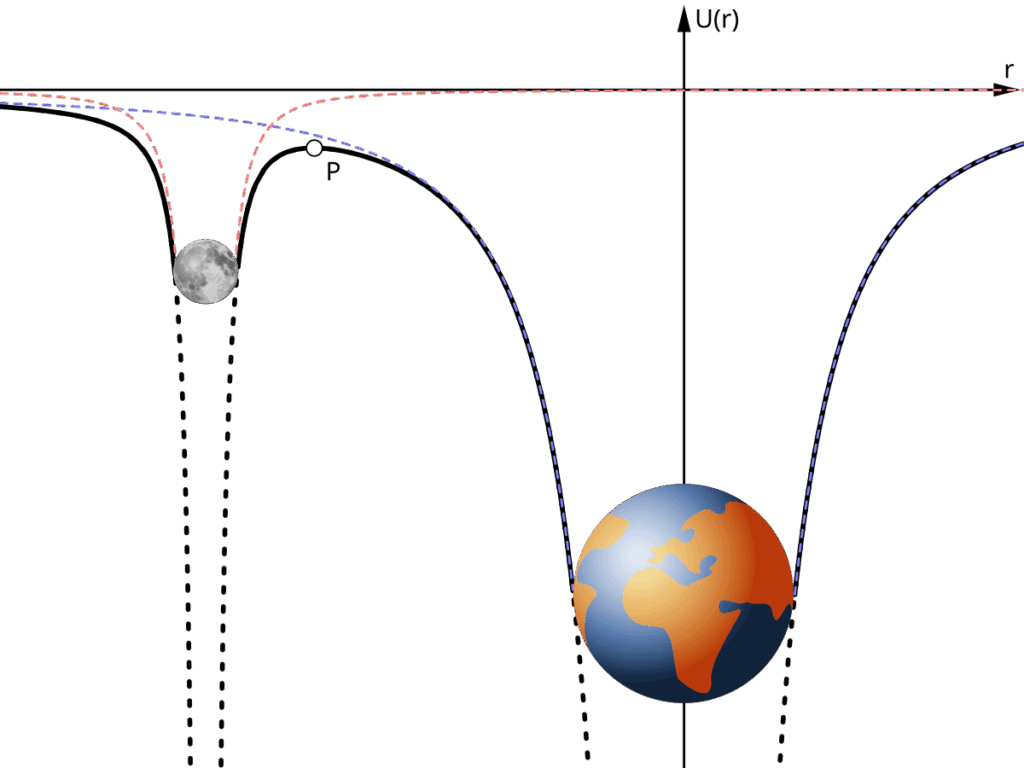
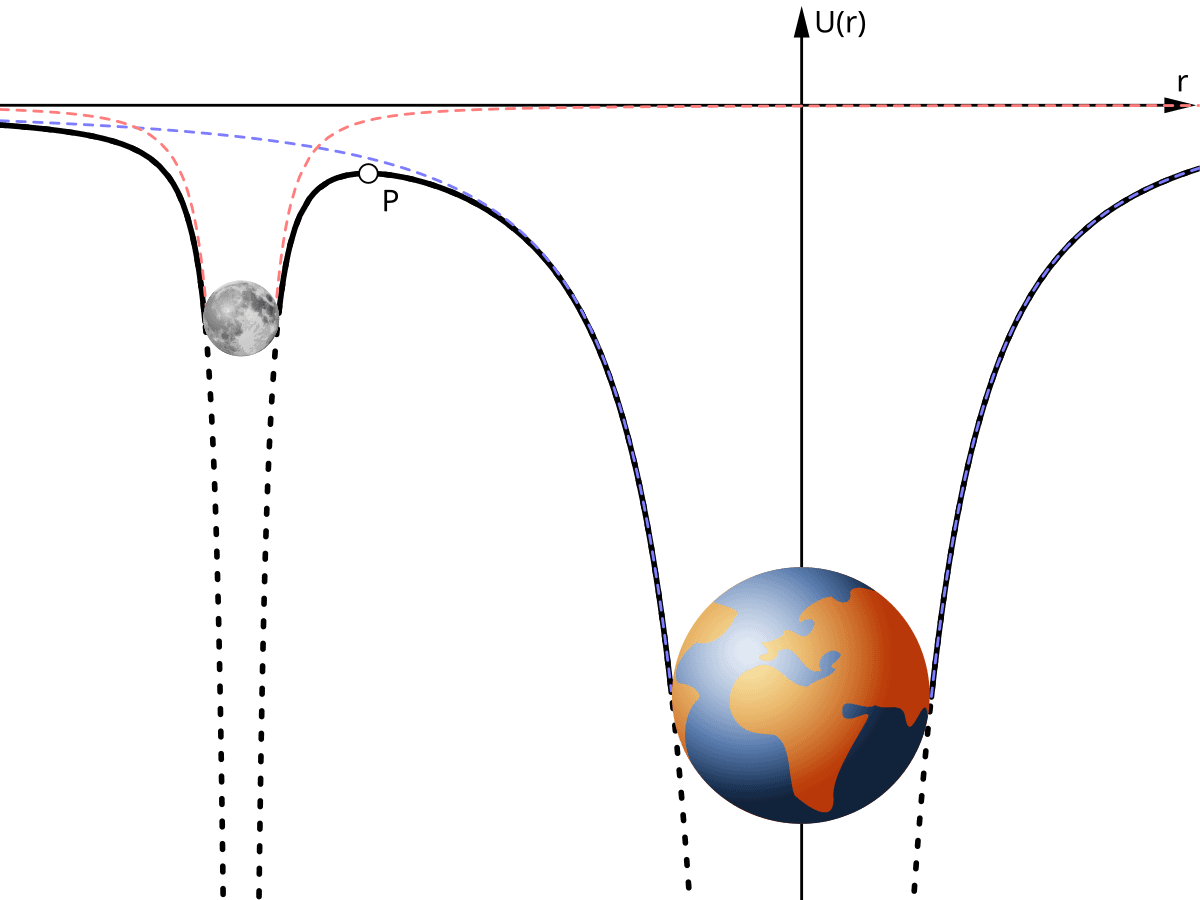
Consider a planet orbiting a star, and a moon orbiting that planet. How far from that planet can that moon orbit?
The moon must be close enough to the planet so that the planet's gravity will dominate its motion. But one must be careful in finding how much the star pulls on the moon, because it also pulls on the planet, and thus one must calculate the difference between those two pulls.
Using Newtonian gravitational constant G, mass of star ms, distance to planet ap, mass of planet mp, distance to moon am, and mass of moon negligible, we find this condition from accelerations of gravity:
G*mp/am2 > G*ms*am/ap3
That gives us am < ap * (mp/ms)1/3 related to the radius of the Hill sphere – Wikipedia by a numerical factor. This, the Hill radius, is less than that by a factor of 31/3 or 1.442.
The orbital angular velocity w = sqrt(G*m/a3) and the orbital period P = (2*pi)/w. The condition becomes wm > wp or Pm < Pp. Thus, a moon must orbit its planet in less time than its planet orbits its star.
Can one do better? I have not found any better stability-limit calculation, so I decided to do one myself. I worked from Dieter S. Schmidt's series expansion of the Hill-Brown lunar solution: Lunar theory – Wikipedia — Literal solution for Hill's lunar problem | Celestial Mechanics and Dynamical Astronomy and The Motion of the Moon and Hill's Lunar Equations and the Three-Body Problem
That solution has several simplifications: the planet's orbit is assumed circular, only the lowest-order terms in the star's gravity are used, with the lowest powers of (am/ap), and the initial solution is a squashed circle that is coplanar with the planet's orbit.
Eccentricity and inclination effects are calculated as perturbations of that initial orbit, and DSS gave series expansions of the anomalistic (eccentricity) and draconic or nodical (inclination) periods. The series-expansion small parameter m = wp/(wm-wp) = Tm/(Tp-Tm).
I then considered where these series solutions might be valid, because an invalid solution means an unstable orbit. The anomalistic series I found to have a radius of convergence of 1/5.11 and the draconic series an apparently larger value, so I used the anomalistic one. With retrograde as reversed sign in m and Pm, I found period limits of
- Direct: Pm < 0.164 * Pp
- Retrograde: Pm < 0.243 * Pp
Ignoring the star's perturbation of the moon's mean distance, I find
- Direct: am < 0.299 * amax
- Retrograde: am < 0.389 * amax
- Hill radius: am = 0.693 * amax
where amax = ap * (mp/ms)1/3
by lpetrich