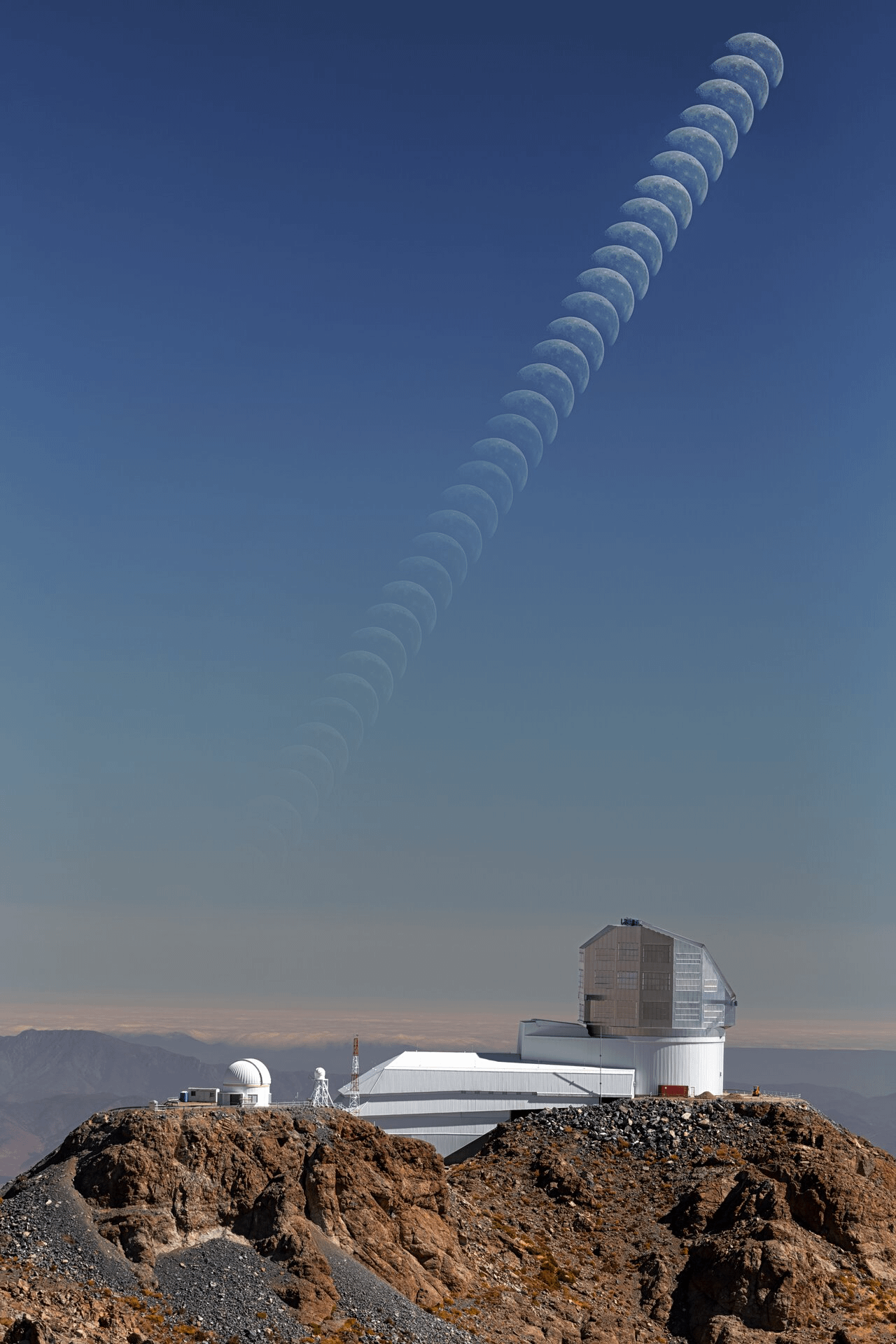
The Moon sets in a bright sky over NSF–DOE Vera C. Rubin Observatory, jointly funded by the U.S. National Science Foundation (NSF) and the U.S. Department of Energy Office of Science (DOE/SC). Why is the Moon setting while there’s still daylight?
We usually associate the Moon with the night sky, but it’s actually visible in daylight nearly half the time. The Moon is one of the most familiar sights in our sky, yet Rubin Observatory won’t be observing it. It’s far too bright for Rubin’s highly-sensitive camera, which is designed to detect much fainter sources of light from distant galaxies, or from closer but dimmer objects like asteroids and comets.
In fact, the best nights for Rubin’s deep-sky observations are those near the new Moon, when the sky is darkest and the Moon can’t be seen at all. When the Moon is up, Rubin uses a filter that’s better suited for the brighter conditions, allowing it to keep collecting high-quality data.
Rubin Observatory is a groundbreaking new astronomy and astrophysics observatory on Cerro Pachón in Chile. It is named after astronomer Vera Rubin, who provided the first convincing evidence for the existence of dark matter. Using the largest camera ever built, Rubin will repeatedly scan the sky for 10 years to create an ultra-wide, ultra-high-definition, time-lapse record of our Universe. Rubin Observatory is a joint Program of NSF NOIRLab and DOE’s SLAC National Accelerator Laboratory.

1 Comment
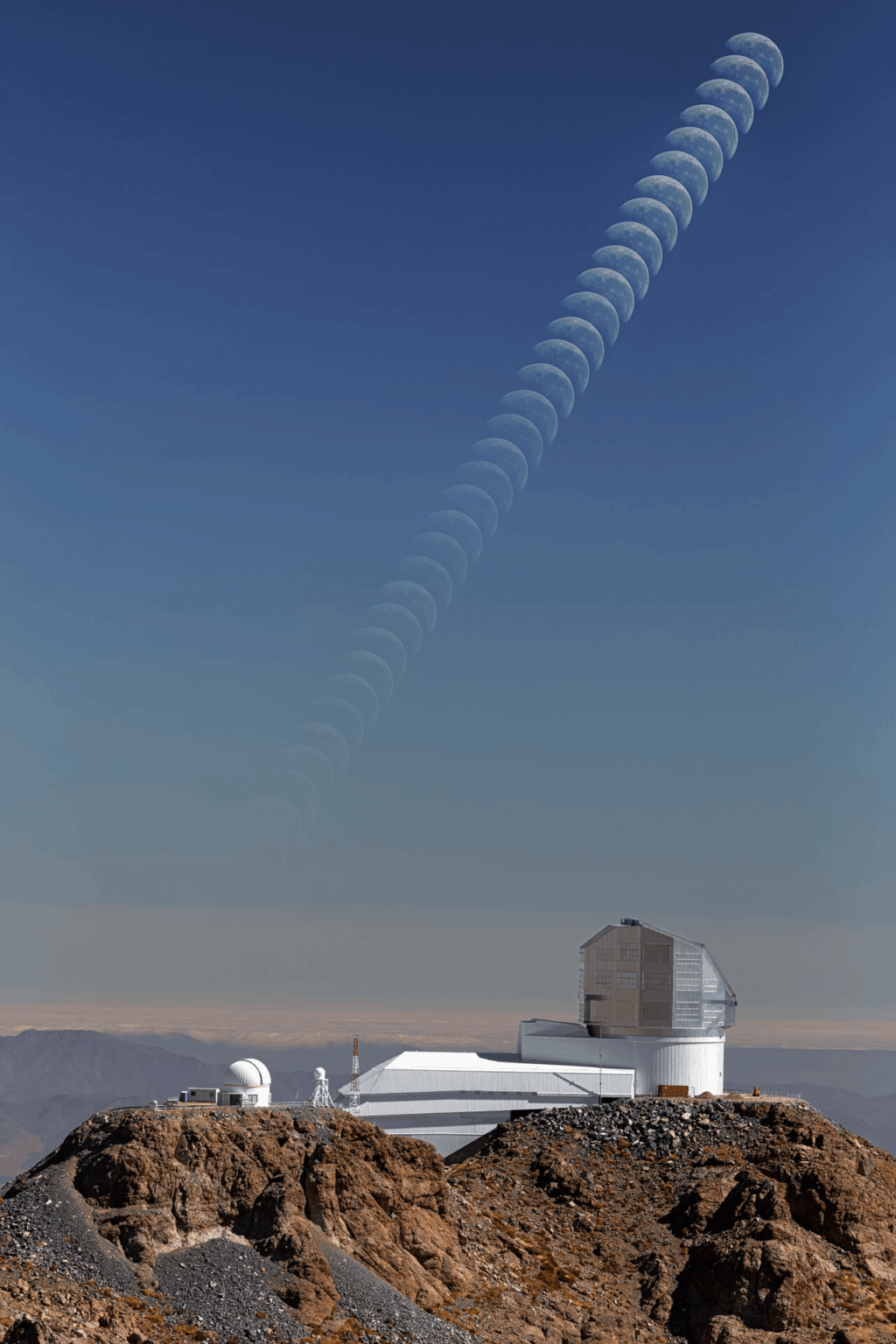
The Moon sets in a bright sky over NSF–DOE Vera C. Rubin Observatory, jointly funded by the U.S. National Science Foundation (NSF) and the U.S. Department of Energy Office of Science (DOE/SC). Why is the Moon setting while there’s still daylight?
We usually associate the Moon with the night sky, but it’s actually visible in daylight nearly half the time. The Moon is one of the most familiar sights in our sky, yet Rubin Observatory won’t be observing it. It’s far too bright for Rubin’s highly-sensitive camera, which is designed to detect much fainter sources of light from distant galaxies, or from closer but dimmer objects like asteroids and comets.
In fact, the best nights for Rubin’s deep-sky observations are those near the new Moon, when the sky is darkest and the Moon can’t be seen at all. When the Moon is up, Rubin uses a filter that’s better suited for the brighter conditions, allowing it to keep collecting high-quality data.
Rubin Observatory is a groundbreaking new astronomy and astrophysics observatory on Cerro Pachón in Chile. It is named after astronomer Vera Rubin, who provided the first convincing evidence for the existence of dark matter. Using the largest camera ever built, Rubin will repeatedly scan the sky for 10 years to create an ultra-wide, ultra-high-definition, time-lapse record of our Universe. Rubin Observatory is a joint Program of NSF NOIRLab and DOE’s SLAC National Accelerator Laboratory.