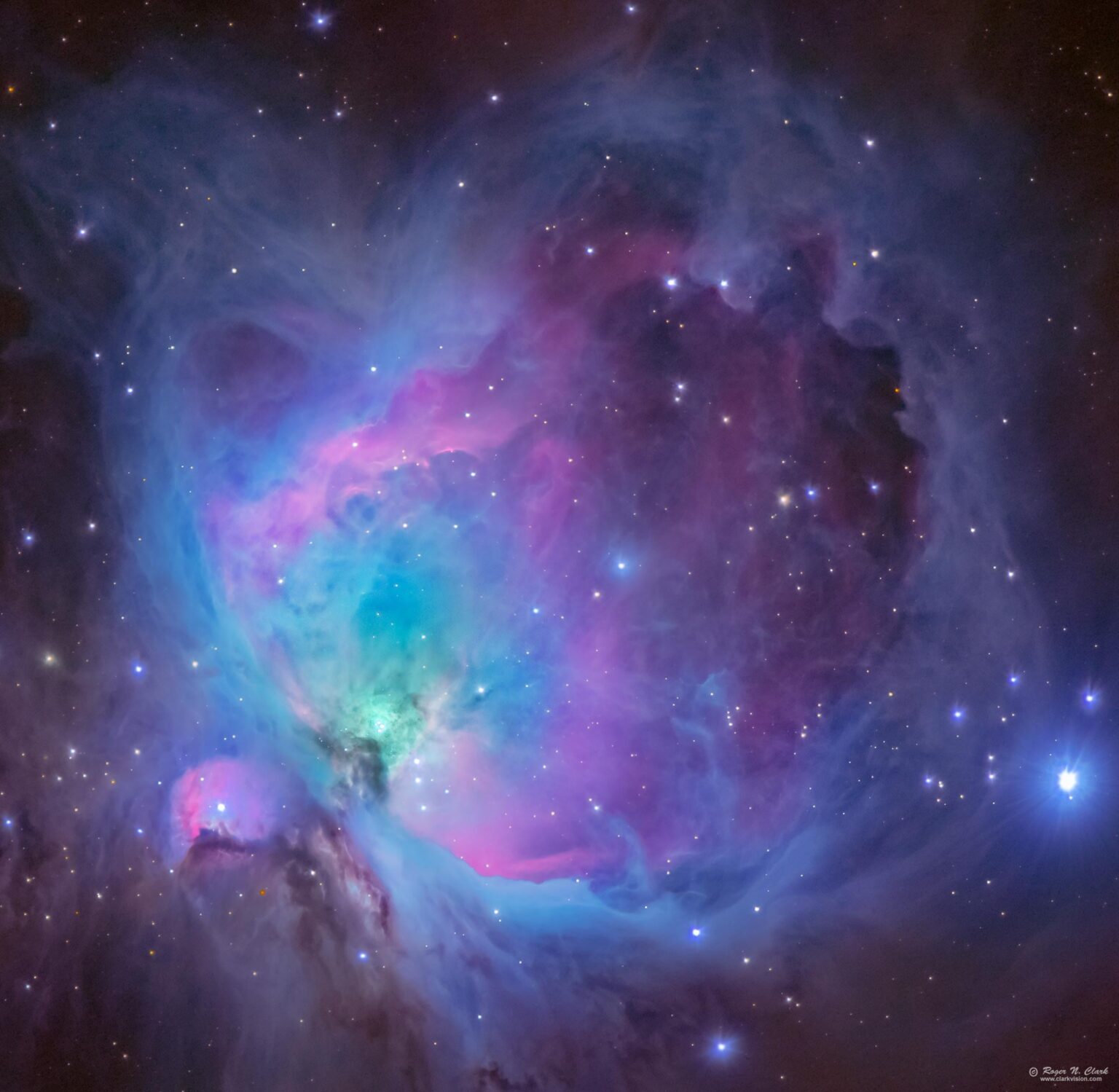
The Great Orion Nebula, Messier 42, shows beautiful colors. The
green/teal in the center (Trapezium area) is due to oxygen
emission. The pink is from hydrogen emission and the blue is
reflection from the many blue stars in the area. These colors can
be seen in large amateur telescopes. Faint reddish-brown interstellar
dust is in the background.
Imaged with a stock Canon 90D and a Canon 300 mm f/2.8 L IS II lens
plus a Canon 2x III teleconverter, giving 600 mm at f/5.6.
Total exposure time was 74.9 minutes at ISO 1600.
The bright Trapezium area includes eleven 1-second exposures,
and 24 2.6 second exposures. The brighter region surrounding the
Trapezium included 16 6.2 second exposures and the rest of the area
was 72 1-minute exposures.
This image was obtained from the slopes of Mauna Kea, Hawaii
(9,000 feet) on a bright airglow night (Bortle 3, borderline 4),
and during high winds, gusting to about 30 miles per hour.
The exposures were tracked on an iOptron HAE29EC strain-wave mount
with high resolution encoders and no guiding (because autoguiding
delays do not work well in gusty wind).
Raw conversion in photoshop to Adobe RGB color space. Photoshop
included a lens profile so the raw converted images are highly
calibrated with a flat field (in the lens profile), bias corrected,
and the sensor blocked dark current. Photoshop included the
application of the color correction matrix that is typically
skipped in the traditional astro workflow. Stacking in deep sky
stacker. Stretched with
[rnc-color-stretch](https://clarkvision.com/articles/astrophotography-rnc-color-stretch/),
and final adjustments in photoshop. No darks, no flats, no bias
frames measured (bias is in the camera EXIF data and a flat field
is in the raw converter lens profile and corrected during raw
conversion). This is a highly calibrated image with color managed
workflow.

1 Comment
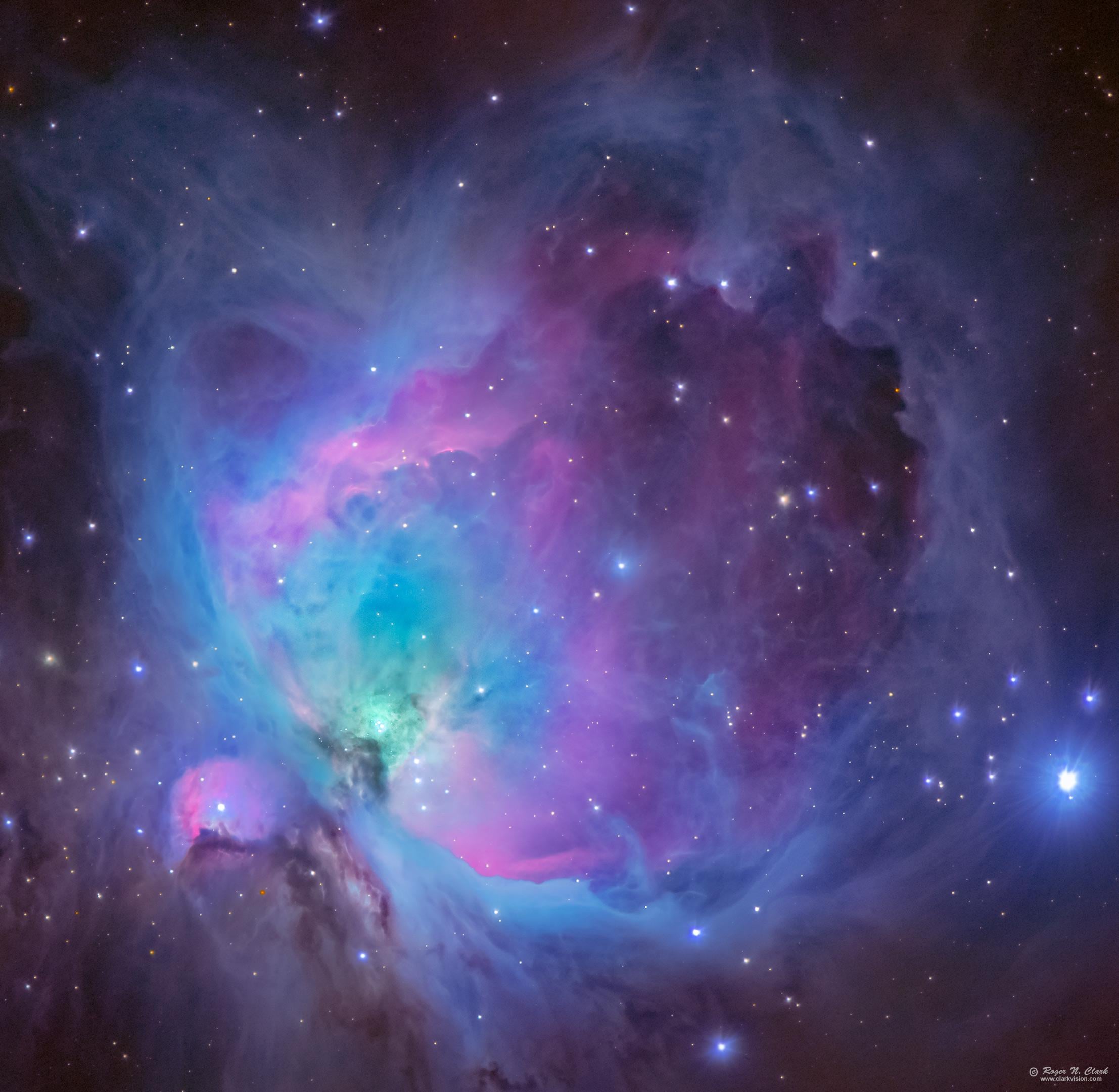
The Great Orion Nebula, Messier 42, shows beautiful colors. The
green/teal in the center (Trapezium area) is due to oxygen
emission. The pink is from hydrogen emission and the blue is
reflection from the many blue stars in the area. These colors can
be seen in large amateur telescopes. Faint reddish-brown interstellar
dust is in the background.
Imaged with a stock Canon 90D and a Canon 300 mm f/2.8 L IS II lens
plus a Canon 2x III teleconverter, giving 600 mm at f/5.6.
Total exposure time was 74.9 minutes at ISO 1600.
The bright Trapezium area includes eleven 1-second exposures,
and 24 2.6 second exposures. The brighter region surrounding the
Trapezium included 16 6.2 second exposures and the rest of the area
was 72 1-minute exposures.
This image was obtained from the slopes of Mauna Kea, Hawaii
(9,000 feet) on a bright airglow night (Bortle 3, borderline 4),
and during high winds, gusting to about 30 miles per hour.
The exposures were tracked on an iOptron HAE29EC strain-wave mount
with high resolution encoders and no guiding (because autoguiding
delays do not work well in gusty wind).
Raw conversion in photoshop to Adobe RGB color space. Photoshop
included a lens profile so the raw converted images are highly
calibrated with a flat field (in the lens profile), bias corrected,
and the sensor blocked dark current. Photoshop included the
application of the color correction matrix that is typically
skipped in the traditional astro workflow. Stacking in deep sky
stacker. Stretched with
[rnc-color-stretch](https://clarkvision.com/articles/astrophotography-rnc-color-stretch/),
and final adjustments in photoshop. No darks, no flats, no bias
frames measured (bias is in the camera EXIF data and a flat field
is in the raw converter lens profile and corrected during raw
conversion). This is a highly calibrated image with color managed
workflow.
Original plate scale = 1.1 arc-seconds per pixel and this image is
presented at 1.34 arc-seconds per pixel.
More information in [my gallery page
here.](https://clarkvision.com/galleries/gallery.astrophoto-1/web/m42-600mm-rnclark-c12-02-2024-acr-IMG_3505-671-av75min-i-1.0x-c1-0.66xs.html)