

Link to the news release on NASA website
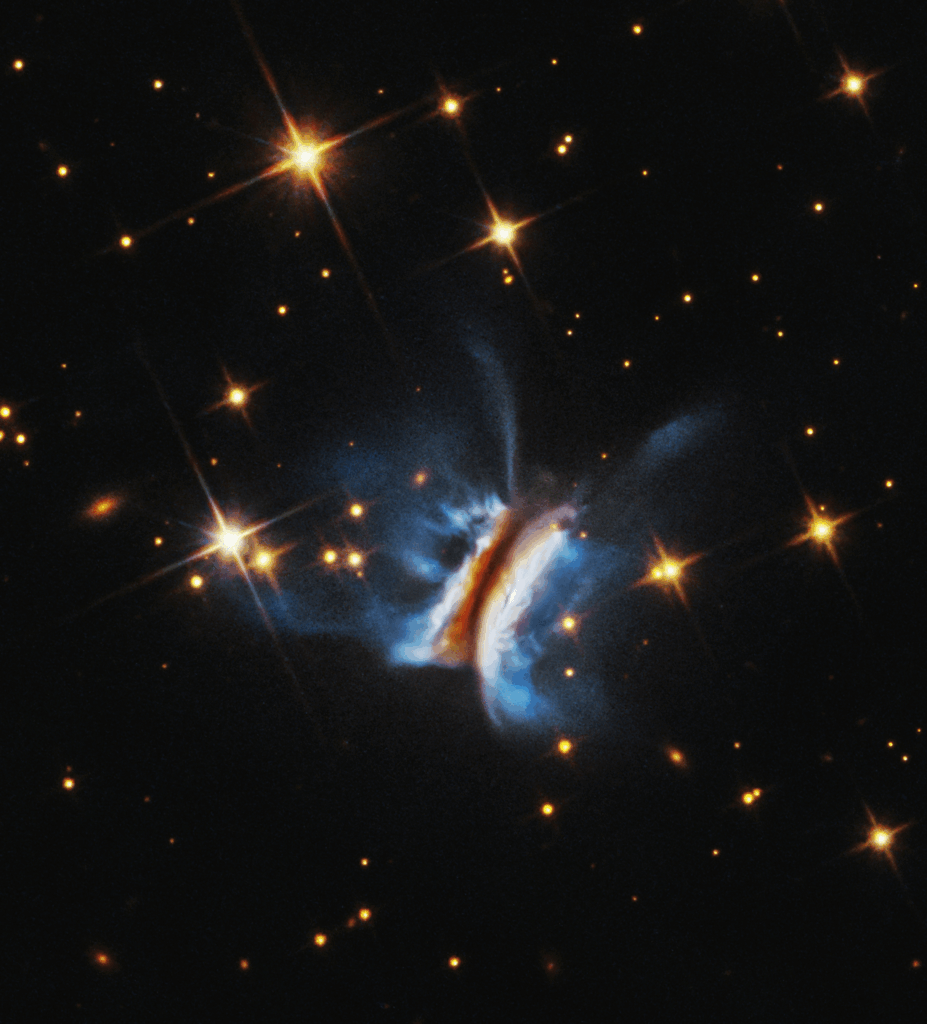
This Hubble Space Telescope image shows the largest planet-forming disk ever observed around a young star. It spans nearly 400 billion miles — 40 times the diameter of our solar system.
Tilted nearly edge-on as seen from Earth, the dark, dusty disk resembles a hamburger. Hubble reveals it to be unusually chaotic, with bright wisps of material extending far above and below the disk—more than seen in any similar circumstellar disk.
Cataloged as IRAS 23077+6707, the system is located approximately 1,000 light-years from Earth. The discovery marks a new milestone for Hubble and offers fresh insight into planet formation in extreme environments across the galaxy.
Image Credit: NASA, ESA, STScI, Kristina Monsch (CfA)
Image Processing: Joseph DePasquale (STScI)
by Busy_Yesterday9455
9 Comments
Looks like a galactic sandwich!
“Now Jason, you can’t be leaving your sandwiches all over the universe for people to observe.” Said Dawn, glaring at him.
Looks like a galactic buttcrack, or spred thighs.
Ya’ll need Jesus. Looks like a butterfly or moth.
And billions of years from now one of its formed planets may harbor complex life while humans here will be long gone.
The cycle continues..
Aww ethereal hotdog nebula
Fascinating
Butterfly Nebulae ?
now i want JWST to also image this region in all it‘s glorius details..