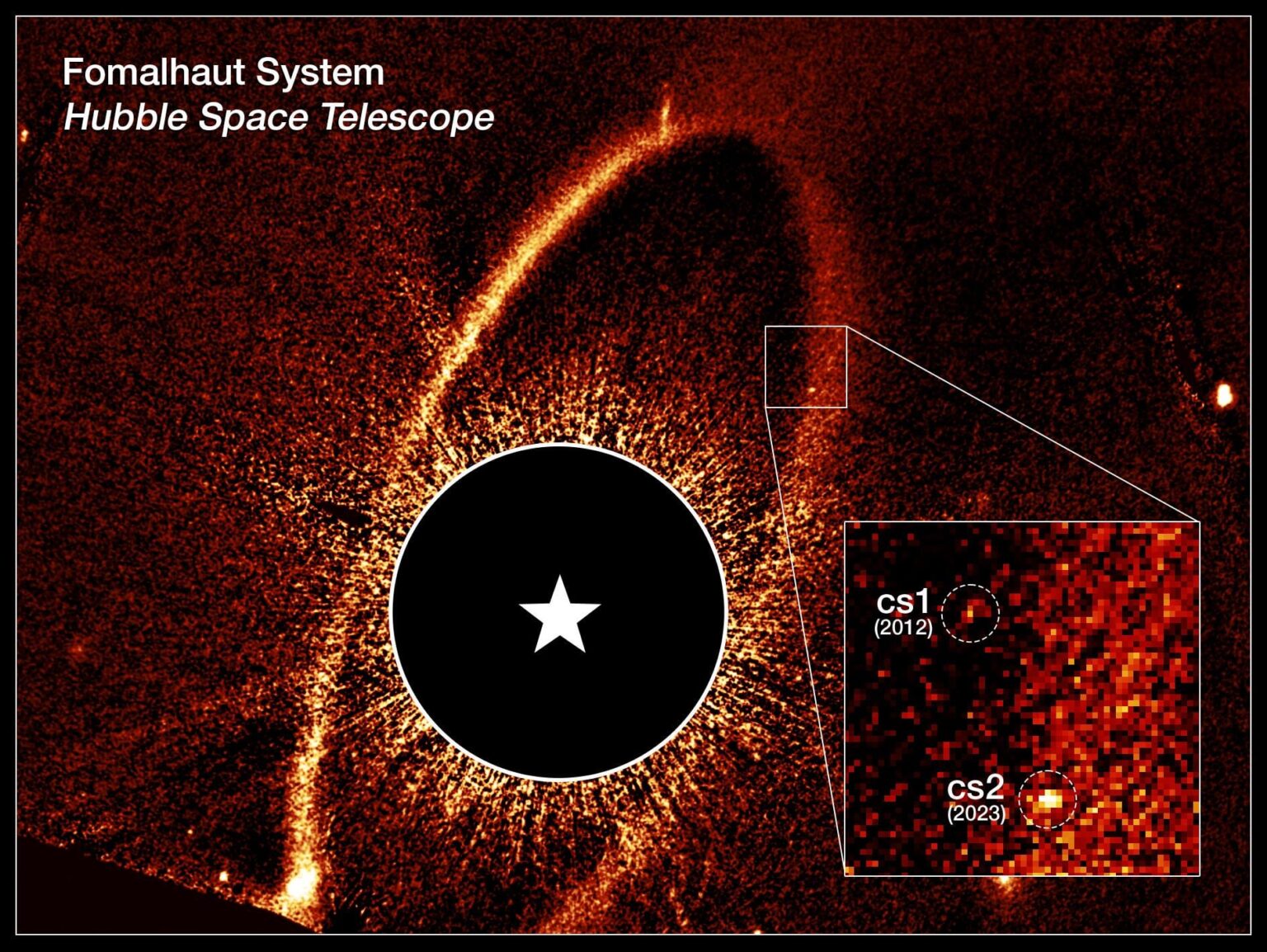
This composite NASA/ESA Hubble Space Telescope image shows the debris ring and dust clouds cs1 and cs2 around the star Fomalhaut. For comparison, dust cloud cs1, imaged in 2012, is pictured with dust cloud cs2, imaged in 2023. The dashed circles mark the location of these clouds. When dust cloud cs2 suddenly appeared, astronomers quickly noticed they had witnessed the violent collision of two massive objects. Previously thought to be a planet, cs1 is now classified as a similar debris cloud. In this image, Fomalhaut itself is masked out to allow the fainter features to be seen. Its location is marked by the white star.
NASA, ESA, P. Kalas (UC Berkeley), J. DePasquale (STScI)
.
In a historical milestone, astronomers using the NASA/ESA Hubble Space Telescope witnessed the catastrophic collisions in a nearby planetary system. As they observed the bright star Fomalhaut, scientists saw the impact of massive objects around the star. The Fomalhaut system appears to be in a dynamical upheaval, similar to what our Solar System experienced in its first few hundred million years after formation.
“This is certainly the first time I’ve ever seen a point of light appear out of nowhere in an exoplanetary system,” said principal investigator Paul Kalas of the University of California, Berkeley. “It’s absent in all of our previous Hubble images, which means that we just witnessed a violent collision between two massive objects and a huge debris cloud unlike anything in our own Solar System today. Amazing!”
Just 25 light-years from Earth, Fomalhaut is one of the brightest stars in the night sky. Located in the constellation Piscis Austrinus, also known as the Southern Fish, it is more massive and brighter than the Sun and is encircled by several belts of dusty debris.
In 2008, scientists used Hubble to discover a candidate planet around Fomalhaut, making it the first stellar system with a possible planet found using visible light. That object, called Fomalhaut b, now appears to be a dust cloud masquerading as a planet – the result of colliding planetesimals. While searching for Fomalhaut b in recent Hubble observations, scientists were surprised to find a second point of light at a similar location around the star. They call this object “circumstellar source 2” or “cs2” while the first object is now known as “cs1.”
Princess_emily12 on
RIP space rock 🙁
bennet99 on
Damn they even captured the star
Cold-Cell2820 on
Today I learned that we can detect astroids in other planetary systems.


5 Comments
image:
Fomalhaut cs1 and cs2 (annotated)
This composite NASA/ESA Hubble Space Telescope image shows the debris ring and dust clouds cs1 and cs2 around the star Fomalhaut. For comparison, dust cloud cs1, imaged in 2012, is pictured with dust cloud cs2, imaged in 2023. The dashed circles mark the location of these clouds. When dust cloud cs2 suddenly appeared, astronomers quickly noticed they had witnessed the violent collision of two massive objects. Previously thought to be a planet, cs1 is now classified as a similar debris cloud. In this image, Fomalhaut itself is masked out to allow the fainter features to be seen. Its location is marked by the white star.
This image was created from Hubble data from proposal #[17139](https://archive.stsci.edu/proposal_search.php?mission=hst&id=17139) (P. Kalas).
NASA, ESA, P. Kalas (UC Berkeley), J. DePasquale (STScI)
.
In a historical milestone, astronomers using the NASA/ESA Hubble Space Telescope witnessed the catastrophic collisions in a nearby planetary system. As they observed the bright star Fomalhaut, scientists saw the impact of massive objects around the star. The Fomalhaut system appears to be in a dynamical upheaval, similar to what our Solar System experienced in its first few hundred million years after formation.
“This is certainly the first time I’ve ever seen a point of light appear out of nowhere in an exoplanetary system,” said principal investigator Paul Kalas of the University of California, Berkeley. “It’s absent in all of our previous Hubble images, which means that we just witnessed a violent collision between two massive objects and a huge debris cloud unlike anything in our own Solar System today. Amazing!”
Just 25 light-years from Earth, Fomalhaut is one of the brightest stars in the night sky. Located in the constellation Piscis Austrinus, also known as the Southern Fish, it is more massive and brighter than the Sun and is encircled by several belts of dusty debris.
In 2008, scientists used Hubble to discover a candidate planet around Fomalhaut, making it the first stellar system with a possible planet found using visible light. That object, called Fomalhaut b, now appears to be a dust cloud masquerading as a planet – the result of colliding planetesimals. While searching for Fomalhaut b in recent Hubble observations, scientists were surprised to find a second point of light at a similar location around the star. They call this object “circumstellar source 2” or “cs2” while the first object is now known as “cs1.”
RIP space rock 🙁
Damn they even captured the star
Today I learned that we can detect astroids in other planetary systems.
Dark forest strikes again