
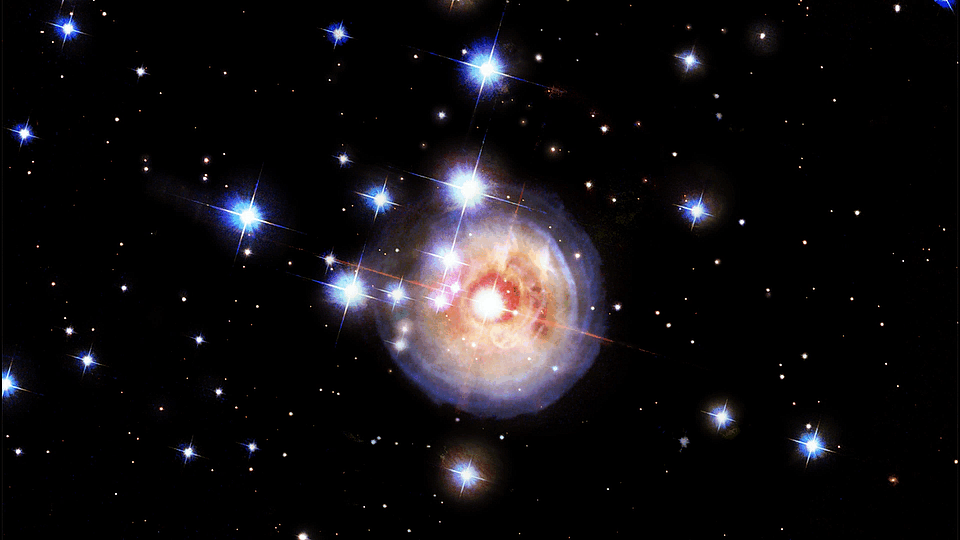
V838 Monocerotis (V838 Mon) underwent an outburst early in 2002, during which it temporarily increased in brightness to become 600,000 times more luminous than our Sun.
Light from this sudden eruption is illuminating the interstellar dust surrounding the star, producing the most spectacular "light echo" in the history of astronomy.
Credit: ESA/Hubble
by Busy_Yesterday9455
7 Comments
Rapidly brightening objects like novae and supernovae are known to produce a phenomenon known as **light echo**.
The light that travels directly from the object arrives first. If there are clouds of interstellar matter around the star, some light is reflected from the clouds. Because of the longer path, the reflected light arrives later, producing **a vision of expanding rings of light around the erupted object**.
The rings appear to travel faster than the speed of light, but in fact they do not.
Wouldn’t that mean hubble was stuck in the same place for several years? Isn’t it moving?
Bwoosh
Sometimes death is beautiful
I could watch this on loop for days and never get bored.
How big was the blast and how fast did it move
So if the telescope saw it between those times, how many millions of years ago did it actually happen?