
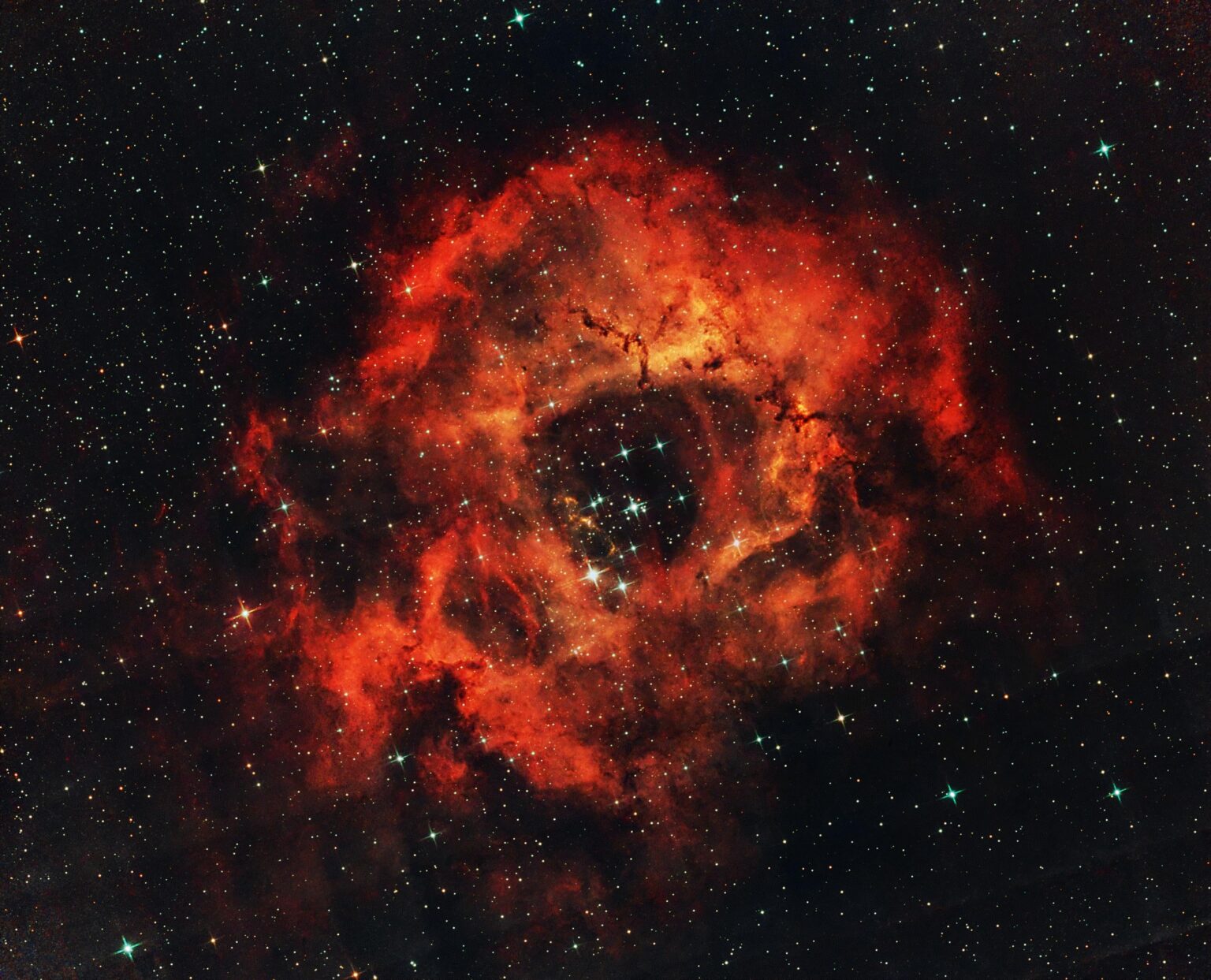

This is the Rosette Nebula — a giant cloud of gas and dust where new stars are being born. It sits about 5,000 light-yearsaway and is roughly the size of 130 light-years across. The bright stars in the middle have carved out the central cavity and heat the gas so it glows red. I photographed this for 7 hours 30 minutes over two nights — that long exposure brings out the faint clouds you see here.
Catalogued as NCG 2237, the Rosette Nebula lives up to its informal nickname, as its circular shape and deep, dark centre gives it a floral appearance.
At the centre of the nebula is NGC 2244, a group of stars that form a gravitationally bound open star cluster thought to be about 4 million years old.
These stars emit streams of charged particles known as stellar winds, carving out the gas and dust at the nebula's centre and giving it the Rosette nickname.
The surrounding gas that forms a ring around the dark centre is glowing because it is being blasted by radiation from nearby stars, making the Rosette Nebula an emission nebula.
Captured using Seestar S50 across two nights
(LP inbuilt filter)
Night 1: Approximately 3 hours and 30 minutes
Night 2: Approximately 4 hours and 18 minutes
Total integration time is approximately 7 hours and 40 minutes
Stacked: Siril
Background Extraction and Denoising: GraXpert
Star Removal and Enhancements (SetiAstroSuite Scripts): Siril
Final Curves and Contrast Enhancements: Photoshop
by Muted_Golf_1550
4 Comments
That long exposure really makes the Rosette Nebula’s details pop, it looks incredible!
Looks like a skull! Incredible!
I forgot to mention
It was a mosaic: 1.6x framed right in the middle, where the star cluster (NGC 2244) lies.
Time: started at 11:40pm (both nights)
Also do check out my Astrophotography Account on IG: _.cosmicframesbypranav._ (Underscores at the start and end)