

ESA/CNR-IASF, Rome, Italy, and Observatoire de Paris, France
https://bsky.app/profile/science.esa.int/post/3m56ndjt4cg2q
https://sci.esa.int/web/venus-express/-/39104-first-images-from-venus-express
by Neaterntal
ESA/CNR-IASF, Rome, Italy, and Observatoire de Paris, France
https://bsky.app/profile/science.esa.int/post/3m56ndjt4cg2q
https://sci.esa.int/web/venus-express/-/39104-first-images-from-venus-express
by Neaterntal
2 Comments
Image:
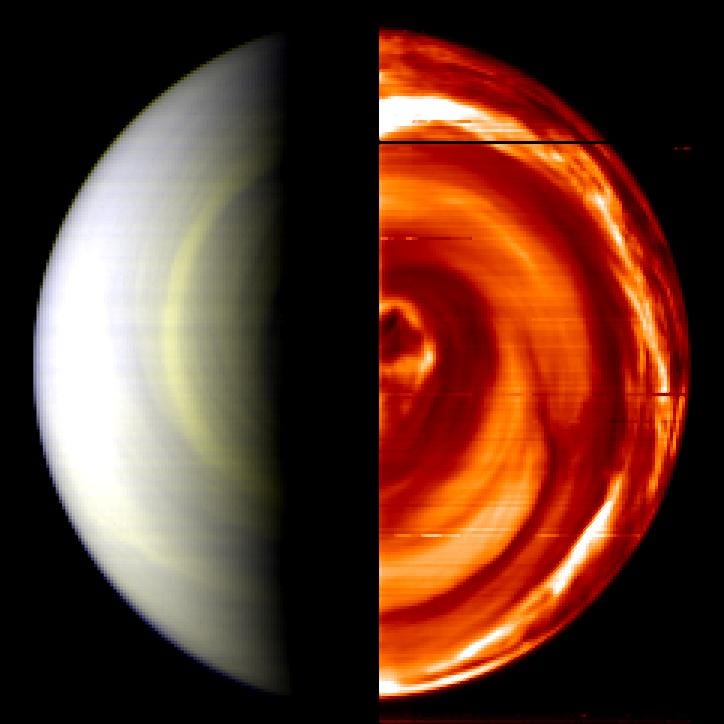
This false-colour VIRTIS composite image shows Venus’s day side on the left and night side on the right, with a scale of 50 km per pixel.
The day half is itself a composite of images taken via wavelength filters and chiefly shows sunlight reflected from the tops of clouds, down to a height of about 65 km above the planet’s surface.
The image of the night half was taken via an infrared filter at a wavelength of 1.7 μm, and chiefly shows dynamic spiral cloud structures in the lower atmosphere, around 55 km altitude. The darker regions correspond to thicker cloud cover, while the brighter regions correspond to thinner cloud cover, allowing hot thermal radiation from lower down to be imaged.
..
13 April 2006
**ESA’s Venus Express has returned the first-ever images of the Venusian south pole, from a distance of 206 452 kilometres, showing surprisingly clear structures and unexpected detail. The images were taken 12 April during the spacecraft’s initial capture orbit after successful arrival on 11 April 2006.**
Engineers have lost no time in switching on several of the instruments and yesterday the VMC (Venus Monitoring Camera) and VIRTIS (Visible and Infrared Thermal Imaging Spectrometer) imaged, for the first time in space history, the southern hemisphere of Venus as the spacecraft passed below the planet in an elliptical arc.
.
Scientists are especially intrigued by the dark vortex shown almost directly over the south pole, a previously suspected but until now unconfirmed structure that corresponds to a similar cloud structure over the north pole. *”Just one day after arrival, we are already experiencing the hot, dynamic environment of Venus,”* said Dr Håkan Svedhem, Venus Express project scientist. *”We will see much more detail at an unprecedented level as we get over 100 times better resolution as we get closer to Venus, and we expect to see these spiral structures evolve very quickly.”*
[More](https://sci.esa.int/web/venus-express/-/39104-first-images-from-venus-express)
..
[#VenusExpress](https://bsky.app/hashtag/VenusExpress) gave us a unique global picture of our nearest planetary neighbour and paved the way to [#ESAEnvision. ](https://bsky.app/hashtag/ESAEnvision.%C2%A0)
The [#VenusExpress](https://bsky.app/hashtag/VenusExpress) spacecraft was an adapted version of our Mars Express and used many of the spare instruments developed for that mission as well as for our Rosetta mission.
Its seven scientific instruments enabled scientists to dig into the secrets of the Venusian atmosphere.
[](https://bsky.app/profile/science.esa.int)
[https://bsky.app/profile/science.esa.int/post/3m56ndjt4cg2q](https://bsky.app/profile/science.esa.int/post/3m56ndjt4cg2q)
*this was not the first mission to venus by a long shot but esa’s first mission to venus