
Credit: ESA & NASA / Solar Orbiter / EUI-Team
https://www.mps.mpg.de/sun-first-glimpse-of-polar-magnetic-field-in-motion
by Neaterntal
Credit: ESA & NASA / Solar Orbiter / EUI-Team
https://www.mps.mpg.de/sun-first-glimpse-of-polar-magnetic-field-in-motion
by Neaterntal
1 Comment
Image:
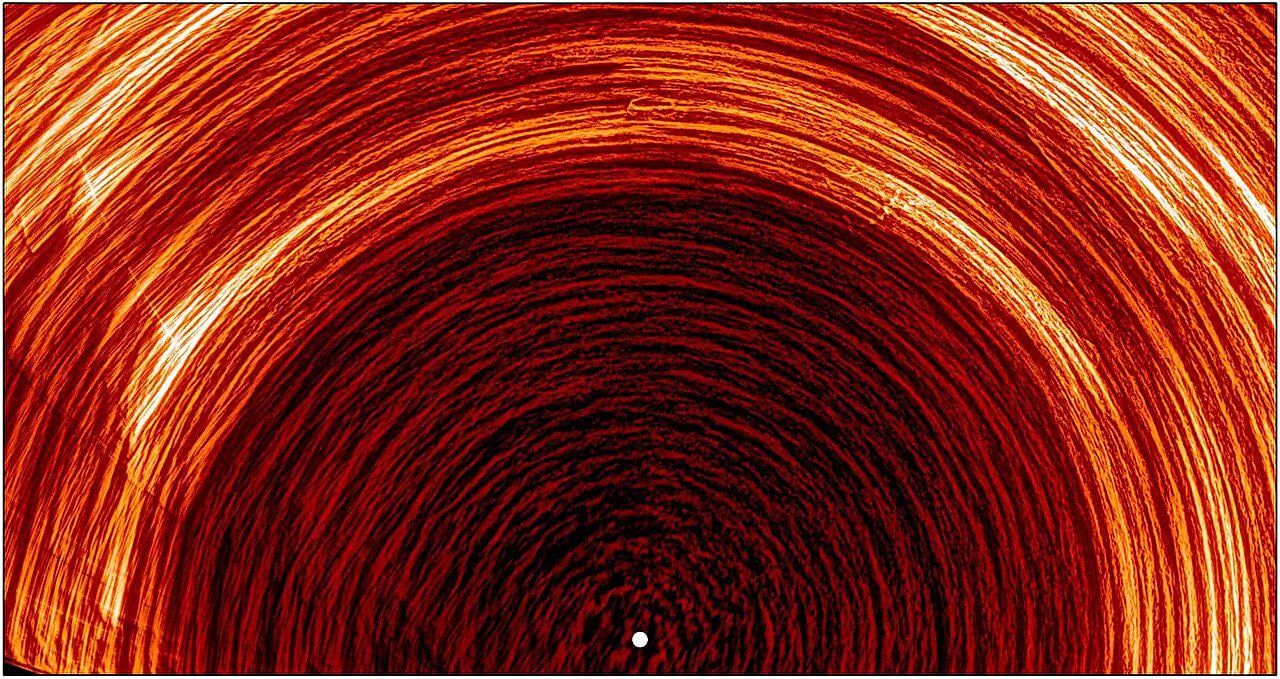
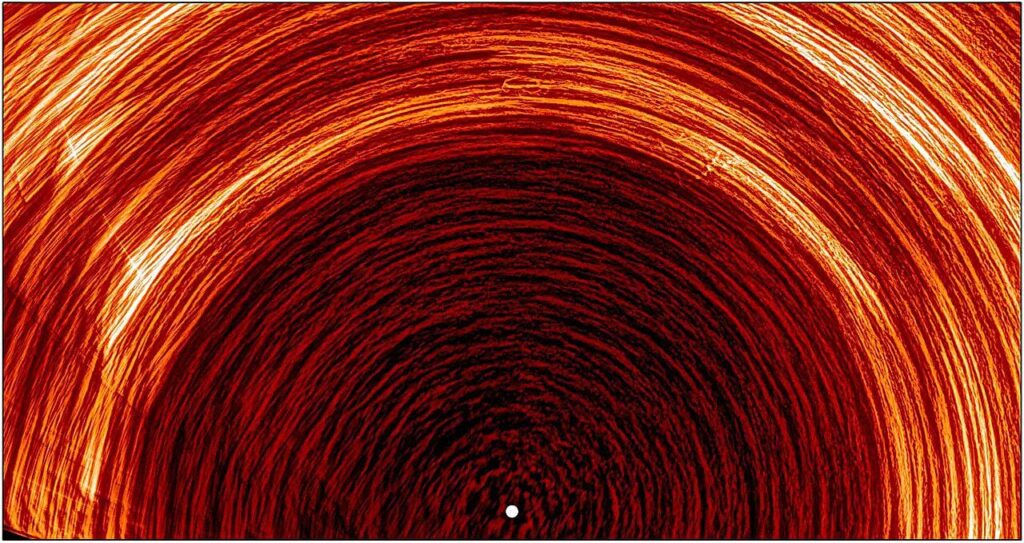
The magnetic network on the solar surface leaves imprints in the chromosphere above. In images of this region taken by Solar Orbiter’s Extreme Ultraviolet Imager (EUI), these imprints appear as bright spots. This processed EUI image of the sun’s south pole (indicated by the white dot) is constructed by combining eight days of observations from March this year. This image shows the tracks of the bright spots. Due to the sun’s rotation, they are seen as elongated, bright arcs. Credit: ESA & NASA / Solar Orbiter / EUI-Team
.
The sun is governed by a strict rhythm. The magnetic activity of the sun displays a cyclic variation, reaching a maximum approximately every eleven years. Two enormous plasma circulations, each in one solar hemisphere, set the pace for this rhythm, thus defining the sun’s eleven-year cycle. Near the surface, the plasma flows carry the magnetic field lines from the equator to the poles; in the solar interior, the plasma flows back to the equator in a huge cycle spanning the entire hemisphere.
Important details of this solar “magnetic field conveyor belt” are still poorly understood. The exact processes at the sun’s poles are likely to be crucial. From Earth, scientists have only a grazing view of this region, making it impossible to determine the properties of the magnetic field. Most space probes have a similarly limited perspective.
“To understand the sun’s magnetic cycle, we still lack knowledge of what happens at the sun’s poles. Solar Orbiter can now provide this missing piece of the puzzle,” says Sami Solanki, MPS director and co-author of a new study on this topic appearing in The Astrophysical Journal Letters.
Since February 2020, ESA’s Solar Orbiter spacecraft has been traveling in elongated ellipses around the sun. In March this year, it left for the first time the plane in which the planets—and almost all other space probes—orbit the sun. From a trajectory tilted by 17 degrees, Solar Orbiter now has a better view of the sun’s poles.
paper
[https://iopscience.iop.org/article/10.3847/2041-8213/ae10a3](https://iopscience.iop.org/article/10.3847/2041-8213/ae10a3)