Image obtained on October 21, 2025 at 11,170 feet elevation in
the Colorado Rockies. Bortle 5.
Camera and optics: Stock Canon EOS R5 Mirrorless 45 megapixel
Digital Camera and Canon 300 mm f/2.8 L IS II lens at f/2.8.
Tracked with no guiding on an
iOptron HAE29EC (the EC model has high resolution encoders that
correct periodic error real time, RPEC, without autoguiding, so
autoguiding is not needed).
Total exposure time was 20.8 minutes (78 15-second exposures) for
the stars and comet plus short exposures to show detail in the head
of the comet: 22 2.5 second exposures plus 24 1-second exposures,
all at ISO 1600. Exposures needed to be no longer than 15 seconds
because the comet was moving among the stars.
Processing: Raw conversion in photoshop, which includes full
calibration with bias in the EXIF data and flat in the lens profile,
daylight white balance, and application of the color correction
matrix for natural color. Color managed workflow. Stacked in
DSS on stars. I tried stacking on comet in DSS but it failed.
Stacked on comet with ImagesPlus using translate, scale, rotate
(TSR) where I manually selected the comet in each frame (manual
selection on 60 frames took about 2 minutes.
The big problem was erasing the blurred comet image in the stacked on
stars stretched image. It was effective but tedious in photoshop.
Then the stacked on comet was added to the stacked on stars for
this final result.
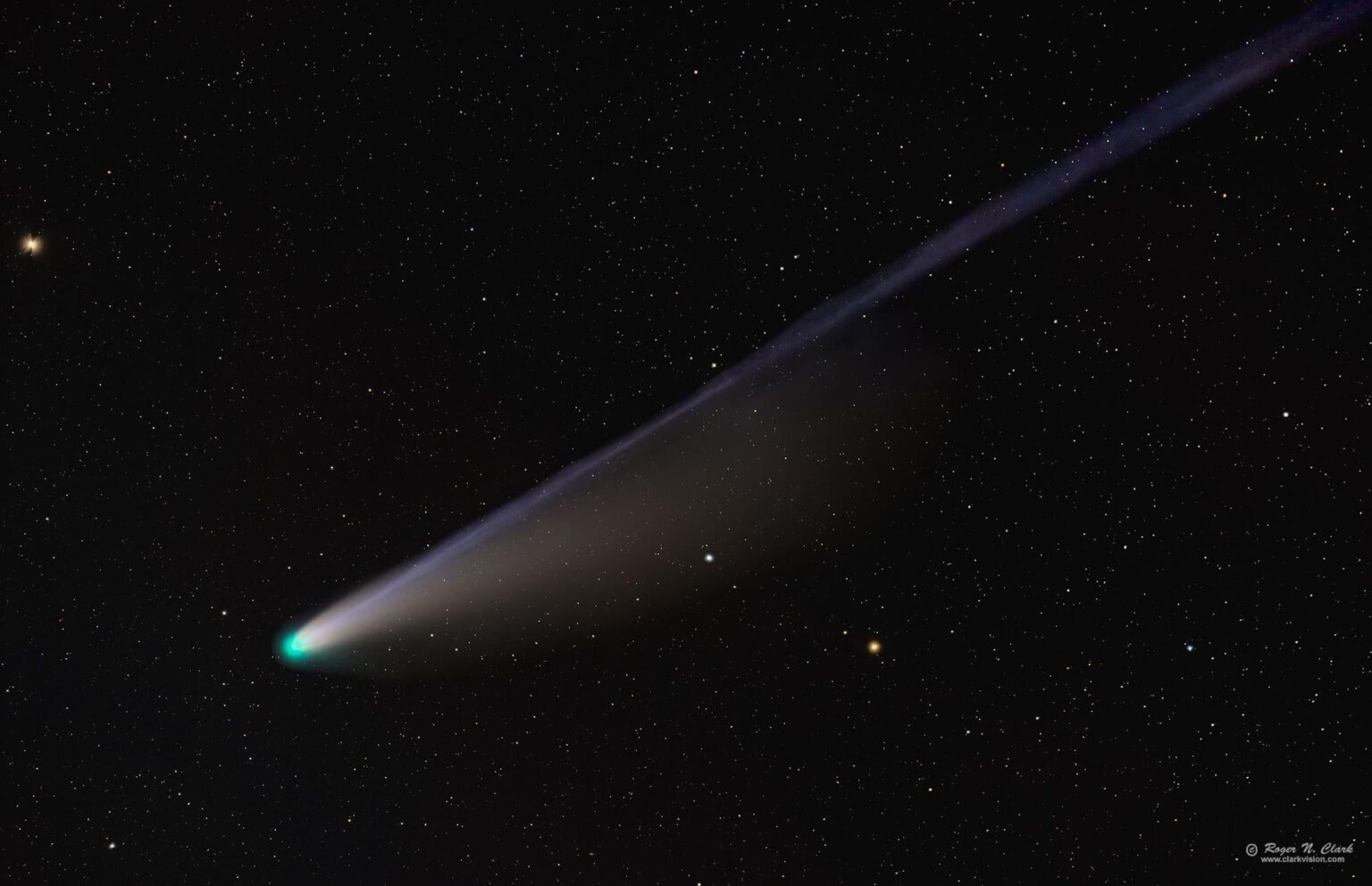
In the image, the ion tail is 5.7 degrees, and the dust tail is
3.1 degrees.

1 Comment
Image obtained on October 21, 2025 at 11,170 feet elevation in
the Colorado Rockies. Bortle 5.
Camera and optics: Stock Canon EOS R5 Mirrorless 45 megapixel
Digital Camera and Canon 300 mm f/2.8 L IS II lens at f/2.8.
Tracked with no guiding on an
iOptron HAE29EC (the EC model has high resolution encoders that
correct periodic error real time, RPEC, without autoguiding, so
autoguiding is not needed).
Total exposure time was 20.8 minutes (78 15-second exposures) for
the stars and comet plus short exposures to show detail in the head
of the comet: 22 2.5 second exposures plus 24 1-second exposures,
all at ISO 1600. Exposures needed to be no longer than 15 seconds
because the comet was moving among the stars.
Processing: Raw conversion in photoshop, which includes full
calibration with bias in the EXIF data and flat in the lens profile,
daylight white balance, and application of the color correction
matrix for natural color. Color managed workflow. Stacked in
DSS on stars. I tried stacking on comet in DSS but it failed.
Stacked on comet with ImagesPlus using translate, scale, rotate
(TSR) where I manually selected the comet in each frame (manual
selection on 60 frames took about 2 minutes.
Stretched both stacked on stars and stacked on comet images the same using
[rnc-color-stretch](https://clarkvision.com/articles/astrophotography-rnc-color-stretch/)
(which also subtracts skyglow in one step) with rootpower = 8,
-rootpower2 = 4, and scurve1.
The big problem was erasing the blurred comet image in the stacked on
stars stretched image. It was effective but tedious in photoshop.
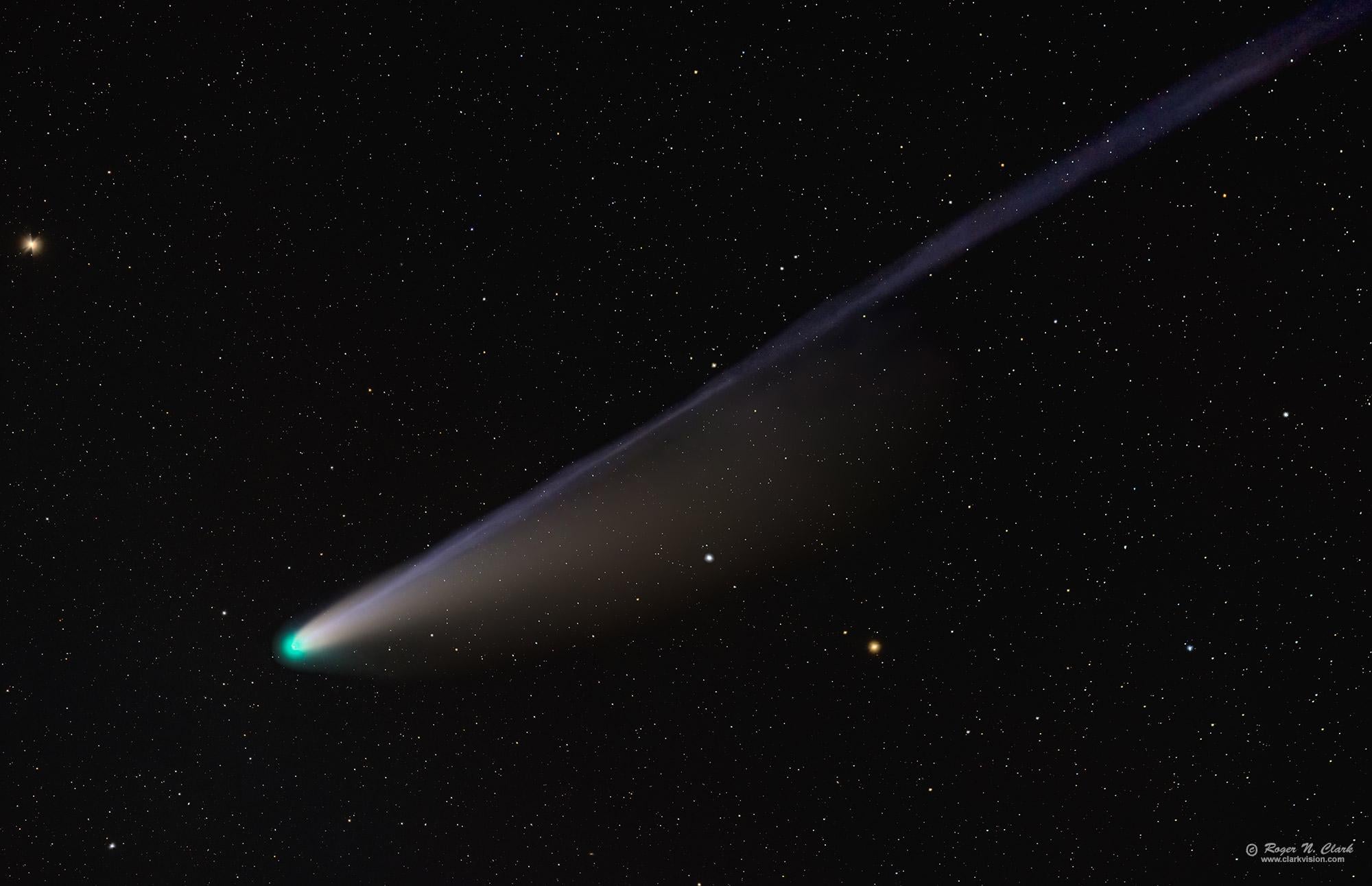
Then the stacked on comet was added to the stacked on stars for
this final result.
In the image, the ion tail is 5.7 degrees, and the dust tail is
3.1 degrees.
More info, including all the satellite
trails in the frames, are [in my gallery
here](https://clarkvision.com/galleries/gallery.comet/web/comet-lemon-2025-10-21-300mm-rnclark-4C3A4714-846-av78-e-2000s.html)