
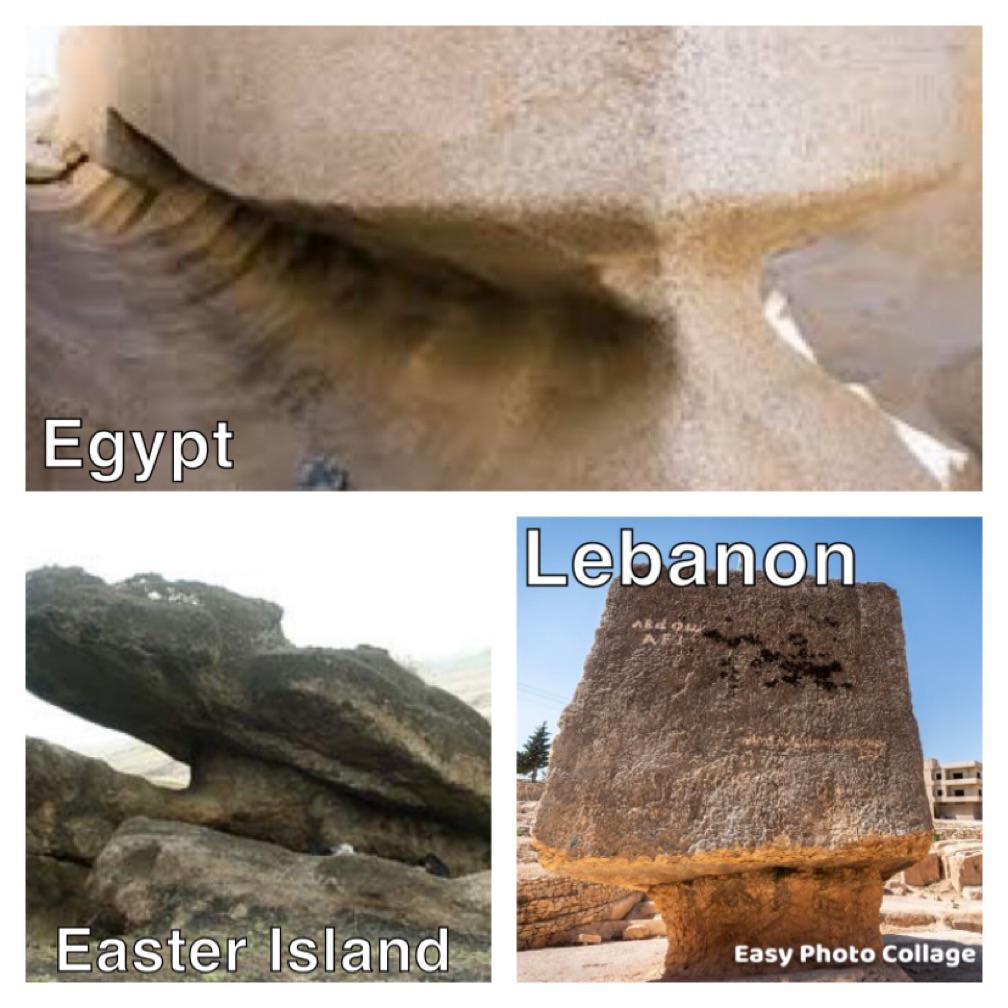
How does mainstream archeology explain the similarities between quarrying methods from ancient times? Surely they don’t say this was all done using pounding stones…..
by LarryWord33
How does mainstream archeology explain the similarities between quarrying methods from ancient times? Surely they don’t say this was all done using pounding stones…..
by LarryWord33
22 Comments
That was all done by pounding stones.
And Easter Island isn’t a continent.
Historically Lebanon shared borders with Egypt.
There’s only one way to dig under a rock.
People in Japan blow their noses the same way as people in Jamaica. It doesn’t mean the Sea People went around the world teaching everyone how to blow their noses.
Some things are similar because there’s only one way to do it.
I’m confused, what’s the alternative method?
Lol
Easter island 🗿
Hey ? Are you me ? Lol I been asking the same questions
> How does mainstream archeology explain the similarities between quarrying methods from ancient times
Because similar methods were used? In contexts where there are similar tool marks, the techniques used are assumed to be analogous.
> The stonecutting marks at *Kachiqhata* recall those found on the unfinished Egyptian obelisk at Aswan. The Incas’ cutting technique must not have been very different from the one used by the early Egyptians^1
–
___
> Surely they don’t say this was all done using pounding stones
No, they don’t. Some of the work shown here is reconstructed with stone tools – that in Egypt and Rapa Nui. I haven’t seen any academic arguments that the work at the Baalbek quarry was done with similar methods. The tool marks visible in [this](https://commons.wikimedia.org/wiki/File:Megaliths_in_Baalbek_quarry_10156.JPG) image show clear linear marks, which pounding stones don’t produce.
On the quarries at Baalbek, I reccomend “The Megalithic Quarry of Baalbek: Sector III the Megaliths of Ḥajjar al-Ḥibla” for a good survey.^2
–
It’s worth pointing out that we’ve not only found stone tools in quarries at Rapa Nui, but sites where stone for tools was mined and worked. Even if you disagree with the arguments that stone tools were being used for quarrying in these contexts, those arguments are being made on the basis of specific evidence.
> Simpson, Dale F., and Laure Dussubieux. “A Collapsed Narrative? Geochemistry and Spatial Distribution of Basalt Quarries and Fine–Grained Artifacts Reveal Communal Use of Stone on Rapa Nui (Easter Island).” *Journal of Archaeological Science: Reports*, vol. 18, 2018, pp. 370–385. https://doi.org/10.1016/j.jasrep.2018.01.038
–
> Simpson, Dale F., et al. “The Archaeological Documentation and Geochemistry of the Rua Tokitoki Adze Quarry and the Poike Fine‐grain Basalt Source on Rapa Nui (Easter Island).” *Archaeology in Oceania*, vol. 53, no. 1, 2017, pp. 15–27. https://doi.org/10.1002/arco.5132
–
___
1. Protzen, Jean-Pierre. *Inca Architecture and Construction at Ollantaytambo*. Oxford University Press, 1993. p. 170.
2. Abdul Massih, Jeanine. “The Megalithic Quarry of Baalbek: Sector III the Megaliths of Ḥajjar al-Ḥibla.” *Journal of Eastern Mediterranean Archaeology & Heritage Studies*, vol. 3, no. 4, 2015. https://doi.org/10.5325/jeasmedarcherstu.3.4.0313
How else are you gonna carve a big piece of rock free from another piece?
Sheesh
The top one is from the Aswan Quarry in Egypt. It’s a tourist site and before you go to see it, you have to watch a video on how they made these markings. It’s explained that they made those markings on the granite by hitting them with rocks over and over.
Believe it or not… this the official explanation…
Actually thats exactly how it was done.
Ancient peoples used a whole bunch of different rocks for different purposes. There were polishing stones, hammer stones, hand axes, and chisel stones.
In ancient Egypt however during the copper age, copper tools were used for many tasks along side old school rock methods. We know that for much of their carving, rock cutting, and quarry mining they used copper shivs and other tools because ancient work sites are littered with them INCLUDING the pyramids. We know that for intricate detailed work Corundum was used as an abrasive for drilling and polishing because it’s found imbedded in polished surfaces and in abundance at the bottom of drill holes. Corundum was used in the form of an abrasive powder made from Emery it was also probably used in a very early form of sand paper made from papyrus, resin, and the emery powder as well because there are murals and other art work showing carpenters using a paper to sand and smooth rough wooden works.
This abrasive powder was also used in Israel and surrounding regions for everyday things. One being the manufacturing of stone vessels.
Proved wrong lol Nope.
We often think of historical civilisations as being unintelligent compared to modern humans, but the fact is they were just as smart as we are, they just didn’t have thousands of years of innovation to support them like we do. Put an ipad into the hands of an ancient Egyptian child and they’ll work out how to use it just as quickly as a modern child would.
These people weren’t idiots that needed outside help to figure out how to carve a rock. Stop treating them as such.
The benefit of having to make every tool you ever touch in life from stone is an intimate knowledge of stone.
With that knowledge you look at stone differently. You can see right away it’s grain structure and how it fractures just at a glance or a test. They knew how to set up fractures to make the work load more efficient. They knew exactly what type of stones would work best for grinding down the project or pecking it to remove material the quickest.
I highly recommend everyone to watch some flint knapping and ground stone axe videos to get a deeper perspective, then to give it all a try.
The method for doing this is probably simple. Low grade diamonds were common. They could have heated a copper drum enough to coat the surface with diamonds and placed it at the end of a boom. Then used ropes and different sized pulleys to rapidly rotate the drum to cut the rock, using water buckets to cool the grinding head.
Not sure how advanced these people were, they apparently didn’t figure out how to get the bottom out.
yeah… there are a lot of questions out there that are unanswered, How you carve the 4th side of a rock you are trying to chisel out of the ground is not one off them.
What would be an alternative method to digging underneath?
It looks like they were quarrying the rock with those high pressure water jets. Makes me wonder if the Dendera Light is depicting them using it, and might also explain those “melted steps” at the temple of Hathor.
Water erosion?
Water
It’s almost as if, when facing the same problem, people find similar solutions
Looks like water erosion.
Ah yes, these three. All were completed on approximately the same day, April 17th 364,00 BCE. Truly remarkable.