
A Chinese supercomputer has topped the global Top500 ranking for the first time since 2017. The new system operates entirely on domestically developed processors, without relying on the graphics accelerators that power virtually all of the world’s other most powerful supercomputers.
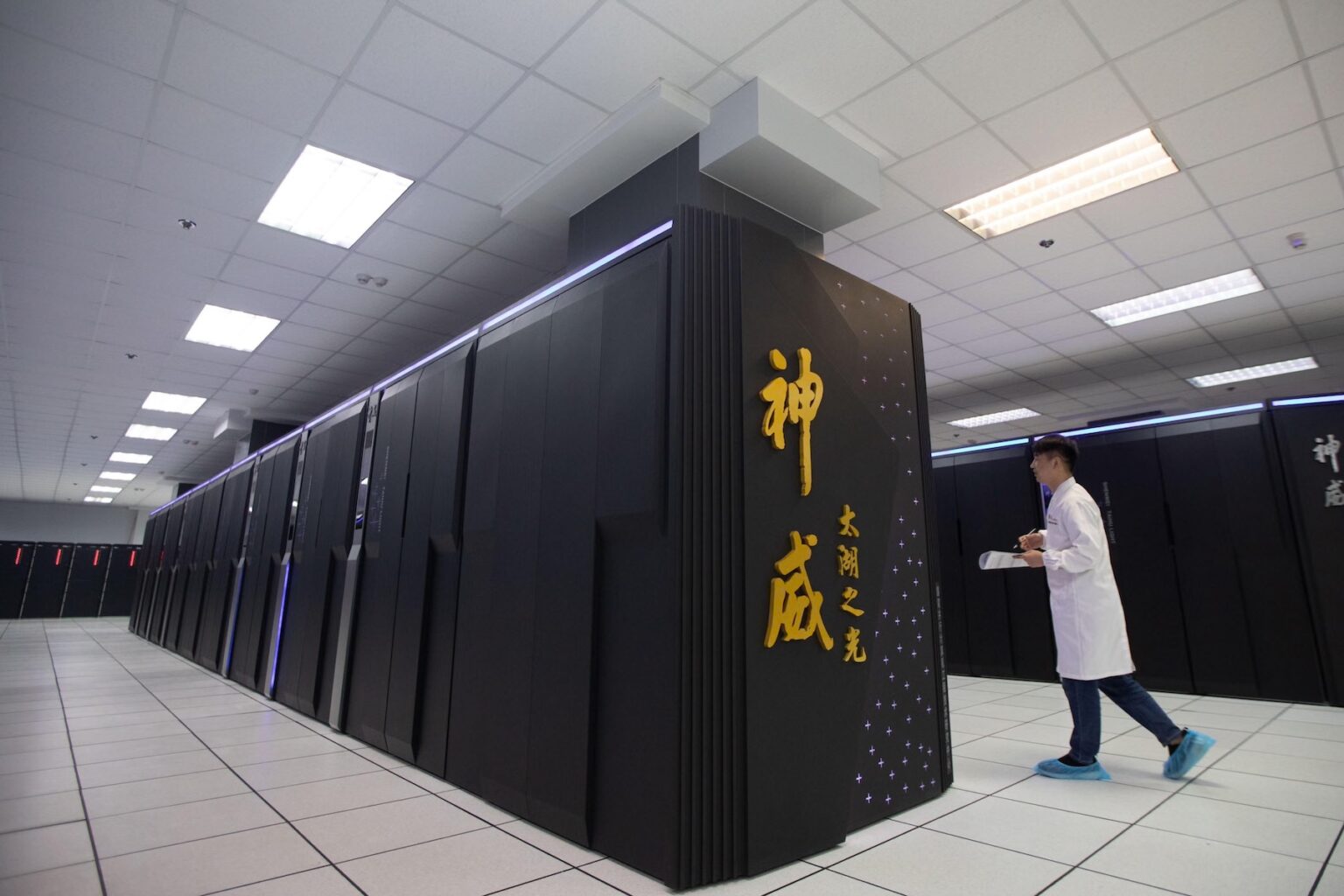 A technician performs an inspection of the LineShine supercomputer. Credit: China News Service, source: Getty Images
A Record Without Accelerators
The LineShine supercomputer is installed at the National Computer Center in Shenzhen. According to the results of the High Performance Linpack (HPL) test, its performance reached over two quintillion calculations per second. This is 21% higher than that of the previous leader, the American El Capitan from the Lawrence Livermore National Laboratory in California.
The system is built on LX2 processors with ARMv9 architecture, totaling nearly 13.8 million computing cores. They are connected via the proprietary LingQi network and run on the Kylin operating system. LineShine requires approximately 42.2 megawatts of electricity to operate.
Top of the Rankings
The El Capitan supercomputer is now in second place, followed by two other American systems at national laboratories in Tennessee and Illinois. The German Jupiter holds fifth place. Together, these machines remain the only publicly verified supercomputers with performance exceeding a quintillion calculations per second.
Among other countries in the top ten are Italy, Switzerland, and Japan. The United Kingdom has 11 systems in the ranking, with the highest-ranked among them—in 11th place—being the University of Bristol’s Isambard-AI.
China’s Return
The previous Chinese leader in the rankings, Sunway TaihuLight, held the top spot in 2016–2017 and was more than 23 times slower than LineShine. After 2017, Japanese and American systems consistently held the top positions.
Following the escalation of the trade war with the U.S., China effectively stopped submitting data to the Top 500, fearing additional sanctions against domestic manufacturers. LineShine’s inclusion in the ranking marked the first such submission in several years and demonstrates the developers’ confidence that none of the components are subject to U.S. export restrictions.
It’s Not Just About Speed
The Top 500 ranking evaluates performance using the HPL test, which assesses the ability to solve large systems of linear equations with double precision. Supercomputers are used to model astronomical phenomena, climate systems, search for new drugs, simulate nuclear explosions, and conduct virtual weapons testing.
On another test, the HPL-MxP, which measures mixed-precision performance and better reflects artificial intelligence workloads, LineShine ranked only fourth. El Capitan remained the leader in this metric with a score twice as high. The lack of specialized accelerators limits the Chinese system’s effectiveness specifically for AI tasks.
The Supercomputer Race in Europe
Last year, the EU announced a €20 billion plan to build so-called artificial intelligence “gigafactories” equipped with powerful supercomputers. These complexes are expected to contain over 100,000 specialized processors, whereas the best modern data centers currently have up to 25,000.
Cooling these facilities requires enormous amounts of water, and the sites themselves are expected to run primarily on “green” energy. Environmental organizations warn that data centers of this scale could jeopardize Europe’s climate goals.
According to theguardian.com