
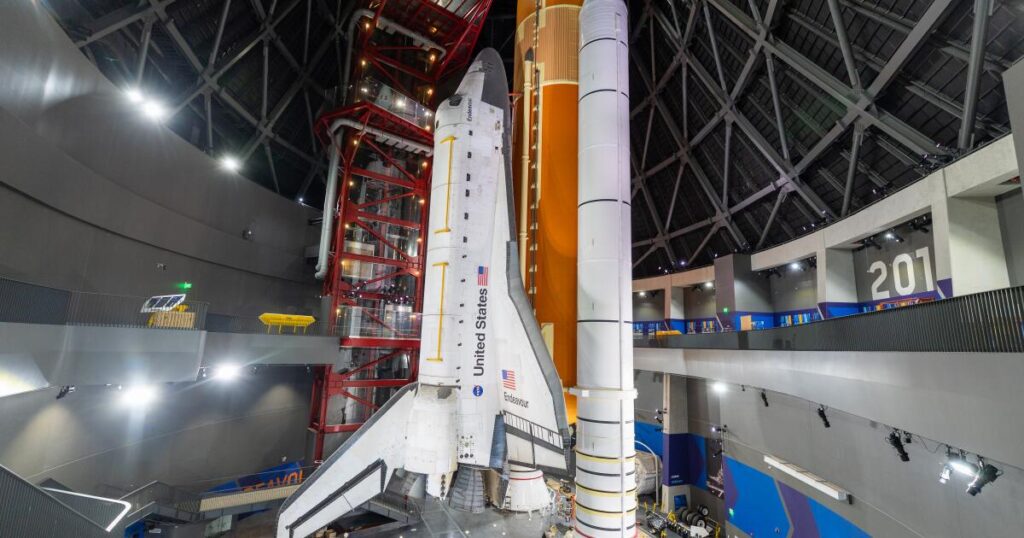
The Space Shuttle Endeavour is approaching its final mission. But this time, it won’t be blasting into a different atmosphere.
The California Science Center on Wednesday announced its Samuel Oschin Air and Space Center will open to the public on Nov. 13. The $450-million, 200,000-square-foot addition will permanently house the Korean Air Aviation Gallery and the Kent Kresa Space Gallery. But its centerpiece will be the Samuel Oschin Shuttle Gallery, where the Space Shuttle Endeavour will be on permanent display in its vertical “ready-to-launch” position.
When it debuts, the gallery will be the only place in the world with a complete shuttle stack, including orbiter, solid rocket boosters and an external tank.
“I’ve been here a long time. We’ve done a lot of great stuff, but this just keeps getting better. Everybody on our team was so proud of it,” said Jeffrey Rudolph, the Science Center’s president and chief executive. “We are incredibly excited, and we actually think people are gonna come from all over the world to see this thing.”
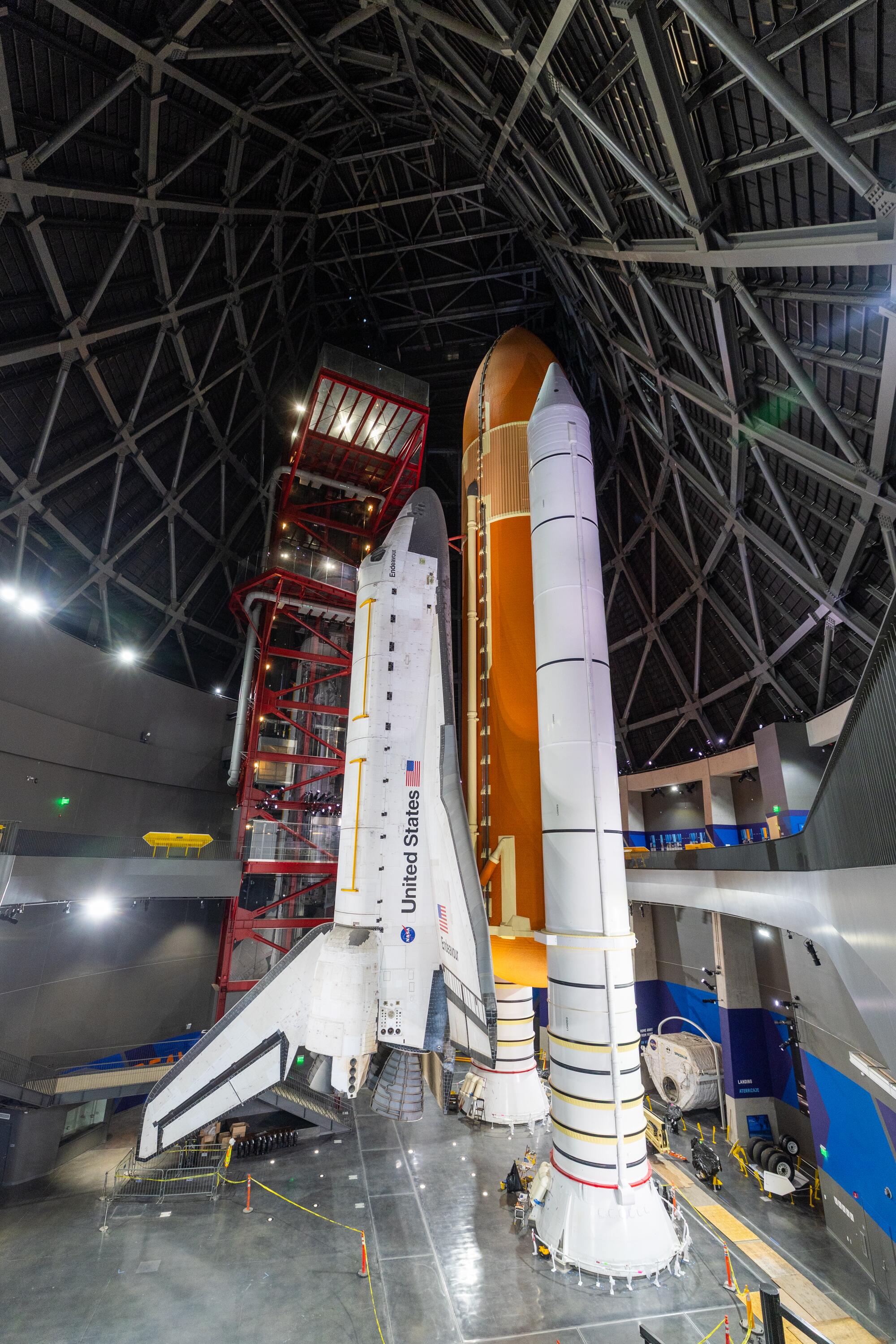
The Samuel Oschin Air and Space Center will open to the public on Nov. 13. The $450-million, 200,000-square-foot space includes the Samuel Oschin Shuttle Gallery, where the Space Shuttle Endeavour will be on permanent display in launch position.
(Allen J. Schaben / Los Angeles Times)
The Air and Space Center opening will mark the completion of the master plan adapted by the Science Center in 1993. One of three surviving space shuttles, the Endeavour made 25 successful missions into space between 1992 and 2011. In 2012, the shuttle arrived at LAX atop a modified Boeing 747 before being taken on a procession through the streets of Los Angeles to reach Exposition Park. Construction on the Samuel Oschin Air and Space Center, a sleek, 20-story building designed by ZGF Architects, finished in April.
“This shuttle really represents everything that my husband loved,” said Lynda Oschin, the widow of Samuel Oschin. “He was very involved in relativity, exploration, inspiration, children, math, science.”
Dennis R. Jenkins, project director at the California Science Center, estimated that at the height of construction, the team averaged about 400 construction workers a day. For Jenkins, who spent 30 years of his career as a NASA contractor working on space shuttles, seeing the Endeavour in its vertical position is “particularly special.”
“I walk in there 50 times a day, and 50 times a day it takes my breath away,” Jenkins said. “Especially when we have the theatrical lights on instead of the work lights, it is just so stunning to me. I’ve been around space shuttles for exactly 50 years now, and it still takes my breath away.”
Retired astronaut Barbara Morgan, who flew aboard Endeavour in 2007, said the shuttle will inspire space enthusiasts.
“This takes me back! I am right there again, strapped in, excited to launch,” Morgan said in a statement. “But this is even better, because here now is Endeavour for our future generations. She will launch big dreams.”
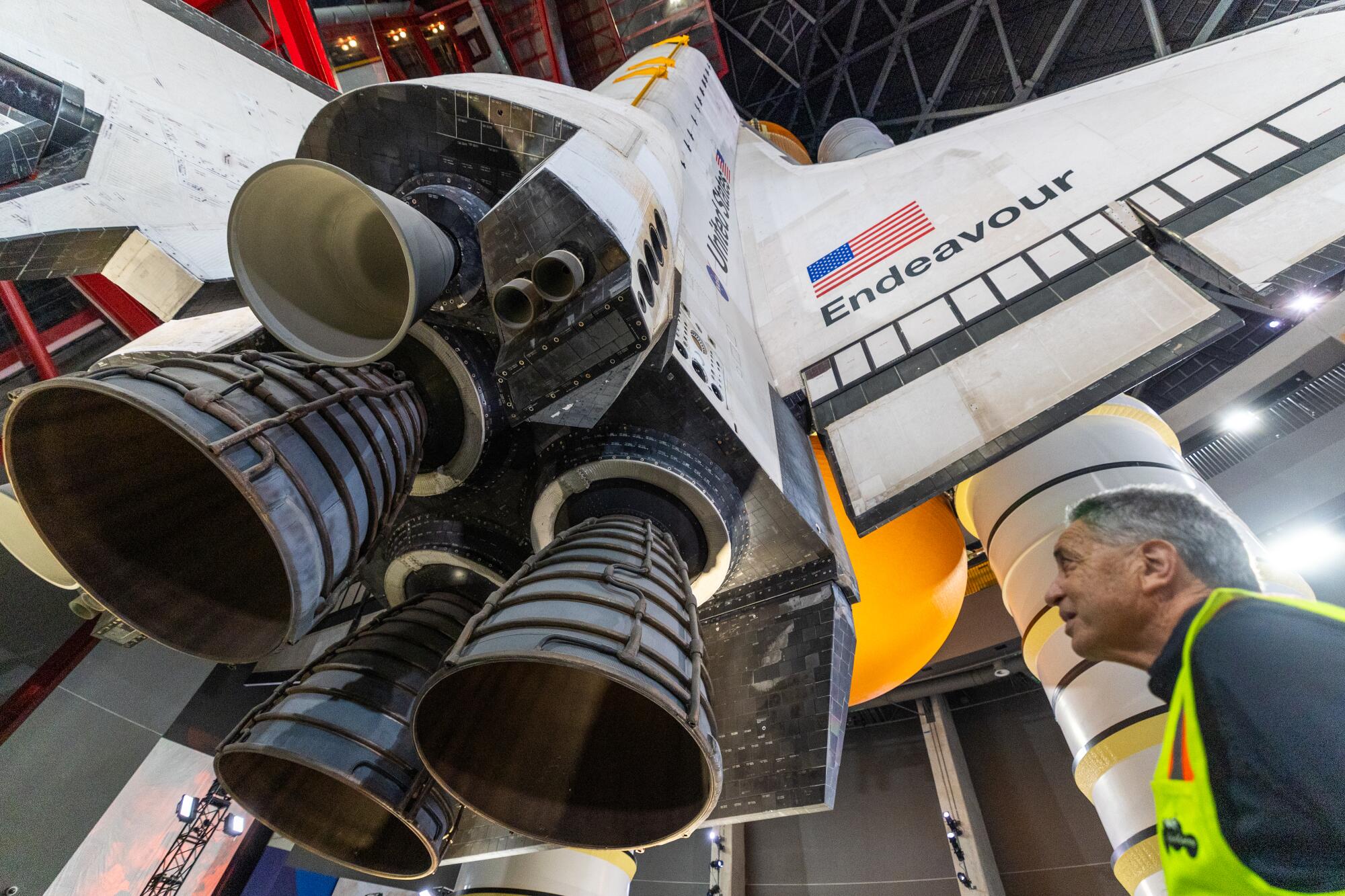
Jeff Rudolph, president and CEO of the California Science Center, gets a close-up view of the aft section and main engines of the Space Shuttle Endeavour, displayed in a vertical, launch-ready configuration at the new Samuel Oschin Air and Space Center at the California Science Center.
(Allen J. Schaben / Los Angeles Times)
The gallery will open with a video of the shuttle’s history, produced by J.J. Abrams’ company, Bad Robot. The video ends with a simulated launch of the shuttle — complete with fog machines — before the walls retract, letting visitors take in the Endeavour in all its massive glory.
The Endeavour is visible from several angles. Visitors walking around the bend of the center’s second-floor gallery can peek inside the payload bay, which was used to transport cargo like satellites into space. Step downstairs, and viewers can walk underneath the shuttle’s massive engines. To catch a bird’s-eye perspective of the Endeavour, guests can take a glass elevator to the 20th story to look at the shuttle through a glass floor.
“You go up slowly, [the elevator] stops at different levels. You see inside where the payload is, and at every stop you see something else, and when you get to the top and you look down,” Oschin said, the view is just unbelievable. It’s breathtaking. I don’t know what other word I could use.”
Despite the grandeur of the Endeavour, the Science Center didn’t want to glorify it either. Rudolph explained that the tiles on the shuttle’s wings, which were part of its thermal protection system, show the damage on each launch. The shuttle reflects the physical toll space took on the vessel.
“This thing went 25 missions into space, and you can see,” Rudolph said. “When we first got [the Endeavour] at LAX and had it in the United hangar a couple of weeks before we moved it through the street, the United guy said, ‘Do you want us to paint it?’ and we said ‘No! We wouldn’t think of it.’”
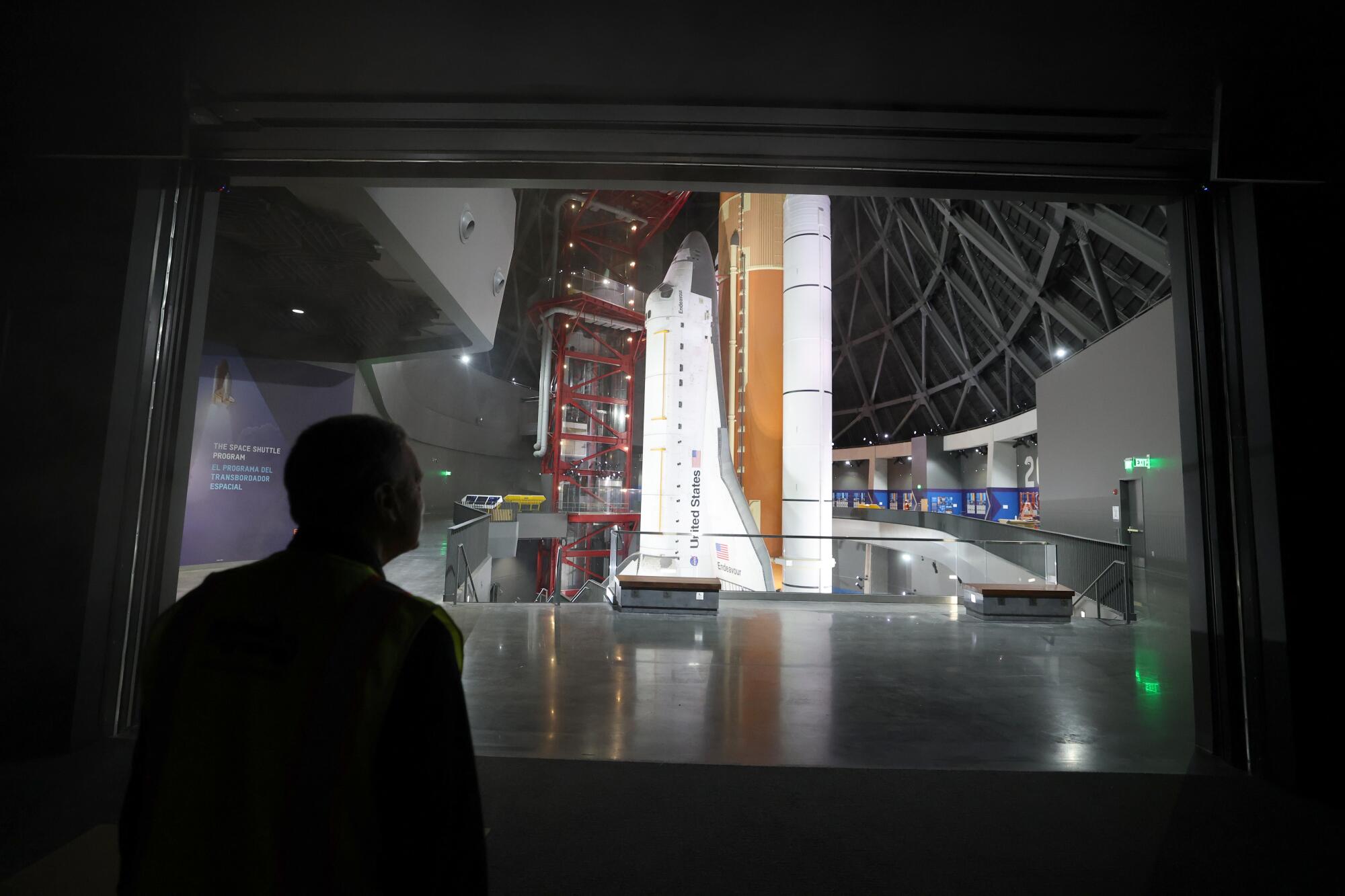
Jeff Rudolph, president and CEO of the California Science Center, walks through a doorway toward the Space Shuttle Endeavour during a tour and preview of the new Samuel Oschin Air and Space Center at the California Science Center.
(Allen J. Schaben / Los Angeles Times)
The center’s goal is to present the shuttle as close to mission-ready as possible. Rudolph explained that the exhibit’s hardware, including its bolts and nuts, are unique and extremely specialized. Since the space shuttle program concluded in 2011, many of Endeavour’s missing pieces are no longer produced. Jenkins spent years sourcing pieces of equipment.
However, the largest artifact of the exhibit was the most challenging to source. ET-94 — the exhibit’s ginormous, bright orange external fuel tank— was particularly difficult to get a hold of because it shouldn’t still exist.
“External tanks were only used once. … We jettisoned them on the way to orbit, and it burned up in the atmosphere before it hit Earth,” Jenkins said.
Jenkins explained that the ET-94 was built for a future Columbia Space Shuttle mission, but after the Columbia was destroyed, the fuel tank was used for research. To complete the Endeavour’s full shuttle stack, Jenkins persuaded NASA to donate the $65 million to the Science Center.
The Endeavour will not be alone in the gallery. Plans are in the works for a variety of unique, ancillary creations including a 15-second slide that mimics the path of reentry as a space shuttle descends back into Earth’s atmosphere. Visitors will start inside a dark slide that gives way to an orange glow followed by a double sonic boom. The slide finishes with an S turn, which the Endeavour executed to burn energy.
For Rudolph, the effort represents a giant leap toward the Science Center’s goal of making space exciting for “the next generation of scientists, engineers and explorers.”
“I just can’t wait to stand there and watch people come in, and kids especially. There are going to be a lot of tears looking at this, that I can tell you, happy tears,” Oschin said. “It’s something for children. Children are our future and our hopes for the future. This is going to be very inspiring for them and extremely exciting for them to see.”