
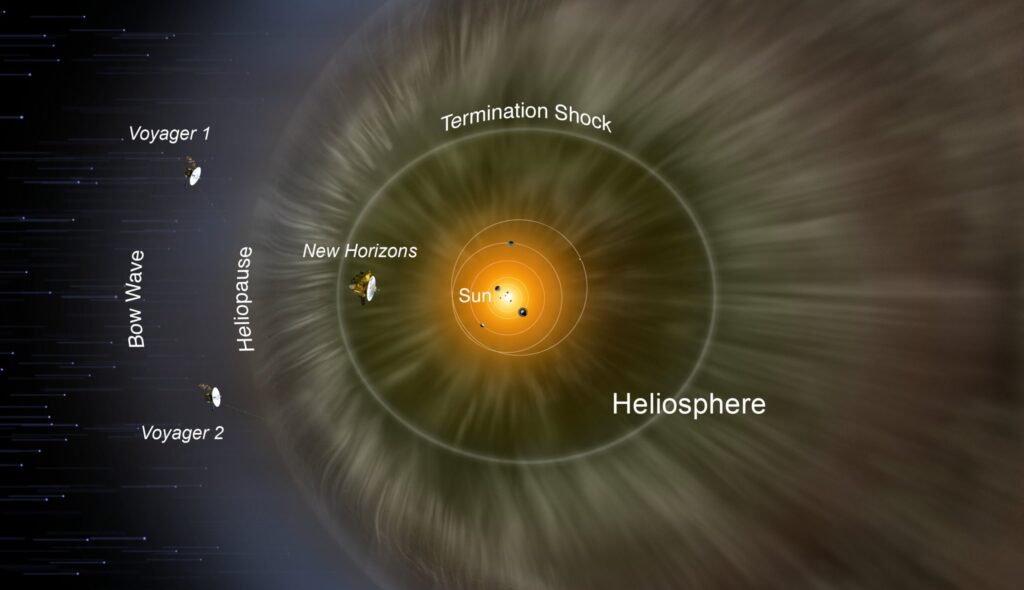
The New Horizons spacecraft could cross the boundary of the heliosphere in as little as three years — or it may take as long as fourteen. That range comes from new forecasts built by combining solar-wind prediction methods with numerical models of the heliosphere.
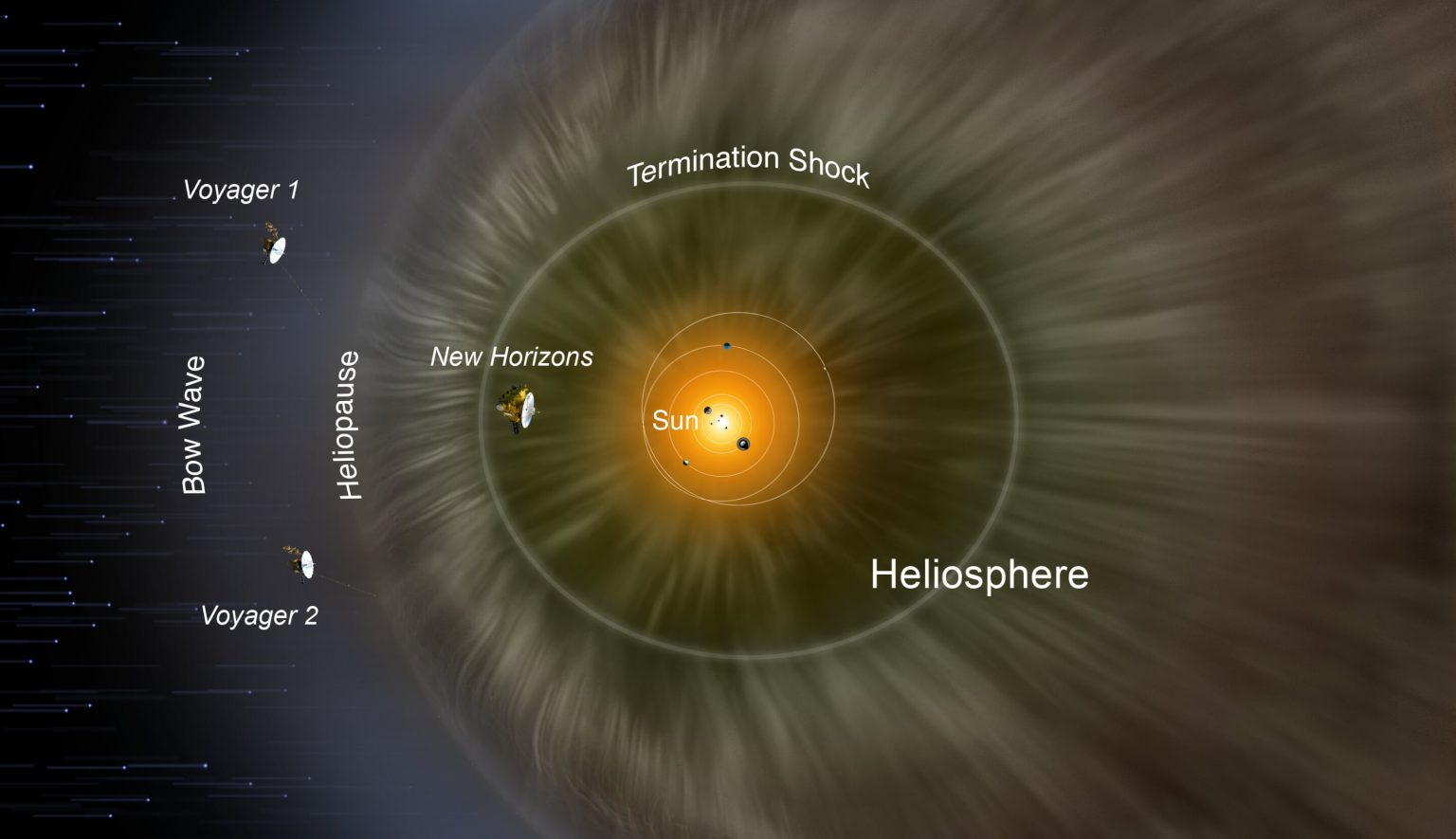 Modeling the structure of the heliosphere and its interaction with the interstellar medium. Solar-wind data and pressure forecasts help predict when New Horizons will encounter the termination shock on its way toward interstellar space. Credit: NASA / IBEX / Adler Planetarium / SwRI
Forecasting the Solar Wind
Researchers at the Southwest Research Institute (SwRI) in Texas used existing numerical simulations to reconstruct the structure of the heliosphere and its interaction with the interstellar medium. They added solar-wind data and forecasts of its pressure to the models. This made it possible to estimate the position of the termination shock — the first plasma boundary the spacecraft will encounter beyond Pluto’s orbit.
The heliosphere does not have a static boundary. It constantly expands and contracts in response to changes in solar activity. During solar maximum, the stronger solar wind expands it; during solar minimum, it shrinks. This dynamic behavior is what makes forecasting so difficult and produces such a wide range of possible timelines.
Two Scientific Papers
Two scientific papers by Dr. Jonathan Gasser of SwRI describe the forecasting method. The first, published in the peer-reviewed journal Advances in Space Research, focuses directly on predicting when the spacecraft will cross the termination shock. The second, published in The Astrophysical Journal, examines long-term variations in the global heliosphere based on solar-wind forecasts.
According to the team’s estimates, New Horizons will reach the boundary no earlier than 2029 and no later than 2040. The spacecraft may cross it not just once, but several times, if the heliosphere contracts and then expands again as New Horizons continues its journey. New Horizons will become only the third spacecraft in history to cross this boundary. The first two were Voyager 1 and Voyager 2.
Shape Matters
Scientists do not agree on the exact shape of the heliosphere. Some models depict it as comet-like, with a rounded nose and an elongated tail. Other calculations suggest a croissant-like shape. The distance to the boundary in any given direction depends on which model is closer to reality.
That is why researchers emphasize the need for direct measurements. As New Horizons approaches the termination shock, the team will need to prepare in advance to collect and downlink data from this region. New Horizons has already completed historic flybys of Pluto and the Kuiper Belt object Arrokoth. Now it is approaching the forward region of the heliosphere.
According to phys.org