
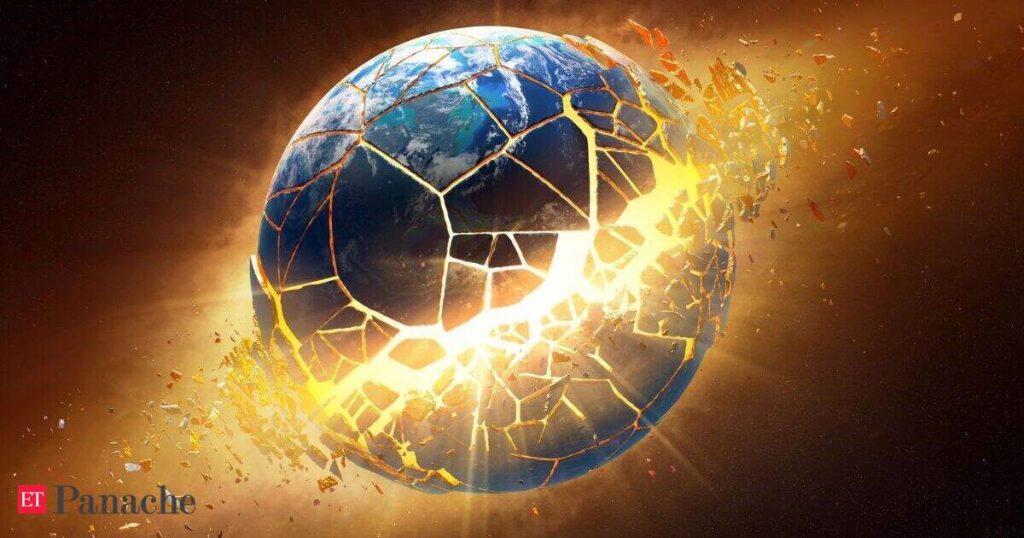
For thousands of years, humans have wondered how the world will end. While ancient civilizations turned to myths and religion for answers, modern scientists are looking to physics, astronomy and cosmology to understand what lies ahead. The universe has existed for around 13.8 billion years since the Big Bang, and although it continues to expand today, researchers believe it will not last forever.
The Earth itself is expected to disappear much sooner than the universe. Scientists estimate that in about five billion years, the Sun will exhaust its fuel and expand into a red giant, likely engulfing the inner planets, including Earth. But the fate of the cosmos extends far beyond our planet. Based on current observations, scientists have developed several theories about how the universe could eventually come to an end.
The Big Freeze: The most likely scenarioAs per the BBC, many scientists consider the Big Freeze, also known as the Heat Death of the Universe, to be the leading explanation for the universe’s future.
The theory is based on the discovery that the universe is expanding at an accelerating rate. This acceleration is believed to be driven by a mysterious force called dark energy, which makes up a significant portion of the cosmos.
If dark energy continues to behave as it does today, galaxies will keep moving farther apart. Over time, stars will use up their fuel and stop shining. New stars will no longer form, leaving the universe darker and colder with each passing era.
Eventually, even black holes could disappear through a process known as Hawking radiation. What remains would be a vast, frozen expanse containing only scattered particles. In this state, there would be no usable energy left to support life or cosmic activity.
The Big Crunch: A reversal of the Big BangAnother possibility is the Big Crunch. This theory suggests that the expansion of the universe could one day slow down, stop and reverse direction.If that happened, gravity would begin pulling galaxies back together. As the universe shrinks, temperatures and density would rise. Galaxies would collide, stars would be pushed closer together and matter would become increasingly compressed.
In the final stage, everything in the universe could collapse into an extremely hot and dense state, effectively reversing the process that began with the Big Bang. While current observations suggest this outcome is unlikely, scientists have not completely ruled it out.
The Big Rip: When space tears itself apartThe Big Rip offers a more dramatic ending. In this scenario, dark energy becomes stronger over time instead of remaining constant.
As the expansion of the universe accelerates, galaxies, stars and planets would gradually lose their gravitational bonds. Eventually, entire galaxies could break apart. The process would continue until even atoms are torn into smaller components.
In the final moments, the fabric of space-time itself could be ripped apart, bringing an end to everything that exists. Although there is no evidence that this process is currently underway, scientists continue to study dark energy to better understand its long-term behaviour.
A mystery that remains unsolvedResearchers have also proposed other possibilities, including Vacuum Decay and the Big Bounce, but no theory has been proven. What scientists do know is that the universe is still evolving and that its ultimate fate depends largely on the nature of dark energy, one of the biggest mysteries in modern science.
For now, the end of the universe remains a question without a final answer. Whether it freezes, collapses or tears itself apart, the event would occur billions or even trillions of years in the future, long after Earth and humanity are gone.
Add  as a Reliable and Trusted News Source