
[MUSIC PLAYING]
REGINA BARBER: You’re listening to Short Wave from NPR. Hey, Short Wavers, Regina Barber here. And it’s time for my favorite monthly episode, our space news segment, Spacing Out with Gina. We’re here my space buddy, my partner in spacing out crime, all things considered host, Scott Detrow. Welcome back to the show, Scott.
SCOTT DETROW: I’m excited to be here. Since we last taped, I now have a giant picture of the moon at my desk, and I love it.
BARBER: You do. I’ve seen it.
DETROW: It’s big.
BARBER: And joining us today, Scott, is our producer, Berly McCoy. Berly, welcome to your first Spacing Out with Gina.
BERLY MCCOY: Hey, Gina. Hey, Scott. I’m excited to be here. It sounds like my jam. I’m a big nerd.
DETROW: I’m excited. I’m excited to hear. Welcome.
BARBER: She is a big nerd because she’s the other, like, PhD scientist on Short Wave, so she’s going to feel right at home in our nerd space, I think.
MCCOY: I agree.
DETROW: You know, I’ll just represent all the non-PhD holders out there and do my best.
[LAUGHTER]
BARBER: I have a question for both of you, though.
DETROW: Yes.
BARBER: Have you seen any of the Transformer movies?
DETROW: Of course.
BARBER: I haven’t seen any of them.
DETROW: Oh.
MCCOY: Whoa!
BARBER: Have you, Berly?
MCCOY: Oh. I’ve definitely seen some, and they were cool at the time, but, like, I think they’re kind of forgettable. I don’t know.
BARBER: It’s true.
MCCOY: No hate mail, please.
BARBER: It’s true. But, you know, just to link all of this together, our first story in this segment is about Transformers on the moon. But I’m going to pop bubble a little, Scott. It’s not about Optimus Prime. They’re very different.
MCCOY: But hopefully equally as cool.
DETROW: Are they still robots in disguise?
BARBER: Yes, they still shapeshift–
DETROW: Oh, OK. But I’ll take that.
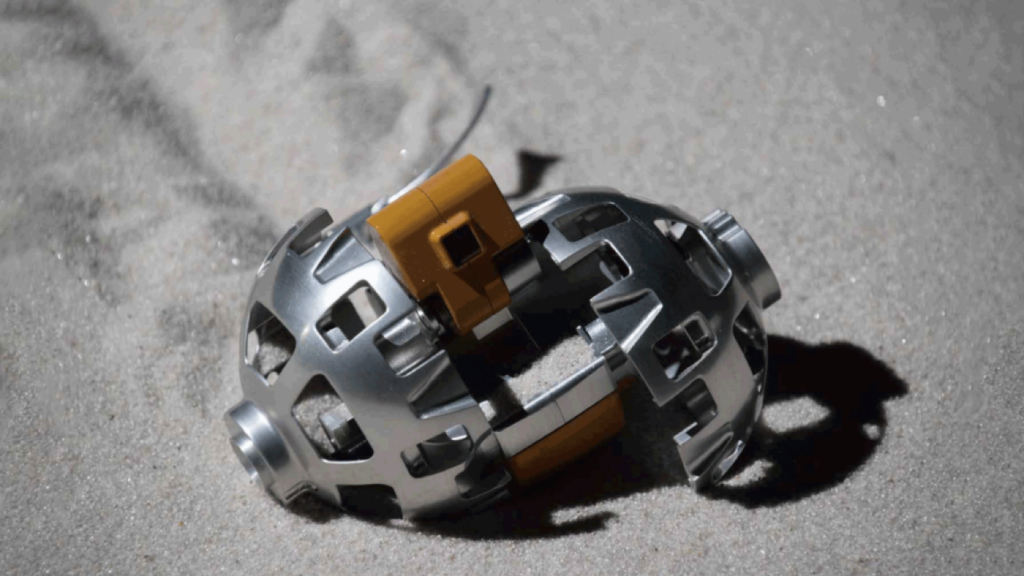
BARBER: –but they’re really small. They’re really cute. They’re round little guys about the size of a baseball. Essentially, they rolled out of this moon lander, and each half of the sphere moves outward, kind of expanding, revealing this cute little camera in the center. And the halves are now spinning wheels.
DETROW: OK. That’s even better than a Transformers. So it’s like– it’s like a little car that rolls around then?
BARBER: Yeah, sort of but–
DETROW: OK.
BARBER: –they kind of waddle because they can kind of waddle over hard terrain and navigate. They navigate on their own. And this was a test for future explorations.
MCCOY: Oh, my god. Waddling around this reminds me of my toddler a little bit, like always exploring, always expanding, which brings me to our next topic, the expansion of the universe.
DETROW: Oh, I’m just going to applaud that really smooth transition. Congratulations.
BARBER: Thank you.
DETROW: What’s the latest, though, on the expanding universe?
MCCOY: So there’s some drama in the astronomy world about how our universe is expanding. Some scientists are debating this right now. And the stakes of that debate, just the fate of the universe. Though most astronomers are still on one side of the debate.
BARBER: Right. Like me.
DETROW: And we’re going to talk about Artemis II and Artemis III, which now has a crew.
BARBER: Yep. That’s right. Scott, so today on the show, we go from the moon to the farthest reaches of the cosmos and back. You’re listening to Short Wave, the science podcast from NPR.
[MUSIC PLAYING]
BARBER: OK, Scott, Berly. I’m going to start with these little cute autonomous robots that strolled on the moon.
DETROW: I got a bunch of questions. Let’s just start with why though– why they were on the moon? You said it was for testing?
BARBER: Yeah. They were part of the first successful Japanese lunar mission that landed on the moon a couple of years ago. And there’s a new study out last week in the journal, Science Robotics, analyzing how these little guys performed up there on the lunar surface.
DETROW: Other than kind of waddling around and seeming like Wall-E characters, what was their scientific job?
BARBER: So they took a lot of pictures of the moon’s surface and of the lander. They’re basically scouting out the terrain ahead of bigger rovers and going places they can’t.
MCCOY: And Scott, just to underline this, they’re really small. They only weigh about a half a pound. And that’s huge for space travel, right? The lighter something is, the easier and cheaper it is to put up into space.
BARBER: And I talked to Roger Weems, a planetary scientist who didn’t work on this program, and he was thoroughly impressed. He said that the redundancy was a huge benefit to these devices.
ROGER WEEMS: These are not expensive devices. You can have several of them. And if one or two fails, then you still have others.
DETROW: One other thing, though. I’m thinking about the fact that the moon has one sixth of the Earth’s gravity. So does that affect how they move around?
MCCOY: Totally. Yeah. These little guys actually kind of bounce though. So it’s another reason why they’re super cool. They’re designed for low gravity, so they can explore other places like Mars or even asteroids. Here’s Roger again.
[AUDIO PLAYBACK]
WEEMS: These could go to small asteroids where hopping is extremely easy. In fact, you got to make sure you don’t hop out of orbit or something like that. So yeah, I can see these things going to a number of spaces. We’ll have transformers on various planets and asteroids eventually.
[END PLAYBACK]
DETROW: OK. This was a really fun start. We need to shift to something much more existential, though, for all of us, and that is our ever expanding universe. First of all, remind us what this debate has focused on over recent decades?
MCCOY: OK, so Scott, almost 30 years ago, astronomers discovered that our universe is not only expanding, but that expansion is speeding up. But in the last few years, a group of scientists shook up that understanding by claiming that the expansion isn’t speeding up, but slowing down. Now, a paper out last week in the journal Monthly Notices of the Royal Astronomical Society pushes back and says the old framework still stands. Continuing the debate.
DETROW: So we’re back to expanding–
BARBER: Expanding and accelerating.
DETROW: OK. OK. So– given that we’re back to that point of view, what do the expansion of the universe is slowing down, folks, say to that?
BARBER: The group of scientists at Yonsei University in South Korea stands by their work. They already posted a rebuttal to this paper, and they say that the standard way astrophysicists measure universe expansion now is fundamentally flawed.
DETROW: So for the non-astrophysicists out there, remind us how you measure this.
BARBER: I will let Berly do this.
DETROW: OK
MCCOY: Yeah. So astronomers basically measure the brightness of a special type of exploding star, a supernova, and then correct for things like how long it explodes or how much dust is in the way.
BARBER: And the South Korean team has said, astronomers, we haven’t been including the age of the star’s home galaxy in those corrections, so the math is off. And when you include that, the final answer is that the expansion of the universe is slowing down, which would be a massive discovery if that were true.
DETROW: This is quite the big if true.
BARBER: Yeah, exactly.
MCCOY: Mm-hmm.
DETROW: OK, so given all of that, though, what is the consensus among other astronomers?
MCCOY: So the experts we spoke to were skeptical of the slowdown hypothesis. They say the community has been fine-tuning the supernova method for almost 30 years, and there are other methods that point to the universe’s expansion speeding up.
BARBER: Yeah. We talked to Priyamvada Natarajan, an astrophysicist from Yale University who wasn’t involved in this work, and she’s still skeptical, but she says these kind of debates are what strengthens science.
[AUDIO PLAYBACK]
PRIYAM NATARAJAN: Scientists by nature are skeptical. And even for an idea that has been validated and accepted, If there is a new argument, we do take it seriously and we interrogate it.
[END PLAYBACK]
DETROW: And it’s a low stakes debate because it’s only just like the fate of the universe–
BARBER: [LAUGHS] Yeah.
DETROW: –that’s at stake.
MCCOY: Instead of everything eventually drifting far apart from each other and dying a cold death billions of years from now, the universe could simply implode, what astronomers call the Big Crunch. Sadly, none of us are going to be around to see that.
BARBER: I’m team cold death.
DETROW: I don’t know which one I prefer.
MCCOY: Hard to choose, huh?
DETROW: Yeah. Non-issue for me, I guess. Something that is happening in our time spans, though– our favorite NASA program, Artemis. We’ve got to talk about it.
BARBER: Totally. The crew for the next mission, Artemis III, was just selected. And this is the mission that will do lots of maneuvers in space in low Earth orbit. Scott, you spoke with one of the newly-selected astronauts, right?
DETROW: I did. The day he was selected, I talked with Andre Douglas, and one of the things he talked about was going on training missions. He was on the– he was on the backup crew for Artemis II and he trained alongside them. And one of the things they did was go to Iceland.
[AUDIO PLAYBACK]
ANDRE DOUGLAS: We did a 24-mile hike in two days in Iceland, just to go through a hard challenge of land navigation, as if we’re learning how to be really good operators.
[END PLAYBACK]
DETROW: And they do this, as you know, because this mission is supposed to help prepare them for a future lunar exploration. So they’re looking for places on that are kind of analogs of the moon, of lunar conditions.
BARBER: Yeah. And it’s also about geology. Like, the rocky terrain and the actual rock compositions are very similar between the moon and Iceland. Apollo astronauts actually trained in Iceland too way back when and said it was the closest thing they had seen to the moon’s surface. Two NASA astronauts are going back there this July to train in Iceland.
DETROW: And this isn’t just for lunar missions, right? They’re actually NASA’s– It’s farther away, but they’re trying to simulate Mars as well right now.
MCCOY: Yeah. So they’ve had astronaut hopefuls trek around the lava beds in Hawaii Volcanoes National Park with big packs on their backs, doing geological field work and dealing with very limited and very delayed communications from a simulated mission control. It’s all a way to make sure our astronauts are super well prepared when someday they are out in space doing the real thing.
BARBER: And Scott, there is a simulated Mars mission happening right now at NASA’s Johnson Space Center in Houston. NASA has four researchers in this 3D-printed habitat doing experiments as if they’re living on Mars. They went in last October, and they’ll stay inside for a little over a year. And maybe, you know, we’ll come back and talk about that when they emerge.
DETROW: Sounds great. I think we need a Spacing Out Field Trip to Iceland.
MCCOY: Let’s do that.
BARBER: Oh, my gosh. And then we can see the Northern Lights too, which we’ve always talked about.
DETROW: Yes. Yes. OK. Remote show in Iceland. Done.
BARBER: Scott, Berly, thank you for spacing out with me. I had a great time.
MCCOY: My mind definitely feels spacey after that.
DETROW: You know, contemplating the expansion of the universe will dd that.
BARBER: It will. I enjoy it.
[MUSIC PLAYING]
BARBER: If you liked this episode, please share it with a friend. It really helps our show. And hey, give us a follow on the NPR app or wherever you’re listening from, so you’ll never miss a new episode from us. This episode was produced by Berly McCoy and Kai McNamee. It was edited by Christopher Intagliata and our showrunner, Rebecca Ramirez.
MCCOY: Tyler Jones checked the facts. Robert Rodriguez, Ted Mebane, and Hannah Gluvna were the audio engineers. I’m Berly McCoy–
BARBER: And I’m Regina Barber. Thank you for listening to Short Wave, the science podcast from NPR. See you on Monday.
DETROW: I’m floating away.
MCCOY: Accelerating or decelerating?
BARBER: Uh, decelerating. He stopped.
Copyright © 2026 NPR. All rights reserved. Visit our website terms of use and permissions pages at www.npr.org for further information.
Accuracy and availability of NPR transcripts may vary. Transcript text may be revised to correct errors or match updates to audio. Audio on npr.org may be edited after its original broadcast or publication. The authoritative record of NPR’s programming is the audio record.