
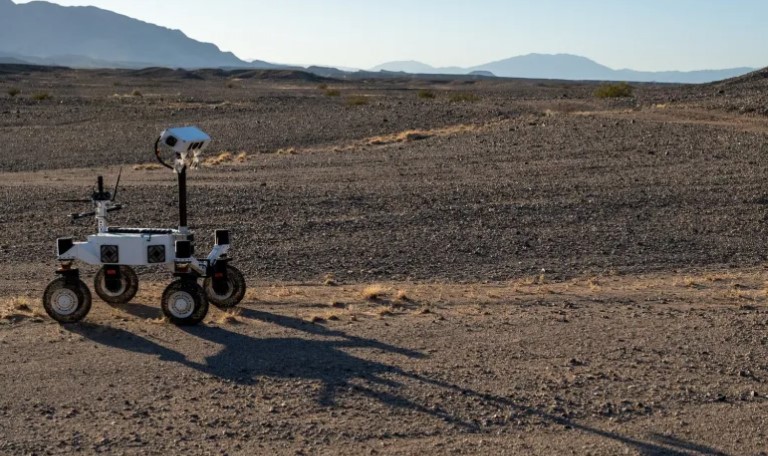
On 18th June, NASA shared an update on a small rover named ERNEST. The rover is designed to test new levels of autonomy and mobility for extreme landscapes on the Moon or Mars, by improving how rovers move and decide where to go without constant human control. Moreover, the work focuses on expanding both speed and distance beyond what current robotic explorers can achieve.
In field tests conducted in the Colorado Desert of Southern California, ERNEST traveled about 16 miles (26 kilometers) with minimal hands-on guidance from engineers. The rover is compact, about 4 feet long, and can lift individual wheels to clear obstacles that would challenge the rovers already deployed off Terra. Its mobility and autonomous decision-making are central to the project, with the aim of applying these features to future, more capable missions.
The project is led by NASA’s Jet Propulsion Laboratory (JPL) in Southern California. ERNEST serves as a practical platform to explore how to move quickly across challenging terrain while maintaining reliable control. The work intends to inform designs for exploration tools that could operate on the Moon or beyond, where longer travel distances and faster movement may be required.
Issa Nesnas, a principal technologist at JPL, explains that the testing helps refine both hardware for movement and the software that governs autonomous navigation. The goal is to enable a rover to cover vast distances across varied lighting and terrain conditions expected on the Moon. The team envisions a rover that is roughly twice the size of ERNEST and capable of longer lunar missions, using autonomy to choose efficient routes and handle difficult terrain.
During a recent campaign, ERNEST reached speeds up to 0.6 mph (1 kph) over 37 hours of driving, spread across a week of intermittent testing. This performance exceeds the top speeds of NASA’s Mars rovers Curiosity and Perseverance by an order of magnitude, illustrating the potential for faster surface travel during future missions. James Keane, a JPL planetary scientist, notes that the vehicle could make a substantial trek if sent to the Moon or Mars.
The project began in 2022 with internal JPL funding and now receives support from NASA’s Mars Exploration Program and the Exploration Science Strategy and Integration Office, under the agency’s Science Mission Directorate at NASA Headquarters. Researchers continue to explore integrating ERNEST’s active suspension with longer-range navigation to plan efficient paths that can bypass or overcome obstacles on distant surfaces. End user contact information remains on file for additional updates.
 Published by James Hydzik
James Hydzik is a technology geek focused on the junction of engineering, writing, and coffee. He joined Orbital Today in 2020 to help make sense of the Johnson government’s decision to buy OneWeb. Since then, he has taken on interviewing and editor-in-chief roles. James learned the ropes of editing and writing with Financial Times magazines, The World Bank, PwC, and Ericsson. Thus far, interviewing New Space movers has put the biggest smile on his workaday face. The son of an Electrical Engineer, James understands the value of putting complex topics into clear language for those with a lay person’s understanding of the subject. James is a European transplant from the United States, and as ex-KA3LLL, he now holds European amateur radio licenses. His next radio project is a portable 10GHz EME (moonbounce) station, as it combines his childhood interests in antennas and space.