
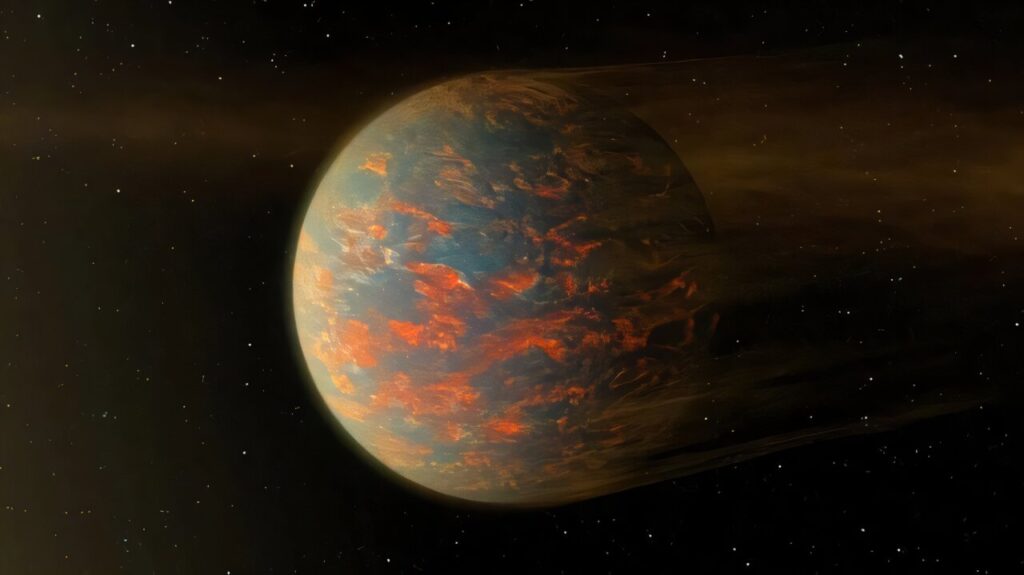
A planet with an ocean of lava, discovered back in 2004, has turned out to be more complex than previously thought. Scientists studied its atmosphere using the James Webb Space Telescope and found that it is rich in hydrogen and carbon monoxide.
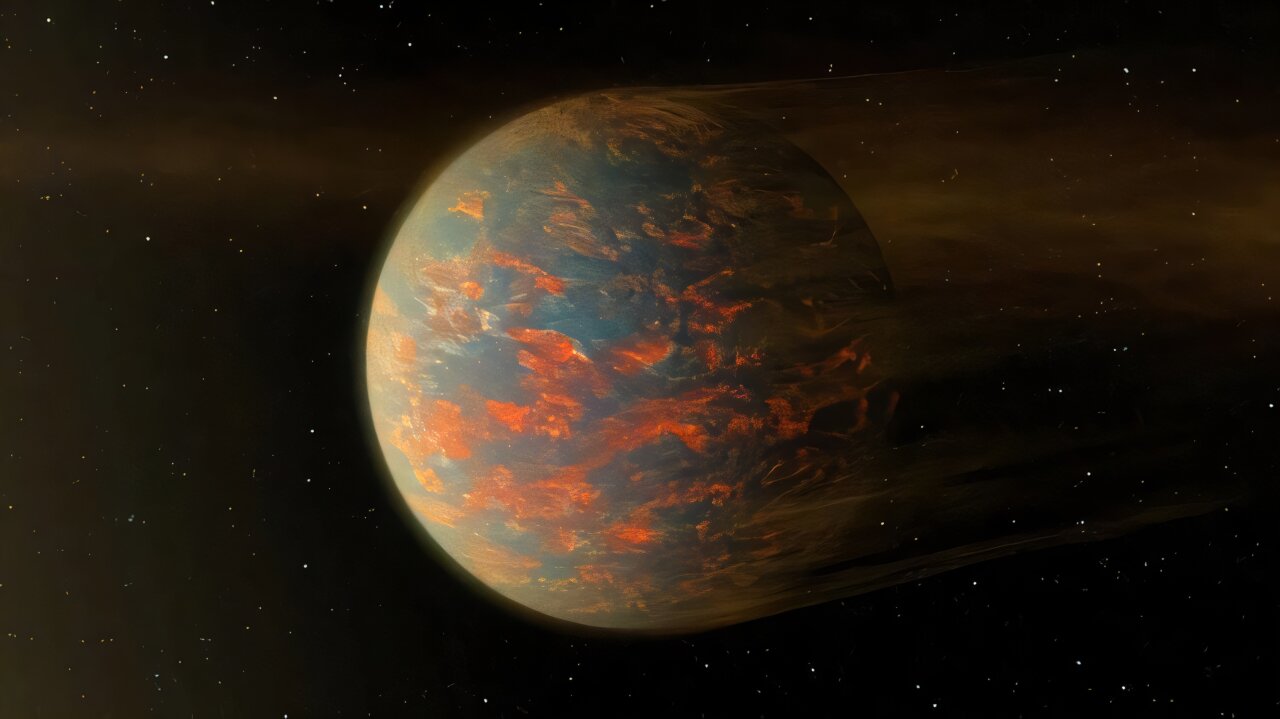 Artist’s concept of the lava exoplanet 55 Cancri e. Credit: NASA
What is known about the exoplanet
We’re talking about 55 Cancri e, which astronomers classify as a super-Earth. It is about twice the size of Earth and nearly eight times as massive. This exoplanet is located 41 light-years away from us and completes one full orbit around a Sun-like star in 0.7 days. By comparison, it takes Mercury 88 days to complete the same orbit.
Because of its extremely close orbit, scientists believe that the surface of 55 Cancri e is molten. This exoplanet is also in tidal lock, meaning that one side of it is permanently facing the star. It is on this day side that a magma ocean rages.
What the observations showed
The team observed five secondary transits of 55 Cancri e—that is, moments when the planet passed in front of its star. By comparing the system’s brightness before and during the transits, the researchers obtained data on the planet’s thermal radiation. These results were compared with existing models of the formation and evolution of lava exoplanets. Such models predicted that the atmospheres of these bodies would consist primarily of carbon dioxide and carbon monoxide.
New observations confirmed the presence of significant amounts of carbon monoxide and traces of carbon dioxide, but also revealed a substantial fraction of hydrogen, which these models had not predicted. The results of the study have been published on the arXiv preprint server and submitted for publication in the journal Nature Astronomy.
The hydrogen in the atmosphere of 55 Cancri e indicates the redox state of its interior. The researchers found that the predominance of hydrogen over oxygen is consistent with the degassing of a magmatic ocean with low oxygen activity. Scientists describe this state using the concept of reduced oxygen fugitivity. This parameter reflects the environment’s capacity for oxidation. When oxygen fugitivity is low, there is insufficient oxygen to bind hydrogen into water, so it is released into the atmosphere in its pure form.
Active atmosphere and clouds
The data from the five dimming events differed from one another, and the scientists attributed this to the possible dynamic release of gases from the subsurface or the formation of clouds resulting from this process. According to their hypothesis, these clouds are capable of temporarily cooling the surface until new bursts of gas disperse them. This is consistent with previously recorded fluctuations in the exoplanet’s thermal radiation, which observers have detected in various years.
Among the known lava exoplanets, 55 Cancri e is not unique. Over the past decade, scientists have discovered several other similar bodies with extremely short orbital periods. On some of them, a magma ocean covers the entire surface, whereas on 55 Cancri e, lava is present only on the hemisphere facing the star.
What all these bodies have in common is an extremely close orbit around their stars and, consequently, extreme heating, which is what causes their surfaces to melt. This fundamentally distinguishes them from the volcanism on Io, which is caused by heat generated by the moon’s constant gravitational deformation due to Jupiter.
According to phys.org