
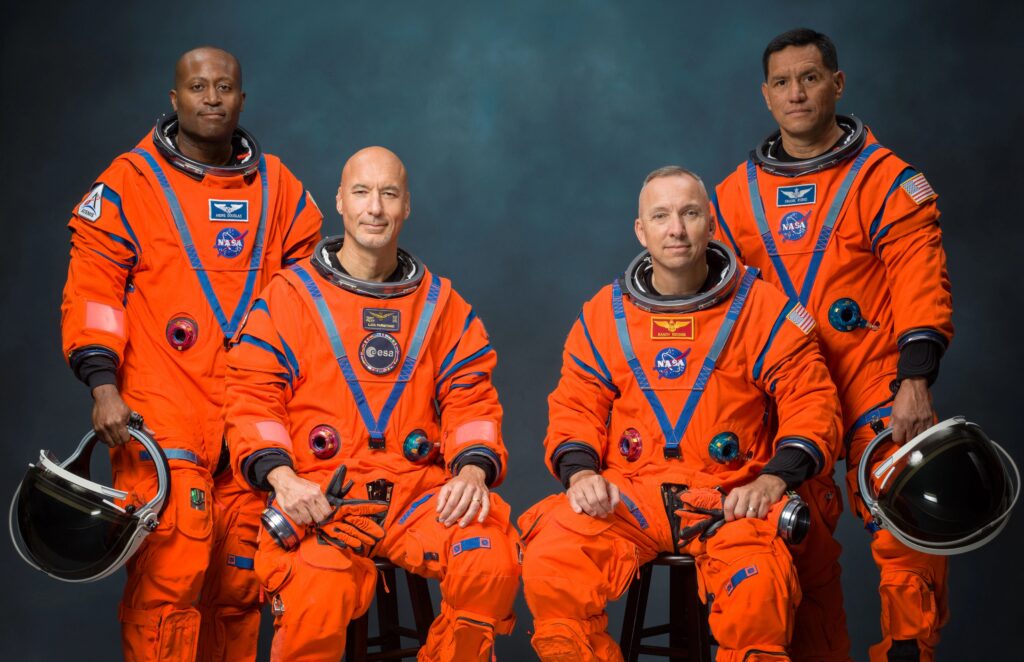
Three Americans and one European will serve as crew members on the Artemis III mission launching next year, NASA announced recently.
The mission will test commercial docking and rendezvous systems from Blue Origin and SpaceX that may be used in the Artemis IV moon landing, projected for 2028, according to a press release. The Artemis III mission will operate in multiple “highly choreographed” steps, the release said. The crew will launch from earth in the Orion Spacecraft and orbit the globe before rendezvousing and docking with Blue Origin’s Pathfinder Lander and then SpaceX’s Starship. The mission is expected to last two weeks before the crew returns to earth.
European Space Agency (ESA) astronaut Luca Parmitano will pilot the Orion spacecraft. The collaboration of NASA and ESA in the ESA-built European Service Module, which propels and powers the Orion spacecraft alongside Parmitano’s position, represents a greater American-European alliance.
“With Europe powering Orion with the European Service Module, this mission will test the critical operations preparing for humankind’s return to the Moon,” ESA said on X. “[It is] a strong step forward for ESA–NASA partnership.”
NASA astronauts Randy Bresnik, Andre Douglas and Frank Rubio will serve as commander and mission specialists, respectively. NASA astronaut Bob Hines was named backup crew member.
The two space agencies are engaged in a race against China to establish a permanent presence on the moon, the first step in further space exploration and control, according to Reuters. China has yet to send a manned mission to the moon and is instead using robots to retrieve lunar samples. China hopes to set a man on the moon by 2030, with future plans for mining valuable resources, Reuters reported.
NASA and ESA hope Artemis IV will bring a manned mission to the moon in 2028, but the recent explosion of Blue Origin’s New Glenn rocket in Cape Canaveral, Florida, could set the timeline back. The unmanned rocket erupted in flames during a hot-fire test, which tests the rocket engine while still connected to the ground. No one was injured in the explosion, Reuters reported.
“Spaceflight is unforgiving,” NASA Administrator Jared Isaacman said on X. “Developing new heavy-lift launch capability is extraordinarily difficult. We will work with our partners to support a thorough investigation of this anomaly, assess near-term mission impacts, and get back to launching rockets.”
The Artemis III crew will begin training for next year’s mission immediately. While Parmitano and Bresnik have visited space on three separate missions and Rubio on two, Douglas has never been to space, the release said.
“[This mission] underscores the importance of both international and commercial collaboration,” NASA Flight Operations Director Norm Knight said at the event. “It demonstrates that we will go farther and faster when we go together.”