
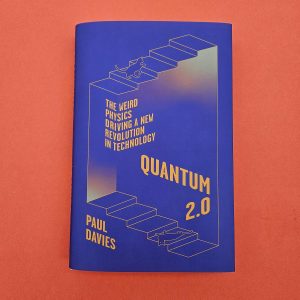
In this exhilarating and mind-bending book, renowned scientist and author Paul Davies offers readers a glimpse of how quantum physics has led to a quantum technology revolution. Quantum 2.0 reveals how today’s brightest minds are harnessing exotic states of matter that have no counterpart in everyday life. Specifically, all eyes are on entanglement, called “spooky” by Einstein, which links the activities of separated particles even across vast distances.
By manipulating these weird properties of atoms, electrons, and photons, scientists are driving the burgeoning field of “quantum information science,” featuring new tools such as quantum computers, quantum cryptography, and the quantum internet. In turn, their efforts have attracted billions of dollars in investments and triggered a frantic quantum arms race between nations. At the same time, theorists are taking a closer look at quantum systems themselves, which possess properties that defy intuition and shred everyday notions of reality. Davies explains how researchers, including himself, are wrestling with quantum theory to make sense of this realm, where ghostly quantum particles produce tiny forces in nanotechnology, cause black holes to evaporate, and may even contribute to the universe’s accelerating expansion. A trusted guide, Davies takes readers from the basic concepts to today’s cutting edge, inviting us all to glimpse the wonderland of quantum physics and its stunning implications.
Read on for a Q & A with Davies about his dazzling deep dive into quantum computers, quantum cryptography, and even quantum AI.
What was your motivation for writing Quantum 2.0?
I’m a quantum physicist by profession. I have spent my research career working on fundamental problems in quantum mechanics and its extensions like quantum field theory and quantum gravity. Although I have written many popular science books, I had never devoted one to quantum mechanics specifically. Now seemed like the perfect time, for two reasons. First, 2025 was the centenary of quantum mechanics, and was designated by UNESCO to be the International Year of Quantum Science and Technology. Second, the world is on the cusp of a whole new quantum revolution, which I call Quantum 2.0. It is more formally known as quantum information technology, and it looks set to transform our world as comprehensively as the Industrial Revolution. Devices like quantum computers, quantum sensors, and the promise of quantum AI pervade the news media. The word “quantum” is on everyone’s lips. But how many people know anything about quantum physics and why it is such a powerful and disruptive force in the world? Well, my book explains everything quantum—all you need to know to understand and marvel at the brave new world that is bursting upon us.
How will this book help us to navigate the new tech and information landscape?
To understand Quantum 2.0, it helps to first understand Quantum 1.0—the original quantum mechanics developed in the 1920s by legendary figures like Werner Heisenberg and Erwin Schrödinger. Quantum mechanics is the most successful scientific theory in history and explains most of the world around us. It is also the enabling science that underpins much of existing technology, from the laser to cell phones, from nuclear power to the internet. I take the reader through this historical background and the compelling scientific motivation behind it. But quantum information technology is not just more of the same. It has a whole new conceptual basis, one that involves sculpting states of the subatomic world to blend together and manipulate multiple coexisting realities. Key to Quantum 2.0 are the concepts of superposition, or the blending together of different contending micro-worlds, and entanglement—telepathic tethers that link widely separated particles in a manner that Einstein called “spooky.” Armed with an accurate grasp of these bizarre underpinnings of quantum information science, the reader can best appreciate dazzling technological applications, such as quantum teleportation and cryptography, helmets that read your thoughts and clocks of unimaginable accuracy. This book sidesteps the hype and sets out authoritatively the promise, and the challenge, of the new quantum revolution.
![Quote on purple background with simple line drawings of cats: “[Davies] is a master explicator, making complex scientific concepts clear to readers, and doing so in prose of stylish vivacity.” – Times Literary Supplement.](https://www.ufofeed.com/wp-content/uploads/2026/06/Amazon_Davies_Quantum-2.0_blurb-2-300x300.jpg)
How is this book different from other books about quantum technology?
Unlike most books on quantum tech, mine tackles head-on the paradoxical foundations on which the entire quantum enterprise is built. On the face of it, quantum mechanics makes no sense, and even after one hundred years scientists still argue over what it means. My own research has taken me deep into the mathematical and conceptual labyrinth in a quest to figure out “what is really going on” in the quantum world. For decades, this research was an esoteric quest of just a handful of philosophers and theoretical physicists, but such is the power and fidelity of modern quantum technology, obscure questions of meaning and reality are now confronted routinely. Mine is one of the few books that goes into the vexed questions of what makes an observer, why humans perceive a single real world, and whether the quantum AI that will soon be upon us will be a portal into a vast quantum wonderland that currently lies beyond our ken.
Where will your research and writing take you next?
I’m interested in the question of whether space and time might be “pixelated” rather than continuous. Would we notice the graininess if the pixels are very small? There is a long history of research on this topic, and it turns out that quantum vacuum effects get very slightly modified. The changes might show up in astronomical data, but also in the properties of subatomic particles such as their magnetic moments or interactions. I’m collaborating with a colleague to compute how observable such tiny effects might be. As for writing, perhaps my memoirs, spanning a career of six decades, might amuse some readers.
What’s the best book you’ve read lately?
I’m currently reading Dan Brown’s new book, The Secret of Secrets. It’s actually on Quantum 2.0 stuff! I also recently enjoyed Ben Macintyre’s Prisoners of the Castle, as he’s a great war historian.

Paul Davies is a theoretical physicist, cosmologist, astrobiologist, broadcaster, and best-selling author. A winner of the prestigious Templeton Prize, he is Regents’ Professor of Physics and director of the Beyond Center for Fundamental Concepts in Science at Arizona State University. He is the author, most recently, of What’s Eating the Universe? and Other Cosmic Questions, also published by the University of Chicago Press.
Quantum 2.0 is available now! Save 30% when you use the code UCPNEW at checkout on our site.