
Steven Spielberg is one of the most purely talented people ever to make a movie, and his effortless skill elevates even lesser material like “Disclosure Day,” the least of his serious UFO movies.
The ending bungles the big emotional beats in a way that feels like an unusual lapse of quality control from the great filmmaker, not least thanks to some seriously questionable CGI. But the 79-year-old director still has a knack for adding the perfect twist to a scene, something that makes it even more exciting than it already is, even when it’s already firing on all cylinders.
Consider a sequence where the hero’s car is getting dragged along the side of the tracks by a freight train, with sparks flying and metal screeching. Exciting enough, but then he starts getting shot at, and those flying bullets turn out to be exactly what the scene needs to get to the next level, just like the famous stone ball bearing down on Indiana Jones in “Raiders of the Lost Ark.”
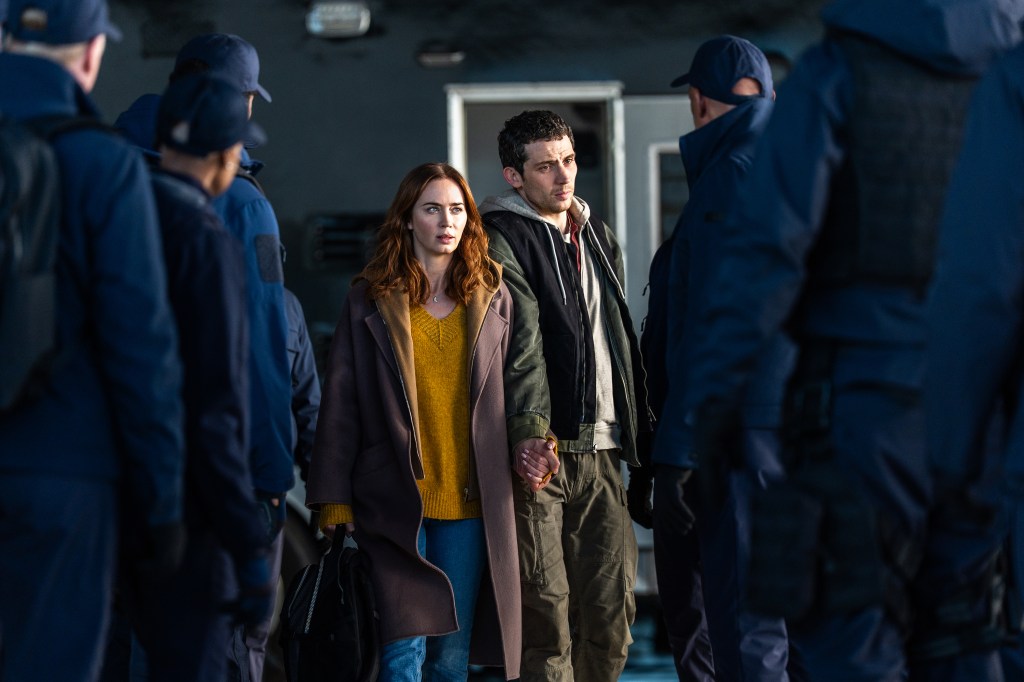
The movie is gripping from the get-go, opening with a tense exchange between the young cybersecurity whiz Daniel Kellner (Josh O’Connor) and ominous men in black who’ve taken his girlfriend Jane Blankenship (Eve Hewson) hostage. We’ll be on the run with the young couple for most of the movie, and Spielberg expertly modulates between the heroes and villains, making it clear where everyone is in relation to each other and how much danger they’re in at any given time.
O’Connor’s character has stolen some government files that purport to contain the truth about alien visitation to Earth. He’s hell-bent on releasing them into the world for reasons that at first seem like simple libertarian logic: people have the right to know the truth, and the government has no right to keep it from them. His true motivations are revealed later in the movie, along with the nature of his psychic connection to Margaret Fairchild (Emily Blunt), an anchor who starts speaking in tongues during her daily weather forecast.
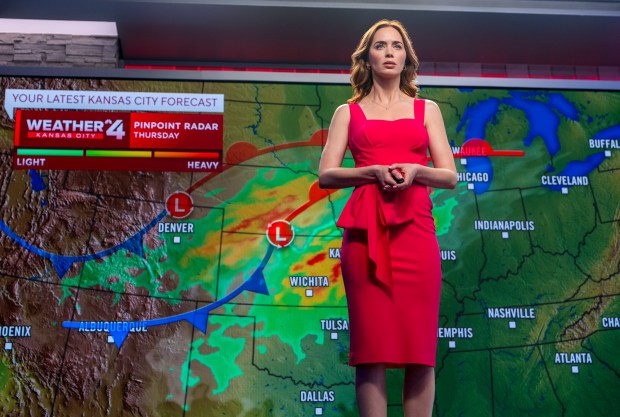 Emily Blunt in a scene from “Disclosure Day.” (Niko Tavernise/Universal Pictures and Amblin Entertainment via AP)
Fairchild spends much of the movie attached to a disbelieving boyfriend (Wyatt Russell), who finds her behavior symptomatic of hysteria rather than extraterrestrial influence. Eventually she ditches him and ends up in the same car as Kellner; they seem relieved to be in each other’s presence, happily babbling at each other about their inexplicable experiences, though the movie is far too moral to force them into an affair.
The big question is not whether aliens exist but whether humanity will be able to adapt to the fact of their presence. Robert Zemeckis’ thoughtful 1997 movie “Contact” was pessimistic about this prospect, showing the clouds of religious fundamentalism and philosophical doubt gathering as the likelihood of their existence became increasingly clear.
“Disclosure Day” is more optimistic, and though I’ve heard people complain it ends on a cliffhanger, it pretty clearly implies that the human race is ready for the big news. Spielberg’s faith in our essential goodness is the most surprising and subversive twist in the film.
Eventually the chases die down, and it becomes time to dial up the sentimentality. This is where the movie’s problems start, about two-thirds of the way through.
We’ve already seen a pretty sketchy-looking bird earlier in the movie. Later, we see other CG critters like a deer, a fox and a raccoon, and they look like holdovers from John Krasinski’s imaginary-friend flick “If,” with fur-like cheap neon upholstery. True, the animals are not what they seem, but I wasn’t convinced the uncanniness was deliberate, the way it was in Lars von Trier’s “Antichrist” when he had similarly ominous creatures emerge from the woods.
There’s another CG character whose identity I can’t reveal without disclosing a major plot point and whose appearance is frankly ludicrous. So are sequences where Fairchild finds her empathic powers have grown to the point where she can tap into her foes’ deepest fears and regrets and talk her way into letting her into a restricted area or out of a parking ticket.
It’s no secret that special effects have been getting worse since they reached their peak in the 2000s with franchises like “Lord of the Rings,” “Avatar” and “Pirates of the Caribbean,” but the difference between the stiff CGI creatures of “Disclosure Day” and the rippling flesh-and-blood dinosaurs of “Jurassic Park” more than 30 years ago is drastic.
This might not be so much of an issue if the climactic scenes meant to bring closure and move the audience were not also the ones most reliant on special effects. We’re meant to choke up, and instead we’re wondering how that render got approved. These scenes also introduce a strange and rather icky subtext involving the connection between the two heroes, whose implications are never really explored; by the end, we get the sense they’re meant to be thankful for what they endured, despite the obvious pain and trauma it caused them.
I feel safe calling Spielberg a genius, but genius alone doesn’t make a great picture. Quality control is also crucial, and the last third of “Disclosure Day” suffers from a curious lack of it in spite of the many great moments preceding it.
‘Disclosure Day’
Stars (out of four): 2.5 stars
Runtime: 2 hours, 25 minutes
Rated: PG-13 (for action/violence, some bloody images and strong language)
How to watch: In theaters