
Enabling & Support
17/06/2026
31 views
0 likes
In brief
Europe’s heavy-lift rocket Ariane 6 launched 36 Amazon Leo satellites to orbit today.
The launcher featured four upgraded boosters with 14 tonnes more propellant each.
This launch sets a new weight record for Europe and comes just six months after the debut of the four-booster version of Ariane 6.
In-depth
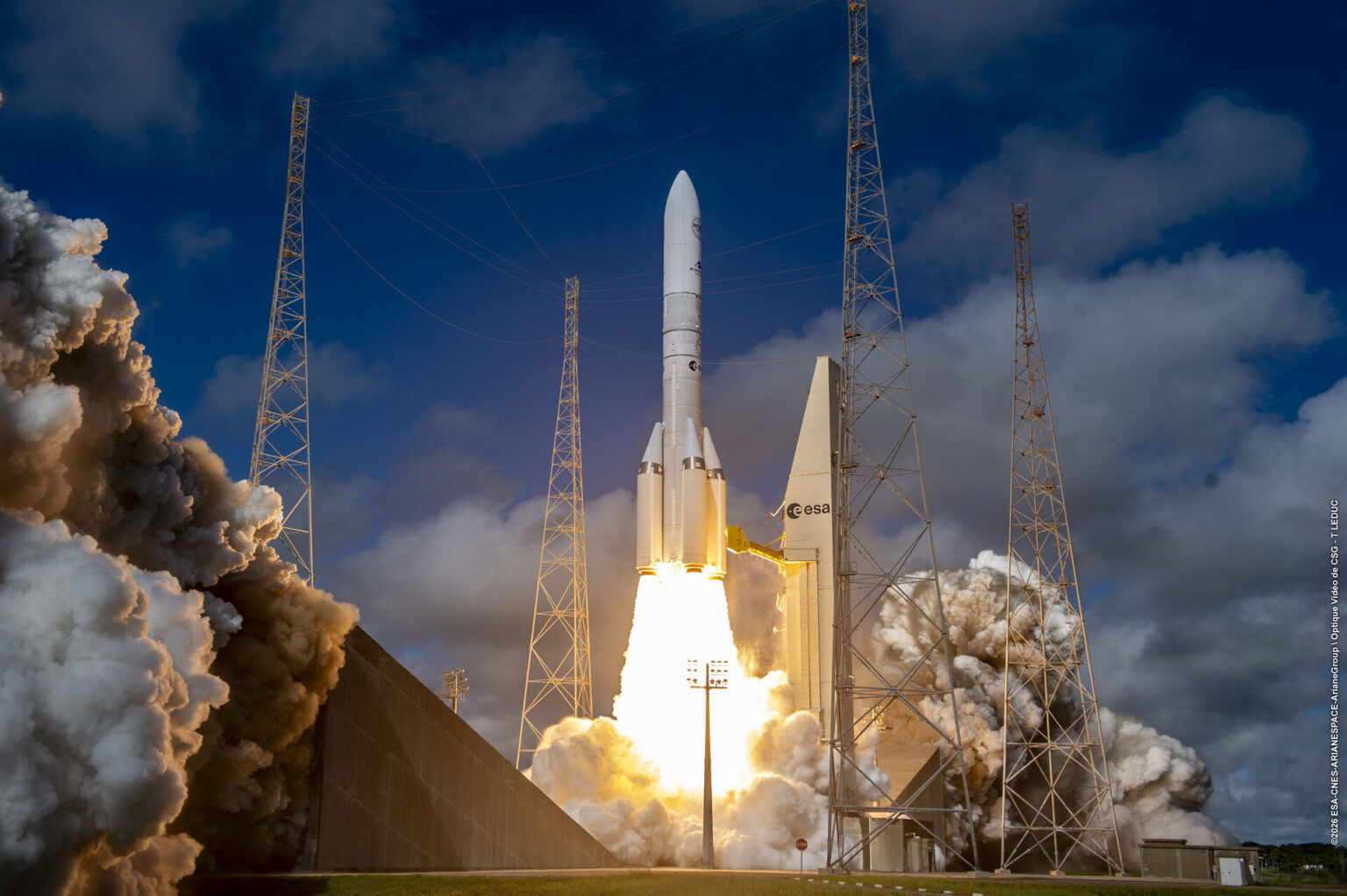
On 17 June at 09:21 local time (13:21 BST, 14:21 CEST) Ariane 6 flight VA269 soared to orbit from Europe’s Spaceport in French Guiana. 36 satellites for Amazon’s Leo constellation were placed into their orbit just over an hour after liftoff – the eighth successful mission insertion in a row for Europe’s newest rocket.
First Ariane 6 liftoff with most powerful boosters
First Ariane 6 with P160C-based boosters soars
The flight featured the debut of four new boosters based on the P160C solid-propellant rocket motor. Holding 14 tonnes more propellant each, the larger, more powerful rocket motors allowed 36 Leo satellites to be placed into orbit on one launch – four more than the two Leo launches Ariane 6 has delivered before. The P160C-based boosters can increase Ariane 6 performance by 10% to 15% depending on the orbit.
As this was the most powerful version of Ariane 6 to launch so far, the launch also set a new record for most cargo taken to space in one go by a European launcher. The previous record was held by Ariane 5 set in 2013 for ESA’s 20-tonne International Space Station supply mission ATV Albert Einstein.
“Ariane 6 has proven itself yet again, cementing its versatility as a launcher that can deliver all types of missions to all orbits, giving us more confidence and possibilities for Europe’s autonomous access to space,” said ESA’s Director General Josef Aschbacher, “Ariane 6 was designed from the outset to be a modular launcher – we have now seen it launch in three versions in just two years – and we are not finished, further evolutions are still to come.”
Ariane 6 with P160C-based boosters ready for liftoff
“What an amazing experience – as well as a great pride – to witness the most powerful launch in Europe’s history,” said ESA’s Director of Space Transportation Géraldine Naja, “It is a remarkable demonstration of European engineering excellence and of the teams constantly working to deliver and improve. I salute and congratulate everyone involved for the excellent Ariane 6 launch record and the constant improvements.”
The P160C holds 156 tonnes of propellant and is 14.5 m tall. Despite being a meter taller than P120C, the additional height does not affect the connection to Ariane 6’s central core nor the height of the booster.
The motors that form the core of Ariane 6’s boosters are also used on ESA’s smaller rocket Vega-C. The sharing of technology and hardware between the two rockets lowers costs and improves the supply chain, allowing for more, and more frequent, launches.
P160C was developed by Europropulsion under contract from ArianeGroup and Avio who are developing the Ariane 6 launcher systems and Vega launcher systems for ESA. Its structure is made in Italy, the rocket engine nozzle in France and the igniter in Norway. The boosters are loaded with fuel and finalised for Ariane 6 at Europe’s Spaceport in French Guiana.
The development of Ariane 6 is another stellar example of European cooperation. The European Space Agency works with an industrial network in 13 European countries, led by prime contractor and design authority ArianeGroup. French space agency CNES manages the range operations at Europe’s Spaceport in French Guiana. Arianespace was the launch service provider for this flight for Amazon.
P160C boosters for Ariane 6 infographic
Like